What Happened Above Greece
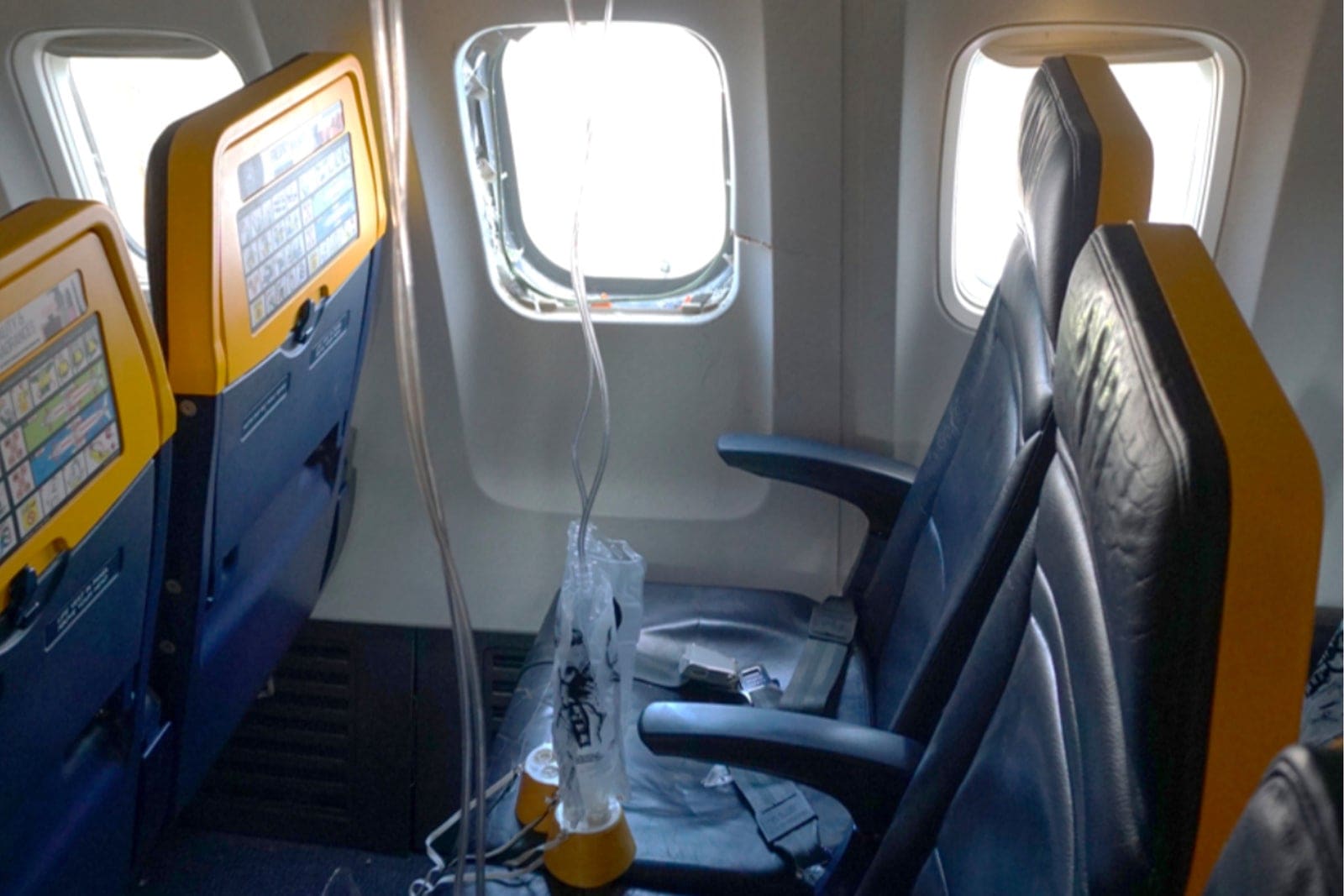
A routine departure from Thessaloniki turned into an emergency on July 10 when metal fragments from a failing engine tore through a Ryanair passenger window at cruising altitude. The 61-year-old man seated in row 11 was partially sucked out of the aircraft before passengers in nearby seats hauled him back into the cabin. He sustained friction burns, neck injuries, and shoulder trauma in the incident.
The National Transportation Safety Board released findings Thursday confirming that a fractured fan blade in the right-side engine threw debris that struck multiple sections of the fuselage. Bird remains discovered inside the engine assembly suggest the Boeing 737-800 may have hit a bird during its initial climb, according to the NTSB.
Flight crew reported heavy, sustained vibrations shortly after takeoff. Mist or smoke filled the cabin moments before oxygen masks deployed automatically. A flight attendant noticed passengers rising from their seats and calling for help after the man became lodged in the damaged window frame. Travelers around him worked together to pull him free, then moved him to row 12, where a doctor aboard provided immediate care. Others grabbed a metal container from the crew and tried to seal the opening while the aircraft descended.
The Descent and Landing
The plane climbed past 15,000 feet about six minutes after leaving Thessaloniki, then dropped rapidly to around 6,000 feet. It circled for roughly 30 minutes to burn off fuel before landing back at the departure airport about an hour after takeoff. Video recorded on board and shared by Radio Thessaloniki showed passengers using oxygen masks after the cabin lost pressure. Another clip captured the broken window with a traveler in an adjacent seat wearing a mask, and later footage showed emergency responders moving through the aisle after landing.
Passengers disembarked normally and returned to the terminal. The injured man received further medical attention on the ground. The airline said at the time that the aircraft returned to Thessaloniki shortly after takeoff when a passenger window dislodged in flight. The flight was operated under Malta Air, a Ryanair subsidiary.
Maintenance History and Prior Bird Strikes
Maintenance logs show the fan blades on the failed engine underwent ultrasonic inspection in May 2026 and again in November 2025, with no defects recorded. Yet crews had reported four suspected bird strikes involving the same engine over the preceding 12 months. Bird remains were recovered in two of those cases, according to the NTSB.
The agency noted that no potential factors have been ruled out as the investigation continues. Greece's Hellenic Air and Rail Safety Investigation Authority delegated the inquiry to the NTSB under international air safety protocols, with Greek officials participating.
The narrow-body jet, which seats up to 189 passengers, was delivered new to Ryanair in 2008, according to Flightradar24. The aircraft had logged 18 years in service by the time of the incident.
A Public Rebuke
The NTSB publicly reprimanded Ryanair CEO Michael O'Leary last month after he told investors the investigation was focused solely on foreign object damage and not on maintenance records or the age of the plane. Federal investigators stated that O'Leary was not authorized to speak on behalf of the investigation and that all possibilities remain under review.
The incident underscores how quickly a mechanical failure can escalate into a life-threatening emergency. Bird strikes are a known hazard during takeoff and landing, but repeated impacts on a single engine over a year raise questions about inspection intervals and detection limits. Ultrasonic testing can miss certain types of internal stress or micro-fractures, especially if damage accumulates between scheduled checks.
For passengers, the event is a reminder that fellow travelers can be the first line of response in an airborne emergency. The man in row 11 owes his survival in part to the quick action of those seated around him, who acted before crew could reach the scene. It also highlights the importance of staying seated with a seatbelt fastened during turbulence or unexpected events, when rapid decompression can turn a routine flight into a fight for survival.