A Remediation Story Wrapped in Titanium
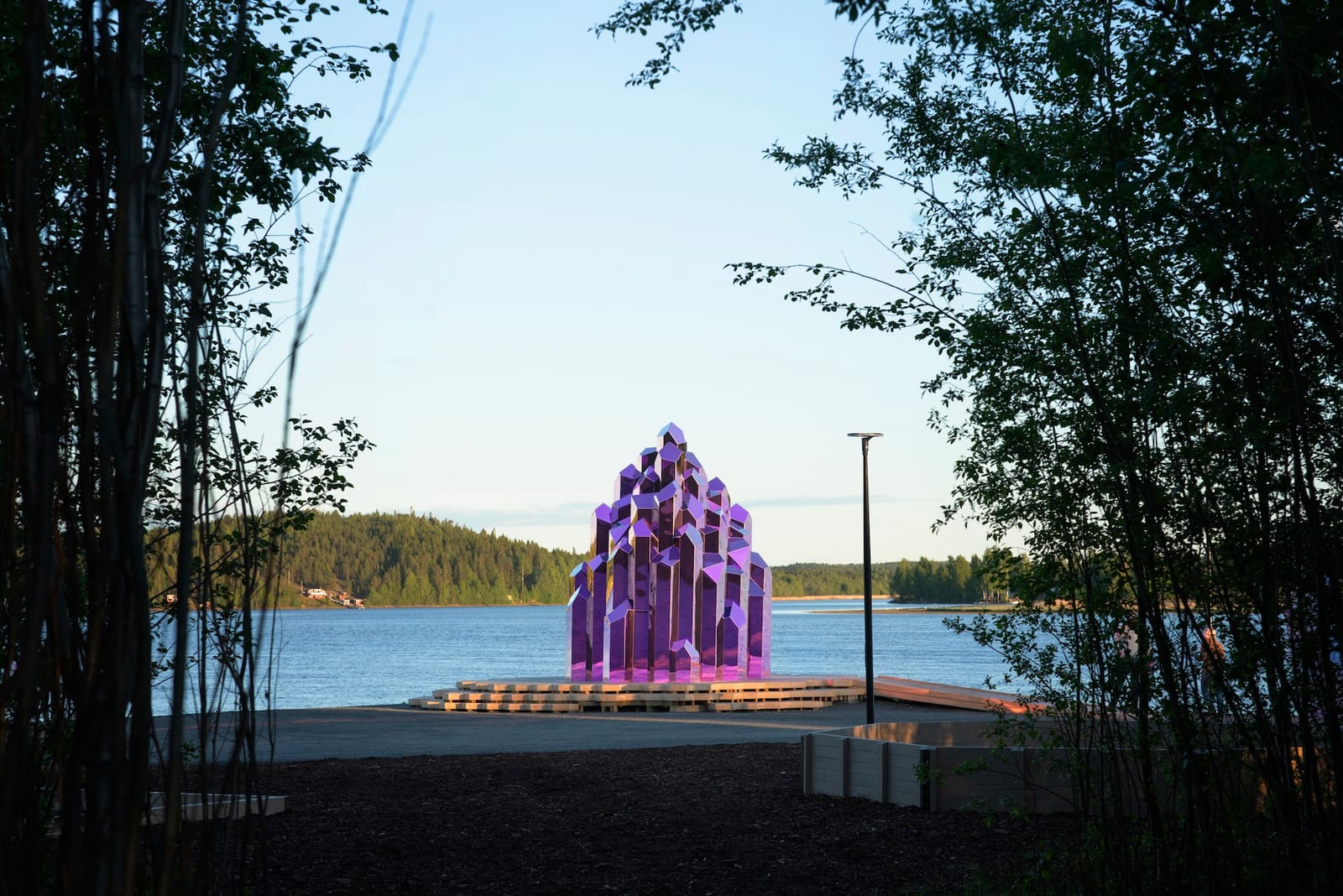
After seventeen years of soil cleanup, a former industrial zone in Ursviken, just outside Skellefteå in northern Sweden, has reopened as Wasteland - a public park billed as Europe's first Climate Action Park. The site's signature piece is a pink, angular sauna that looks like it has been pulled from the earth itself. Designed by artistic studio Bigert & Bergström, the structure is modeled after a lithium crystal, a choice that speaks directly to the contradictions embedded in the green energy transition.
Lithium powers batteries, electric vehicles, and much of the infrastructure meant to replace fossil fuels. It is also mined in ways that can wreck ecosystems, displace communities, and leave scars on landscapes not unlike the one Wasteland is trying to heal. The sauna's form is both homage and critique, a visual nod to the element that symbolizes a cleaner future while acknowledging the environmental cost of getting there.
The building's exterior is clad in stainless steel coated with titanium, giving it a reflective, rose-tinted surface that shifts with the light. The structure is made up of 280 individual prisms, each cut with CNC machines and laser technology, and tilted back at a four-degree angle to suggest emergence rather than construction. It is a piece of architecture that wants to be read as geology.
Wood, Stone, and Battery Heat
Inside, the aesthetic flips entirely. The sauna is lined with local heartwood pine on the floor and alder on the benches, materials chosen for their moisture resistance and warmth. At the center sits a metal cage holding 260 kilograms of olivine stones, which absorb and radiate heat. The heating system runs on a custom battery, a practical extension of the lithium theme.
The space holds up to twelve people at a time. Sessions last two hours and cost 1,000 Swedish kronor, roughly 91 euros. Visitors must book in advance and are greeted by two hosts who walk them through the site and explain the rules. The ritual is partly logistical, partly ceremonial - a way to frame the experience as something more than a sweat.
The sauna is not the only installation at Wasteland. An observation tower designed by the Oslo School of Architecture and Design also sits on the grounds, offering views over the rehabilitated landscape. Most of the park is free to access, though the sauna itself is ticketed.
From Waste to Promise, With a Footnote
Wasteland's tagline is "From Waste to Promise," a phrase that tries to capture the arc from contamination to recreation. The park is meant to be a place where art, science, and public life converge, where the history of extraction is acknowledged rather than erased. Bigert & Bergström describe the sauna as more than an artwork - it is a gathering point, a symbol of transformation, and a provocation.
But the choice of lithium as a symbol is not accidental. It forces a conversation about what "green" really means when the materials enabling the transition carry their own environmental baggage. The sauna does not resolve that tension; it holds it. Visitors are invited to sit inside a representation of the very material that powers the devices in their pockets, the cars they might drive, the infrastructure they depend on - and to consider what that dependency requires.
The park's emphasis on remediation is also a reminder that transformation takes time. Seventeen years is a long stretch to wait for soil to become safe again, and even then, the work is never fully complete. What was once industrial wreckage is now a curated landscape, but the history remains embedded in the ground.
A Symbol That Does Not Simplify
The sauna's design is striking, but its real work is conceptual. It asks visitors to think about the materials that underpin modern life, the landscapes altered to produce them, and the trade-offs inherent in any transition. It does not offer easy answers or celebrate progress without asterisks.
Skellefteå has positioned itself as a hub for green industry, particularly battery production. The sauna fits into that narrative, but it complicates it too. It is a piece of infrastructure that functions as art, a wellness space that doubles as a provocation, a symbol of hope that refuses to ignore cost.
Whether the park succeeds as a destination will depend on how visitors engage with it. A sauna is, at its core, a place to slow down, to sweat, to sit with discomfort. In this case, the discomfort is not just physical. It is the recognition that every solution carries the seeds of new problems, and that the future being promised is still very much under construction.
Wasteland is open to the public now. The sauna is bookable, the tower is climbable, and the soil, after nearly two decades, is safe to walk on. What visitors make of it - whether they see a reclaimed landscape or a reminder of what was lost - will shape what the park becomes.