An 18-Hour Hop Across the Pacific
Qantas announced it will begin flying nonstop between Sydney and New York from mid-2028, according to the airline. The route will be the first commercial service to link the two cities without a stop, covering roughly 16,000 kilometres in about 18 hours.
The Sydney-New York launch follows the airline's planned October 2027 start for Sydney-London, the first route under Project Sunrise, Qantas's initiative to connect Australia's east coast directly with major cities in the northern hemisphere. Both services will use specially configured Airbus A350-1000 aircraft fitted with an additional 20,000-litre fuel tank that extends their range to 16,000 kilometres and up to 22 hours of flight time.
Today, passengers flying Qantas between Sydney and New York stop in Los Angeles, a journey that takes about 21 hours gate to gate. The nonstop option shaves three hours off that total.
Twelve Aircraft, Four Cabins, One Wellbeing Zone
Qantas has ordered twelve A350-1000ULR jets for Project Sunrise. Each aircraft will carry 238 passengers across four cabins: six first-class suites, 52 business suites, 40 premium economy seats, and 140 economy seats.
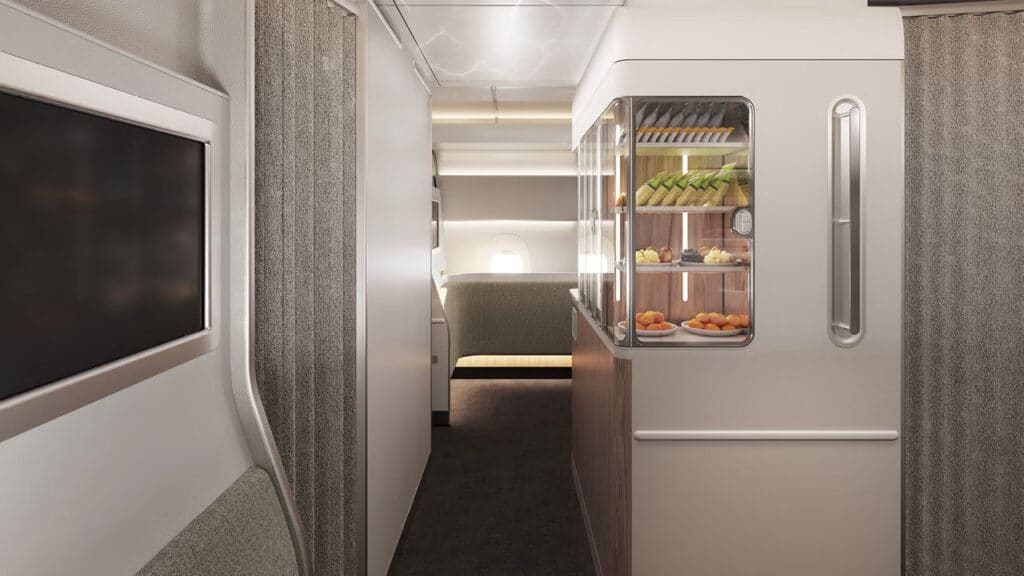
A feature unique to these aircraft is a wellbeing zone located between the economy and premium economy sections. Passengers will be able to stretch, follow guided exercise videos on screens, and help themselves to snacks and drinks. The zone is designed to ease the discomfort of sitting for the better part of a day.
Qantas Group chief executive Vanessa Hudson described the New York route as the completion of a long-held ambition. "Conquering the tyranny of distance has been part of who Qantas is from the very beginning," she said. "Reaching New York nonstop completes a vision we set out many years ago."
A Long Road to Launch
Project Sunrise was originally slated to begin in 2022, but the pandemic and manufacturing delays at Airbus pushed the timeline back repeatedly. The airline completed a 19-hour test flight from Toulouse to Melbourne in July 2026; the return leg, flown against prevailing winds, took 24 hours and 24 minutes.
The first A350-1000ULR is expected to arrive in April 2027. By the time all twelve jets are in service, Qantas expects to have trained 360 pilots and 1,200 cabin crew to operate them.
Tickets for the Sydney-New York route are set to go on sale in August 2027. Qantas has not yet disclosed fares, but the airline previously indicated that Project Sunrise tickets could cost around 20 per cent more than current one-stop options. A return Sydney-New York ticket via Los Angeles typically costs around USD 1,900; a one-way fare runs about USD 1,400.
What It Means for Long-Haul Travel
Ultra-long-haul flying remains a niche. Only a handful of city pairs worldwide support nonstop services longer than 16 hours, and airlines that operate them do so with relatively low frequencies and carefully managed seat inventories. Demand tends to come from premium travellers and those willing to pay for the convenience of skipping a connection.
The economics are tight. Fuel burn is higher per passenger on these routes, and the aircraft carry fewer seats than standard long-haul widebodies. The 20 per cent fare premium Qantas has floated is intended to offset those costs, but it also narrows the market. Leisure travellers comparing prices may still choose the cheaper one-stop option, especially if the layover is brief and comfortable.
Still, the appeal is clear for a segment of passengers. Business travellers on tight schedules, families with young children, and anyone averse to the hassle of clearing security twice will find value in a direct flight. And for Qantas, the route serves a symbolic purpose. It positions the airline as a pioneer in long-haul aviation and reinforces its brand as Australia's connector to the world.
Qantas has hinted that additional ultra-long-haul routes from Perth may follow once the A350 fleet is fully operational. Perth's location on Australia's west coast makes it a natural staging point for nonstop flights to Europe and southern Africa, though no firm plans have been announced.