A Country Shaped by More Than One Story
Rwanda occupies roughly the same area as Maryland, yet its reputation often hinges on a single chapter of its history. Thirty-two years have passed since the genocide, and while memorials and documentation remain essential, the living culture unfolding across the nation's hills and valleys rarely makes headlines. Visitors who venture beyond the well-worn gorilla-trekking routes find community-led projects, contemporary galleries, and culinary scenes that speak to resilience without ignoring the past.
The Kigali Genocide Memorial anchors many journeys, offering context that helps travelers understand how far the nation has traveled. But the story picks up momentum in less formal spaces: a women's cooperative in the north, a tea estate on the edge of a forest, a youth center that doubles as a cultural exchange hub.
Women's Collectives and Tea Trails
In Kinigi, near the border with Uganda, the Women's Village operates as both sanctuary and economic engine. Founded by Doreen Kanyesigye, the cooperative teaches traditional craft techniques to women fleeing violence. Weaving, tailoring, crochet, and painting fill the workshop floors, and finished pieces line the shelves of an on-site shop. Visitors browse while staff offer drinks, turning commerce into conversation.
Further west, the Gisakura Tea Plantation stretches along the edge of Nyungwe Forest National Park. Guided tours at Inmo Tea Plantation walk visitors through emerald rows of Camellia sinensis, explaining the harvest cycle and processing steps. The experience ends with tastings, connecting the leaf in your cup to the hands that picked it hours earlier.
In Musanze district, Red Rocks Intercultural Exchange Center combines hostel accommodation with cultural programming. The center employs disadvantaged youth and women, offering jobs, training, and a stable environment. Guided outings introduce guests to local music, dance, and cooking traditions, grounding tourism revenue in community benefit.
Kigali's Layered Creative Scene
The capital moves at a different tempo. With just over a million residents, Kigali lacks the sprawl of Nairobi or Lagos, but its cultural infrastructure has thickened in recent years. Boutique hotels, independent shops, and rooftop bars cluster in neighborhoods that blend residential calm with commercial buzz.
Amata n'Ubuki Boutique Hotel, a nine-room property priced from around 141 dollars per night, feels more like a private residence than a lodging. A garden and pool anchor the grounds, and walls double as gallery space, lined with art that traces Black creativity and heritage. Meals lean homemade, the kind of cooking that prioritizes comfort over ceremony.
Shopping in Kigali means navigating both open-air markets and polished storefronts. Saint Umi specializes in garments crafted with attention to fabric and finish, while Kezem fuses traditional patterns with contemporary silhouettes, aiming to honor African heritage without treating it as costume. Both stores draw local buyers and travelers looking for pieces that travel well beyond souvenir status.
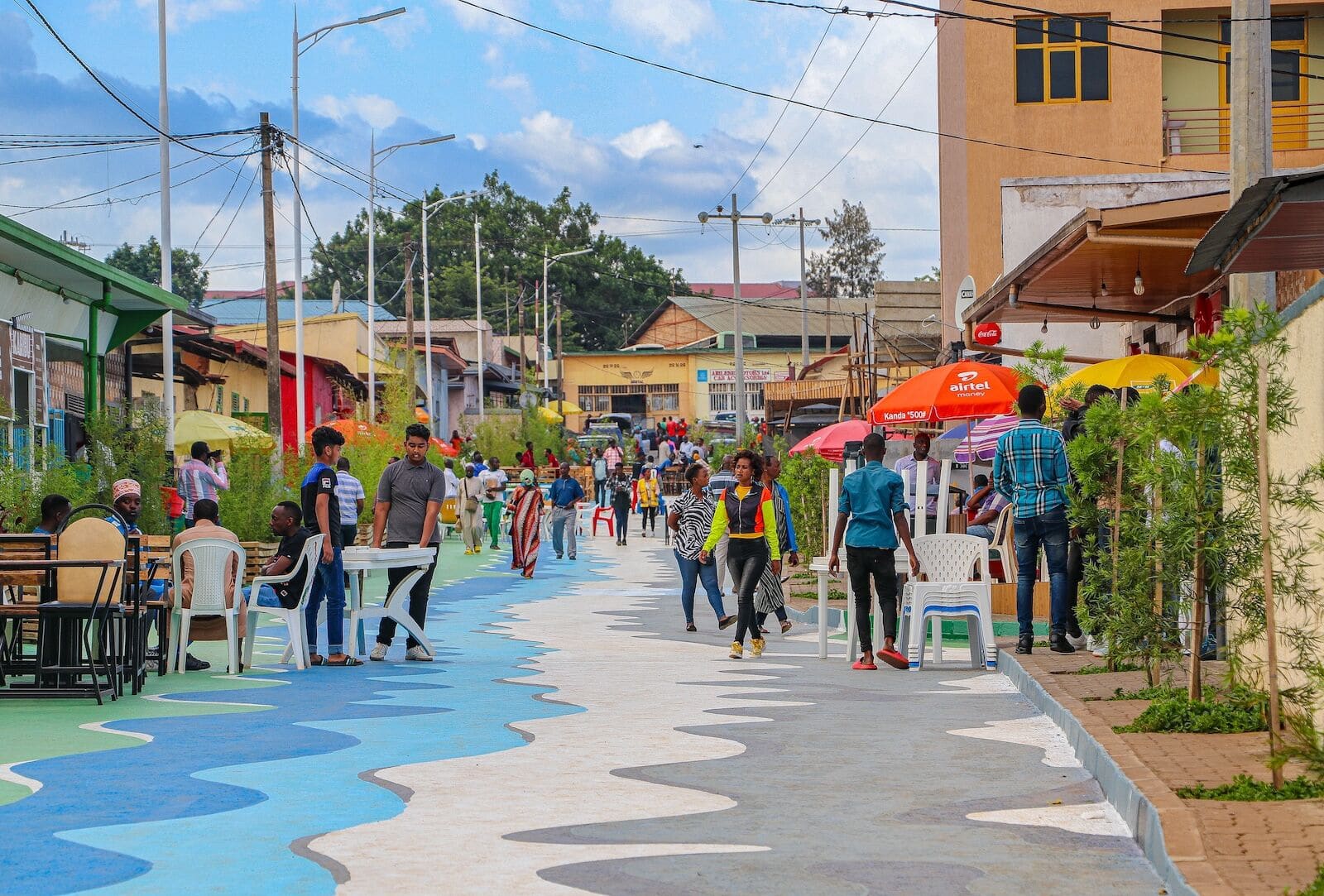
For food beyond hotel dining rooms, Jollof Appetit runs walking tours through Nyamirambo, a lively district known for its car-free streets and Islamic cultural presence. Guides lead groups from stall to stall, sampling brochettes, chapati, ugali with stew, isame rice, sambaza, and matoke, finishing with fresh fruit. The format prioritizes variety over volume, offering a snapshot of everyday eating rather than a curated restaurant experience.
Ruä, a rooftop restaurant and cocktail bar, occupies the opposite end of the dining spectrum. Perched above the city with sweeping views, it caters to golden-hour crowds seeking elevated ambiance. The menu and drinks lean upscale, and the setting turns a meal into a visual experience as much as a culinary one.
Conservation and Contemporary Art
Umusambi Village sits on the outskirts of Kigali, dedicated to the rescue and rehabilitation of Rwanda's grey crowned cranes. The facility maintains walking trails where the birds roam freely, allowing visitors to observe them up close while learning about the threats they face in the wild. As Rwanda's national bird, the species carries symbolic weight, and the project links conservation work to national identity.
Gihanga Institute of Contemporary Art showcases painting, sculpture, and mixed media from Rwandan and African artists. The gallery rotates exhibitions, reflecting shifts in the continent's art discourse. For travelers interested in how cultural identity gets expressed through visual language, the institute offers a quieter counterpoint to the city's bustling markets and food tours.
Telling the Whole Story
Writer Chimamanda Adichie once warned against the danger of a single story, arguing that incomplete narratives rob people and places of dignity. Rwanda's recent history demands acknowledgment, but freezing the country in that moment does a disservice to the communities building new chapters. The women weaving in Kinigi, the youth working at Red Rocks, the artists exhibiting at Gihanga are all part of a narrative that refuses to be defined solely by tragedy.
Travelers who spend time in Rwanda encounter a nation still processing its past while actively shaping its future. That duality appears in nearly every interaction: a memorial that honors the dead, a craft cooperative that trains survivors, a rooftop bar where young professionals gather to celebrate small victories. The country's size makes it possible to move between these spaces quickly, but understanding the connections between them requires slowing down.
Tourism in Rwanda often centers on wildlife, particularly the mountain gorillas that draw visitors willing to pay premium permit fees. Yet the cultural infrastructure surrounding those headline attractions tells a richer, more textured story. Tea plantations double as agritourism sites. Women's cooperatives offer economic pathways while preserving craft traditions. Art galleries and food tours give shape to a contemporary identity that coexists with historical memory.
The landscape itself reinforces this layered experience. Known as the land of a thousand hills, Rwanda's topography shifts from volcanic peaks in the north to dense rainforest in the west, with terraced farmland stitching the spaces in between. Each region supports distinct communities, and each community has found ways to invite visitors into their daily rhythms without turning culture into performance.
For travelers willing to look beyond the gorillas and the genocide memorials, Rwanda offers a case study in how a small nation rebuilds not by erasing its past but by refusing to let that past define every conversation. The work happens in workshops, kitchens, galleries, and tea fields, places where people show up each day to create something new. That resilience does not erase the scars, but it does ensure they are not the only story worth telling.