Water as Gateway
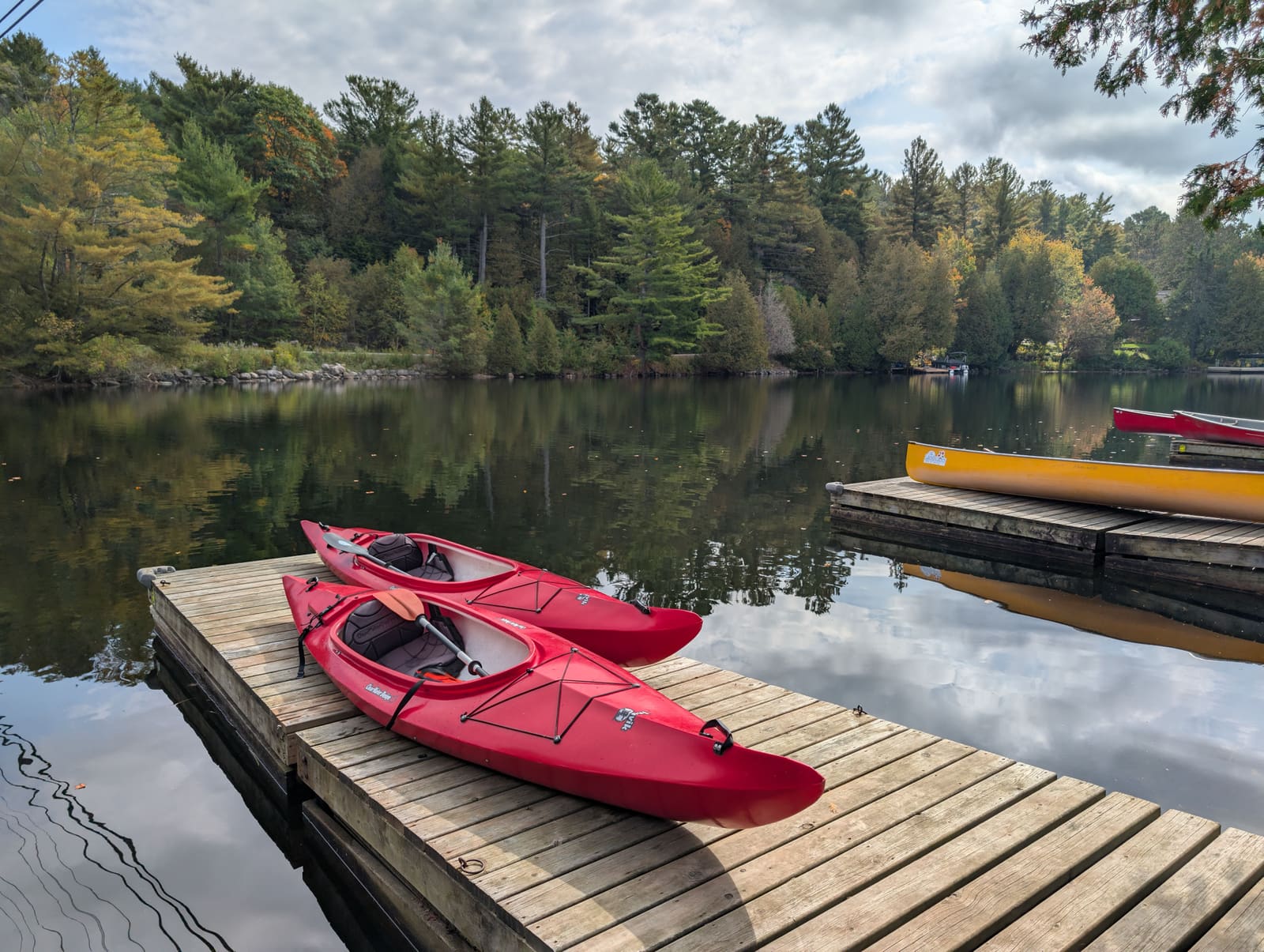
Stillness settles across Canoe Lake in mid-May. A loon surfaces, inspects the ripples from a paddler's stroke, then vanishes beneath indigo water. For a first-time visitor navigating these channels with an Algonquin Outfitters guide, the scene feels oddly familiar - not from memory, but from canvas.
Tom Thomson's early twentieth-century paintings, particularly The Jack Pine, captured this terrain with a vibrancy that made Ontario's backcountry legible to urban audiences. His work, and the collective that formed after his death in 1917 at age thirty-nine, placed Canadian wilderness into global consciousness. The Group of Seven, as they became known, turned remote lakes and windswept pines into national symbols.
Yet standing on the silent island where Thomson's memorial cairn rises, contradictions surface. A brightly painted totem pole marks the spot, erected by summer camp students in the nineteen-thirties. The style mimics coastal First Nations traditions from thousands of kilometres west - an "incongruous marker," as biographer Roy MacGregor termed it, grafted onto a place rich with its own Indigenous heritage.
What the Frame Left Out
Christine Luckasavitch spent years bringing Omàmìwininì and Madaoueskarini Anishinaabe stories back into Algonquin's narrative. Her family was among those forcibly removed when the park was established in 1893 to facilitate logging. The mobility that Thomson and his contemporaries enjoyed - setting up easels along portages, camping for weeks - was denied to the people who had stewarded these watersheds for millennia.
In summer 2023, a birchbark canoe built by Algonquin craftsman Chuck Commanda returned to Lake Opeongo. It was the first vessel of its kind, made by an Algonquin builder using birch from the park, to travel those waters in a century. The canoe now sits in the Visitor Centre, a quiet testament to restoration.
"Thomson's paintings do not tell the only story," Luckasavitch notes. Red ochre markings on rock faces, quartz and granite tools - these were earlier expressions of knowledge and connection, predating oil on board by generations.
Kevin Eshkawkogan, President and CEO of the Indigenous Tourism Association of Ontario, frames it plainly: "The Group of Seven created images of landscapes without any people in their work; however, the land they painted was taken care of by the First Peoples, who are still here ensuring the land's beauty and purpose live on for all."
Shifting the Gallery
Ontario holds the largest concentration of Group of Seven works. The McMichael Canadian Art Collection in Kleinburg displays them alongside contemporary Indigenous artists, including Two-Spirit Miss Chief Eagle Testickle, the alter ego of Kent Monkman. Curator John Geoghegan describes the Seven as "on the frontline of building a unique Canadian identity, distinct from being part of the Commonwealth" during the interwar years.
That identity, however, was incomplete. The Professional Native Indian Artists Inc., formed in the nineteen-seventies and nicknamed "The Indian Group of Seven" by media, worked in bone, wood, textile, and performance - media that colonial policy had long suppressed. Norval Morrisseau, an Ojibway Anishinaabe founder of the collective and considered the father of Woodlands Art, depicted spiritual beings in vivid, surreal compositions. His painting The Protector shows a giant crow intertwined with fish-like figures, a visual language rooted in reclamation.
"The PNIAI's approach to landscapes was different," Geoghegan explains, "referencing and reclaiming the visuals that First Nations had been prevented from creating freely on their native lands for decades."
Living Practice
Mādahòkì Farm, located between Algonquin and Ottawa, turns museum objects back into daily use. A teepee hosts summer gatherings. Ojibwe Spirit Horses graze. Pikwakanagan artist Stephanie Sarazin speaks of dance and pow-wows not as historical artefacts but as ongoing practice.
Visiting the farm clarifies what static displays cannot: culture persists beyond frames. The landscapes Thomson painted remain inhabited, animated by stories that predate and outlast any single artistic movement.
Urban Counterpoints
Ottawa's Canadian Museum of History, designed by Anishinaabe architect Douglas Cardinal, curves in the shape of Turtle Island. Across the river, the National Gallery of Canada holds Thomson's work alongside European masters. Mid-May brings the Tulip Festival, when the capital blooms in coordinated beds of colour - a different kind of curated landscape.
Two hours south, the Art Gallery of Ontario and the Arts and Letters Club in Toronto preserve the Group's urban haunts. These institutions now share wall space with voices that were once excluded, a rebalancing that feels less like revision than completion.
What Remains
Dr James MacCallum, the Group of Seven's primary patron, claimed Thomson and his peers "put the spirit of Canada on a piece of board eight by 10 inches." The statement rings true only in part. The boards themselves - the birch, the land, the waters - carry older meanings.
Leaving Algonquin for the city, the contrast sharpens. Wilderness and metropolis are not opposites but continuities. The same forces that shaped access to park land shaped access to galleries. Only now, as institutions make room for parallel narratives, does the full picture emerge.
Algonquin's nineteen hiking trails still bear traces of the logging industry that justified the park's creation. Beech trees glow yellow in autumn light, as they did when Arthur Lismer painted Wood Interior, Algonquin Park. Franklin Carmichael's moody skies remain overhead. But the trails also pass through sites marked by red ochre, evidence of a visual tradition that never required external validation.
Tourism infrastructure has improved. Killarney Lodge offers lakeside cabins within the park. Ottawa's Fairmont Château Laurier, the city's oldest hotel, sits along the Rideau Canal. Air Transat operates direct flights from London Gatwick to Ottawa, making the circuit from urban galleries to backcountry accessible within a long weekend.
Yet the journey's value lies less in logistics than in layered seeing. To follow Thomson's route is to confront what his frame excluded. To stand where he stood is to ask whose stories were painted over, and whose are finally being restored.