A Late-Night Arrival
The cab from the airport takes half an hour, winding through streets that grow busier as you approach the center. Past midnight, Republic Square pulses with crowds watching water jets choreographed to orchestral scores and, unexpectedly, a Star Wars medley. Vendors hawk balloons and flowers to families and couples who treat this nightly routine as casually as a park stroll.
This is a typical Monday in Armenia's capital, where public spectacle feels woven into daily rhythm rather than reserved for holidays. The square itself curves into an oval, bordered by buildings faced in tuff, the rose-tinted volcanic rock that earned Yerevan its nickname. Architect Alexander Tamanian drew up much of the city center in the 1920s, reimagining the layout under early Soviet administration. Government offices, a national gallery, and the main post office all share that same pink stone facade.
Why Go Now
Wizz Air began flying direct from London Luton on June 12, with Monday and Friday departures starting at £46 one way. The budget carrier's managing director framed the launch as part of a push to connect passengers with places beyond the usual circuits. Yerevan qualifies. Sandwiched between Georgia, Turkey, Iran, and Azerbaijan in the South Caucasus, Armenia hasn't featured prominently on mainstream itineraries, despite a foundation that predates Rome by decades.
Records place the city's origins at 782 BC, though successive empires - Byzantine, Ottoman, Persian, Russian - left little of the ancient fabric intact. What stands today is a twentieth-century capital of 1.1 million, where aging Ladas share lanes with electric sedans and tree-lined boulevards stretch wider than many European counterparts.
Culture on Every Corner
Walk any major avenue and you encounter plaques, busts, and full statues honoring poets, composers, and painters. A recent bronze depicts Charles Aznavour, born Shahnur Vaghinak Aznavourian, installed to recognize his fundraising after the 1988 earthquake. The grey, circular Opera and Ballet Theatre anchors one district; nearby, Swan Lake draws joggers and weekend picnickers.
In 2015, Kanye West performed an impromptu set at the lake's edge before wading in fully clothed, prompting fans to follow en masse. Kim Kardashian accompanied him; her Armenian ancestry has drawn intermittent celebrity attention to the country. Cher, born Cheryl Sarkisian, visited in 1993 and posed beside a toppled Lenin statue that once dominated Republic Square before independence.
The Cascade and the Mountain
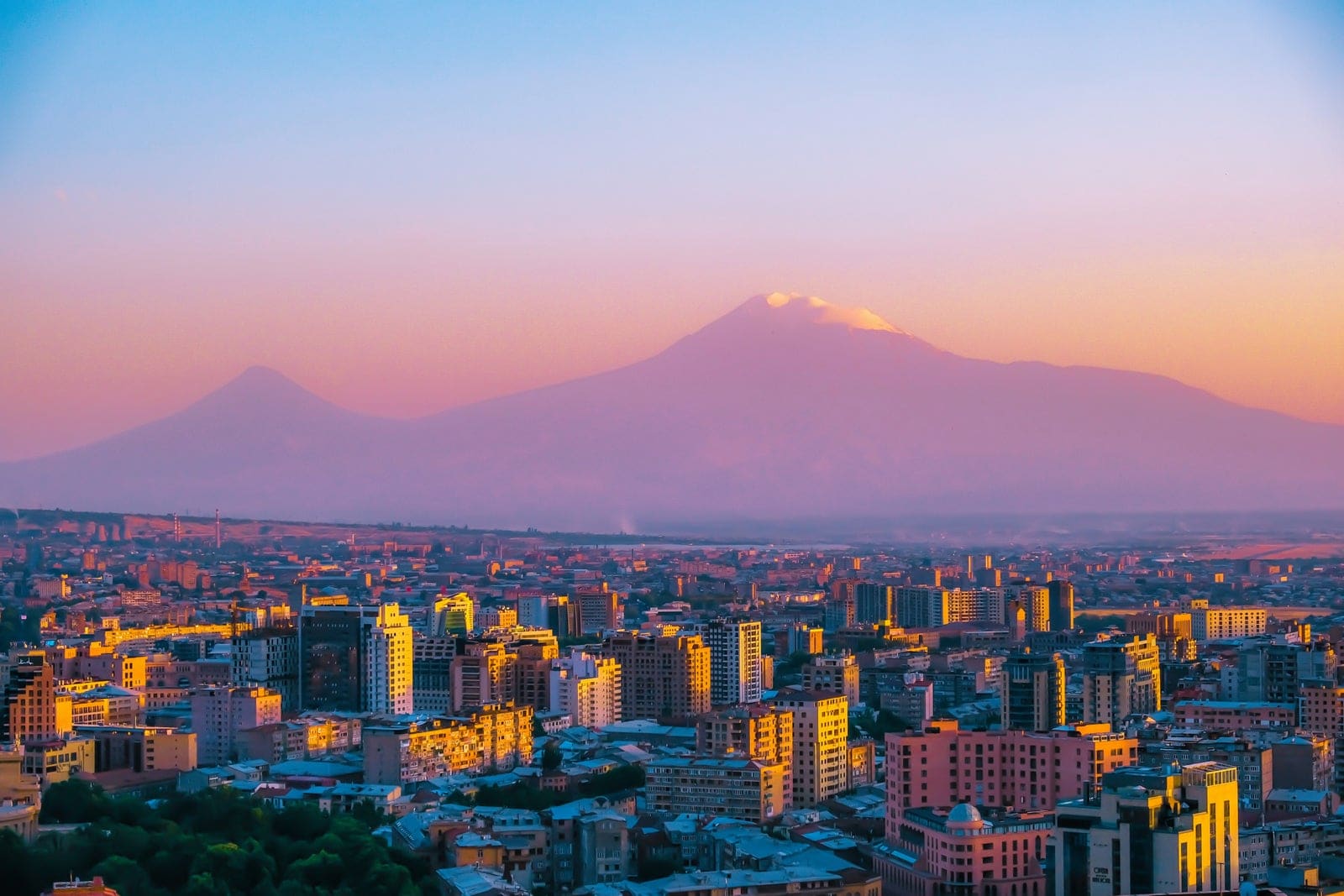
Five hundred and seventy-two steps climb the Cascade Complex, a tiered monument punctuated by fountains, reliefs, and contemporary sculptures donated by collector Gerard Cafesjian. Escalators run through the interior, flanked by additional artworks. From the summit, Mount Ararat fills the horizon, its twin peaks capped in permanent snow. The taller cone rises beside a smaller, Fuji-shaped sibling.
Tamanian oriented his street grid so residents could glimpse the mountain from multiple vantage points, even after Soviet authorities ceded the land beneath it to Turkey in 1921. Many Armenians regard Ararat as a sacred site, linking them to the biblical account of Noah's Ark.
Confronting Darker History
Between 1915 and 1916, the Ottoman Empire orchestrated mass killings targeting the country's Christian population. The Tsitsernakaberd Memorial sits on a hill above the Hrazdan Gorge, documenting the genocide through exhibits and testimony. The visit is sobering but offers necessary context for understanding the nation's resilience and the weight it carries into contemporary politics.
What to Eat
Lavash, a thin flatbread recognized by UNESCO, appears at nearly every meal. Women prepare it by stretching dough until translucent, then slapping it against the walls of a tonir, an underground clay oven. The result blisters and chars in seconds.
Grilled meats, called khorovats, dominate menus alongside red trout and dolma - minced meat and rice bundled in vine leaves. Harissa, a dense porridge made with chicken or lamb and cracked wheat, offers comfort on cooler evenings. Salads arrive piled with tomatoes, cucumbers, peppers, olives, and local cheese, often dressed simply with olive oil and herbs.
At Sherep, one of the city's top-rated spots, plates come loaded with multiple preparations. Zepyur, a retro-styled restaurant off Aboyvan Street, serves a dessert shaped like Lenin's bust - red icing over chocolate mousse. The theatrical presentation nods to the statue that once loomed over Republic Square, dismantled after the country declared independence in 1991.
Gata, a round brioche-style cake with sweet filling, turns up in food markets and bakeries across the city. It travels well and makes a practical souvenir for anyone with room in their carry-on.
Beyond the Capital
An hour's drive opens access to several UNESCO-listed and historically significant sites. Garni Temple, a first-century Greco-Roman structure, remains the only colonnaded building of its kind surviving from the Soviet era. Nearby, the Symphony of Stones lines the Garni Gorge with thousands of hexagonal basalt columns, a geological formation that rivals Northern Ireland's Giant's Causeway.
Geghard Monastery, carved into the cliffs of the Azat Valley, dates to the medieval period and occasionally hosts choirs performing in its rock-cut chapels. Zvartnots Cathedral, built in the seventh century and destroyed by earthquake three centuries later, preserves circular ruins on the site where Gregory the Illuminator met King Tiridates to advocate for Christianity's adoption.
Etchmiadzin, possibly the world's oldest cathedral, was constructed in 301 shortly after Armenia became the first nation to declare Christianity its state religion. The complex now serves as the administrative center for the Armenian Apostolic Church.
Planning a Trip
Twice-weekly flights from London Luton make weekend trips feasible, though a longer stay allows time for excursions outside the capital. Accommodation options range from international chains to boutique guesthouses; the Ramada Hotel offers doubles from £129 per night. Summer temperatures hover around 23°C in the evenings, cooling from daytime highs that can reach the low 30s.
Yerevan's compact core is walkable, though taxis remain inexpensive for longer journeys or airport transfers. English is spoken in tourist-facing businesses, and the local currency, the dram, stretches further than the euro or pound in many Western European cities.
The city's reopening to budget travelers marks a shift in accessibility, offering an alternative to the saturated circuits of Southern and Western Europe. For those willing to look past the familiar, Armenia delivers history, flavor, and a streetscape that refuses to blend into the background.