A Season of Variety
Europe's accommodation landscape this summer reflects a broader shift in how people want to stay. The latest wave of openings stretches from a Scottish wilderness lodge to a tiny Greek island most travelers have never heard of. What ties them together is less about luxury tier and more about intention: properties designed around place, whether that's through local art, architectural restraint, or simply knowing when to get out of the way of a view.
The range is wide. Mandarin Oriental opened on Mallorca's rust-colored cliffs with direct access to two small coves and interiors in tones that mirror the surrounding pines and stone. The property spans three hectares and includes two pools, a spa, and a private pier for boat access to Puerto Portals. Service follows the brand's Asian-rooted attention to detail but adapted to what the company describes as a Spanish softness.
On Mykonos, Four Seasons arrived on the quieter side of the island, away from the concentrated nightlife but within reach for those interested. The property, designed by Greek architect Nicos Valsamakis, mimics a traditional Mykonian village with white buildings cascading toward a private beach. Cobbled courtyards feature trailing bougainvillea, and the palette includes the expected blues plus an unexpected postbox red. It's the brand's second property in Greece, following the 2019 Athens opening.
Renovation as News
Not every opening is new construction. Hotel Danieli in Venice, a five-century fixture on the Riva degli Schiavoni next to the Doge's Palace, closed for a full renovation when Four Seasons took over management in 2023. It reopened in August 2026. The overhaul addressed what had become a threadbare interpretation of medieval opulence: heavy damasks, deep reds, gilded woodwork that felt more like stage dressing than livable space.
The renovation sent chandeliers back to Murano, brought in the Academy of Fine Arts to restore painted ceilings, and enlisted local artisans for the grand staircase and Corinthian columns. Designer Pierre-Yves Rochon introduced celadon green, soft blues, and champagne tones drawn from the Venetian lagoon, along with mirrors throughout to expand space and play with the city's signature light and reflections.
The project illustrates a question facing historic properties across Europe: how to preserve identity while shedding the parts that have aged poorly. In this case, the answer involved keeping the bones and rethinking everything else.
Scale and Seclusion
Fouquet's Mykonos breaks from the island's typical aesthetic uniformity by layering in color, pattern, and statement art. Loungers at the Roka pool and beach restaurant come in rust orange and sunshine yellow. Shared spaces feature bold artwork, including an original Salvador Dalí. The property has 60 suites and three private villas. Beachfront bungalows are large, with private terraces and walk-in wardrobes. Higher up, smaller suites have private plunge pools overlooking the sea.
At the other end of the scale, The Duchess on Thirasia, Santorini's less-visited neighboring island, offers just 11 cave-style suites with domed roofs and arched interiors. The adults-only property sits above the cliffs of Manolas, looking out over Korfos Bay toward Santorini. Logistics are complicated: milk for morning coffee often waits for the ferry from the mainland. Fresh vegetables, fruit, and bread come from the island itself, grown in volcanic soil and baked in local ovens. Interiors feature textiles from Athens company Kamarinos Design and silk artworks by Zografos artisans from Soufli.
Size here isn't a drawback. The infinity pool overlooks Manolas, where roughly 150 residents live largely removed from the tourism economy dominating Santorini. The appeal is the opposite of what drives most Cycladic travel: fewer options, slower rhythms, views uncluttered by crowds.
Beyond the Mediterranean
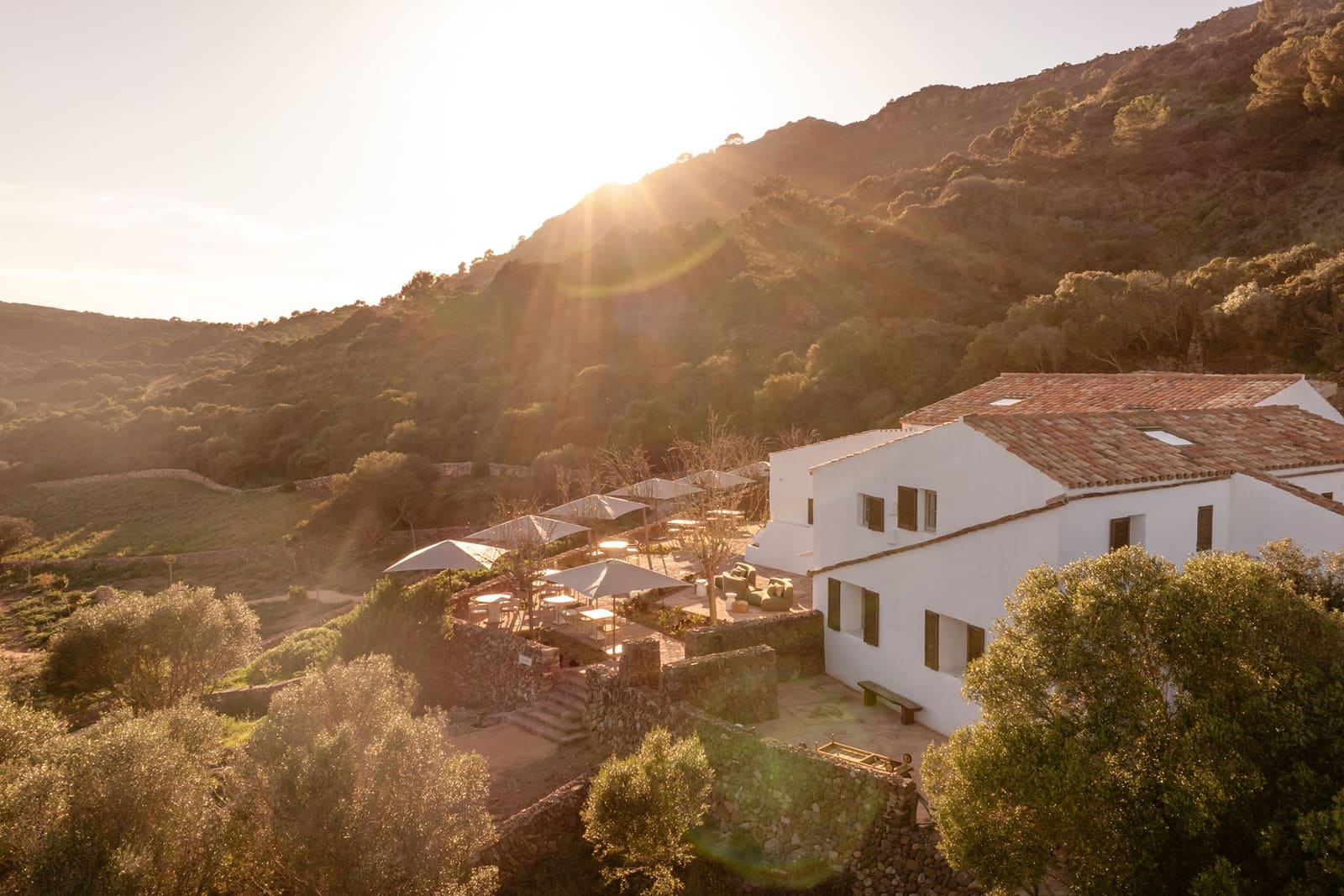
In Menorca, Binidufà offers 11 beds in a valley setting, part of a growing interest in properties that serve as base camps rather than full-service resorts. Details are limited, but the model fits with a pattern across Spain's islands: smaller, design-conscious places aimed at travelers who want a foothold in a landscape rather than insulation from it.
Scotland's Hope by WildLand takes that concept further. The property, an 1867 hunting lodge and collection of cottages, reopened after 15 years of development as an exclusive-use retreat. Conservation pioneer WildLand describes it as akin to a Scottish safari lodge. Floor-to-ceiling windows direct attention outward, toward lochs and munros. Design references British craftsmanship and the surrounding wilderness. Days are organized not by schedules but by elemental "rhythms": earth, fire, water, each flowing through activities and music. The earth day includes a sound bath in a subterranean room; the water day opens with a walk into a cold loch, followed by a campfire, ginger shots, and a run to the outdoor cedar sauna.
The model assumes guests will stay put rather than use the property as a touring base, though it's possible to thread together an itinerary with WildLand's nearby Lundies House and Kinloch Lodge or drive the North Coast 500 route.
In the Cotswolds, Dumbleton Hall completed a major restoration of its 19th-century stone estate near Winchcombe. Built on a historic wool fortune, the manor house once hosted Charles Dickens, Elizabeth Gaskell, and John Betjeman. The renovation introduced maximalist Belle Époque interiors, including leopard print rugs, within the old stone shell. The grounds include a lake, and the Library Bar runs wall to wall with books. It's a contrast to the restraint favored by many contemporary country house hotels, betting instead on pattern and color to refresh the genre.
What It Signals
This summer's openings don't point toward a single trend so much as a broadening of what counts as noteworthy. Major brands continue expanding into established resort markets, but the attention also falls on smaller, harder-to-reach places and properties willing to take aesthetic risks.
The question for travelers is less about which opening is "best" and more about which approach fits. The Four Seasons model offers consistency and polish. The Duchess offers logistical friction in exchange for seclusion. Dumbleton Hall offers maximalism where others offer minimalism. Fouquet's offers color where others offer restraint.
What they share is specificity: a clear point of view about what a stay should feel like, even when those points of view differ widely. That specificity matters more than the thread count or the number of dining venues, though those details still matter to some travelers more than others. The real shift is that there's now enough variety that travelers can choose based on what they actually want rather than settling for the only option in a given price range or location.
For anyone planning late-summer or early-fall travel, the range of choices is wider than it's been in years. The challenge isn't finding somewhere to stay. It's deciding which version of Europe you're after.