A Plane Built for the Long Haul
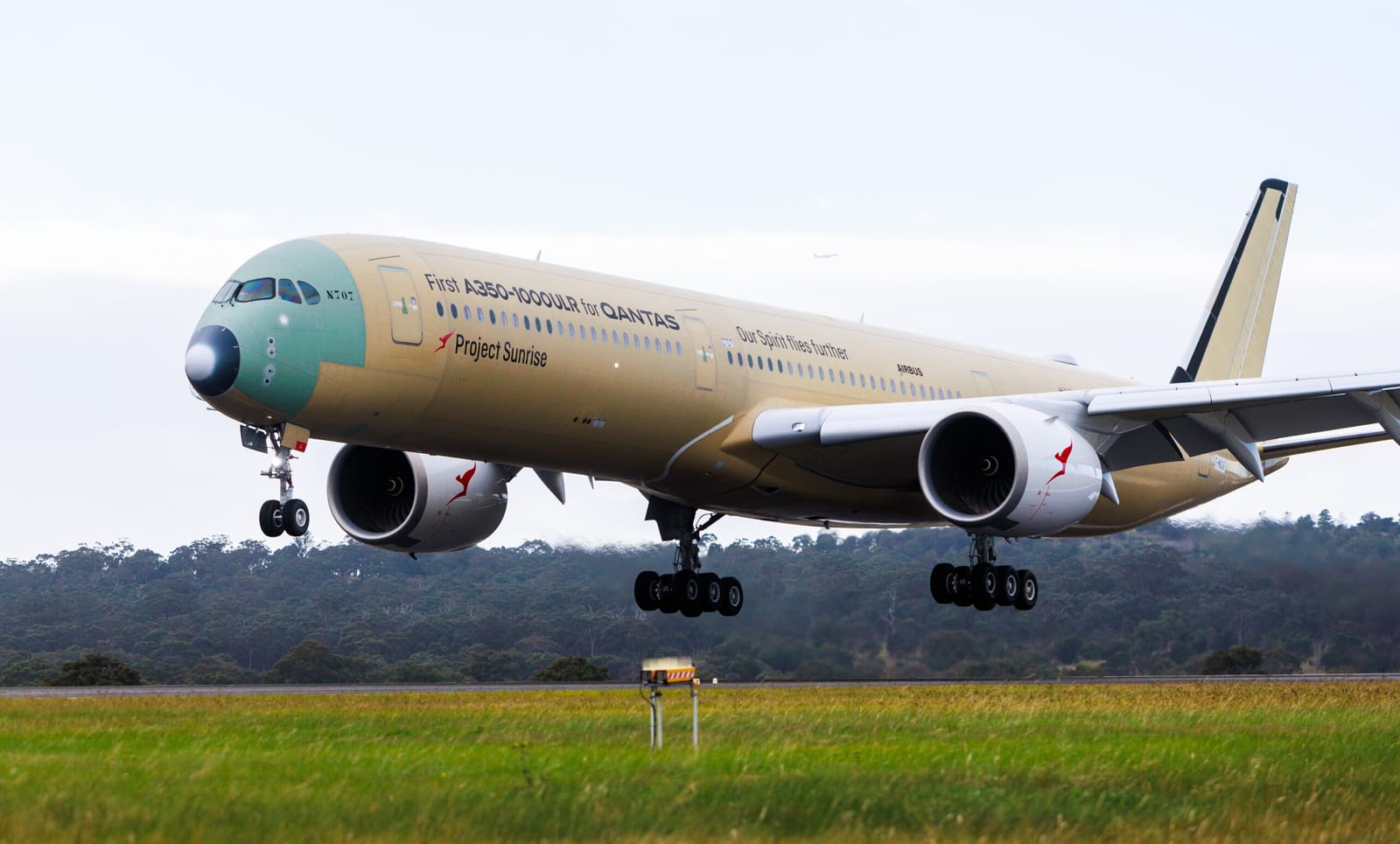
The first aircraft purpose-built for Qantas's Project Sunrise landed in Melbourne last Thursday after flying nearly 20 hours straight from southern France. The Airbus A350-1000ULR departed the manufacturer's Toulouse facility at 7:33 a.m. and arrived at 10:46 a.m. local time, covering the distance with a crew of four Airbus test pilots and five flight engineers.
This delivery marks the start of a fleet that will eventually number twelve jets, each configured to carry 238 passengers on routes that can stretch past 20 hours. Qantas has ordered the planes specifically for direct service between Australia and distant cities that currently require a stopover. Sydney to London will be the first route when commercial flights begin in October 2027, with New York to follow.
The aircraft itself doesn't yet wear the airline's signature red tail. For now, it flies in a plain tan finish with Qantas logos visible only on the wingtips, giving it an oddly utilitarian appearance during its testing phase.
More Watchers Than a Royal Farewell
Interest in the delivery flight surprised even those tracking it. Flightradar24 recorded more than 67,000 people following the journey in real time, a figure that climbed to roughly 75,000 by touchdown. That makes it the second most-watched flight in the platform's history, trailing only the aircraft that carried Queen Elizabeth II's coffin from Edinburgh to London in 2022.
The attention reflects both the novelty of ultra-long routes and the technical curiosity surrounding how airlines will make them work. A return trip is scheduled for Monday, expected to take around 23 hours as the crew flies back to Toulouse. Two Qantas pilots will join for that leg to test fuel management, air conditioning, and other systems under conditions closer to what paying passengers will experience.
Chief technical pilot Alex Passerini told reporters that fatigue management would be part of the testing. "Everyone is going to get tired," he said, noting that scheduled rest periods have been built into the flight plan.
The Engineering That Makes It Possible
The core modification enabling these journeys is an additional fuel tank holding 20,000 litres. That expansion allows the A350-1000ULR to stay aloft for up to 22 hours, enough margin to handle headwinds or routing changes. Qantas ran a shorter test in early June, a three-hour, 43-minute loop over France and the Atlantic coast, before attempting the full-distance delivery.
The dozen aircraft on order are now moving through Airbus's production line, with deliveries scheduled to begin in April 2027. The programme has faced delays, pushing back the original timeline, but Qantas chief executive Vanessa Hudson confirmed that tickets for the inaugural Sydney-London flight will go on sale in February 2027.
Hudson also noted that route decisions will remain flexible. "Demand can change, and we're going to be responsive to that," she said. Sydney-New York is confirmed, but Melbourne departures have yet to be locked in. The airline plans to announce additional routes as more aircraft arrive over the next two and a half years.
Routing Over the Pole
Passerini revealed that the London-Sydney path will take passengers over the North Pole. The routing might seem indirect on a flat map, but seasonal wind patterns can make it faster than more southerly tracks. The choice illustrates how ultra-long flights depend as much on meteorology as engineering.
Passengers heading to London will spend roughly 12 hours in darkness and cross seven to nine time zones. Those flying to New York will cross up to 16, a shift that Peter Cistulli, a sleep medicine professor advising Qantas, calls "a major biological challenge."
Designing for Disrupted Sleep
Light is the strongest signal for resetting the body's internal clock, so Qantas has focused on cabin lighting schedules, meal timing, and protected sleep windows to help passengers adjust before they land. A wellness zone will sit between premium economy and economy, offering guided exercises available to all ticketholders. The space was developed with input from the Charles Perkins Centre, a research institute focused on health and disease prevention.
The setup reflects a broader question facing airlines as ultra-long routes become viable: how much can design and scheduling mitigate the physical toll of sitting in a pressurized tube for nearly a full day? Qantas is betting that careful attention to circadian rhythms and movement can make the experience manageable, if not comfortable.
What Comes Next
The test aircraft will spend the next two months cycling between Toulouse and various destinations, gathering data that will inform cabin layouts, crew scheduling, and operational procedures. The tan livery will eventually give way to the airline's standard branding, and the interiors will be fitted out for passengers rather than engineers.
If the timeline holds, the first paying customers will board a Project Sunrise flight in October 2027. The route will cut roughly four hours off current Sydney-London journeys that require a stop in Singapore or the Middle East. Whether travelers will embrace the trade-off between time saved and endurance required remains to be seen, but the appetite for ultra-long-haul travel appears strong enough for Qantas to commit a dozen wide-body jets to the experiment.