A Rare Alignment Over Iberia
On August 12, 2026, mainland Spain will witness something it hasn't seen since before the Titanic sank: a total solar eclipse. The moon's shadow will sweep across the Iberian Peninsula near sunset, plunging parts of Portugal and Spain into brief daytime darkness. The last time this happened over mainland Spain was in 1912, though some astronomers point to 1905 as the country's last true totality experience.
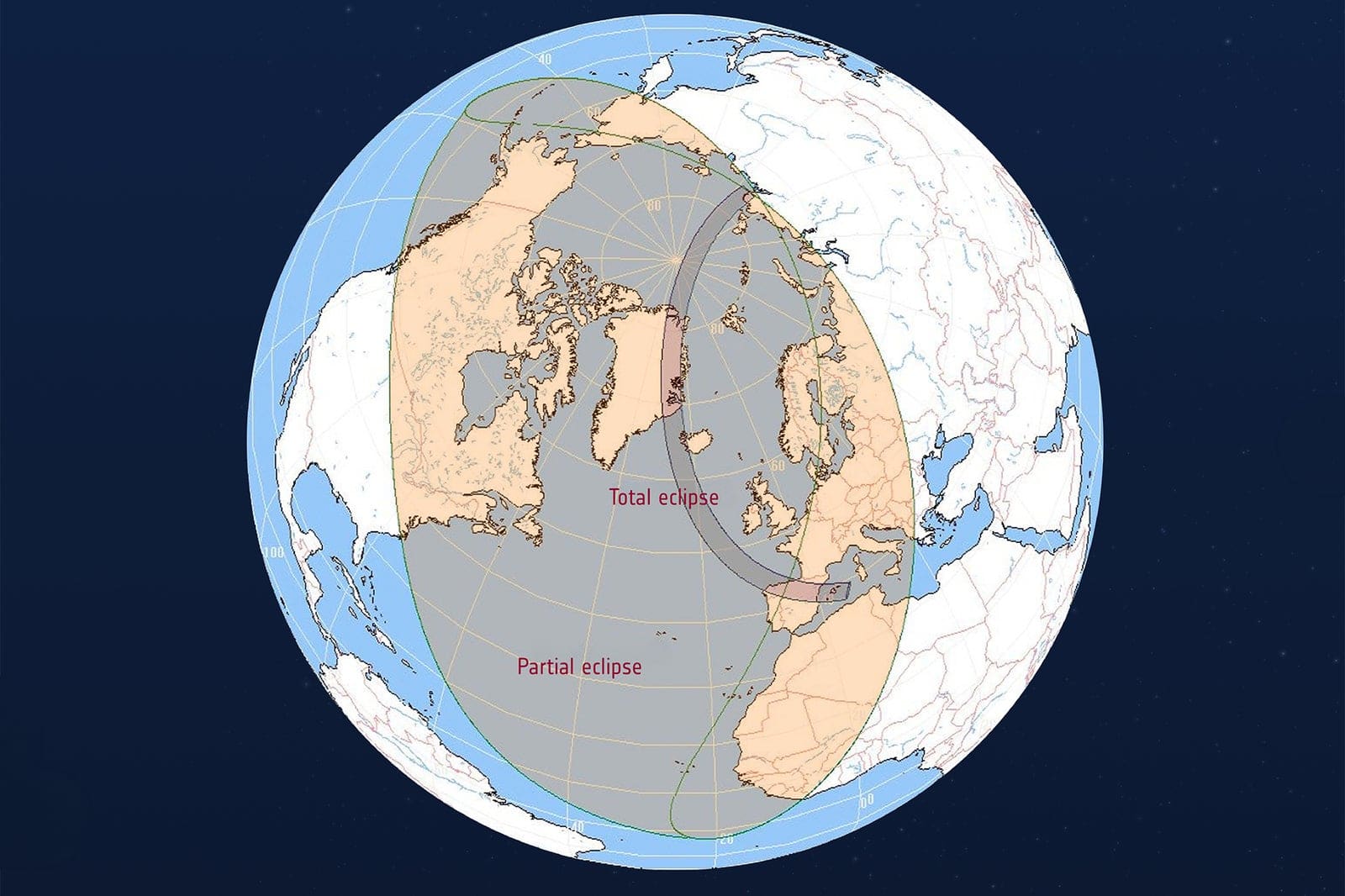
The eclipse path will stretch 5,130 miles, beginning near the North Pole and tracking south across the Atlantic before reaching Europe. Totality will last up to two minutes and 18 seconds at its maximum point off Iceland's west coast, according to the European Space Agency. By the time the shadow reaches Spain's crowded viewing areas, totality will shrink to about a minute.
Small sections of Greenland and Iceland will also fall within the path of totality. The entire journey from start to finish will take roughly 90 minutes, with most of the track crossing empty ocean.
Beyond the Shadow's Edge
Hundreds of millions of people outside the narrow totality zone will still catch a partial eclipse. The phenomenon will be visible as far as Alaska and Siberia, covering Canada, the northern United States, much of Europe, and parts of West Africa.
Coverage percentages will depend on proximity to the main path. Dublin will see 94% of the sun obscured, while Oslo registers 83%. In North America, Montreal gets 18% coverage, dropping to 9% in New York and just 2% in Norfolk, Virginia.
Even during a partial eclipse, eye protection remains essential. Special eclipse glasses are required whenever any portion of the sun remains visible, no matter how small.
A Day of Celestial Abundance
The eclipse arrives on a day already crowded with astronomical events. Before dawn, six planets will form an arc across the sky. After nightfall, the Perseid meteor shower reaches its peak under a new moon, offering ideal viewing conditions. Some of the brighter meteors may even appear during totality, along with visible planets and stars that emerge as daylight fades.
Temperature drops during the brief period of totality, and the sudden darkness creates measurable changes in Earth's atmosphere. More than 60 high-altitude balloons will launch from Spain and Iceland to study these shifts, part of a research project funded by NASA and led by Montana State University.
A NASA high-altitude aircraft will chase the eclipse at 460 mph, extending the observation window to nearly three minutes in the air. Four cameras aboard the plane will capture thousands of images of the sun's corona in nine different wavelengths during those 180 seconds.
Scientific Opportunities in Brief Windows
The European Space Agency plans live coverage from Spain's Astrophysical Observatory of Javalambre and will host a public event in Leon. NASA and the Italy-based Virtual Telescope Project will provide their own broadcasts. Two ESA space telescopes will observe the eclipsed sun and its outer atmosphere during the event.
The Proba-3 mission, which uses two satellites flying in formation to create artificial eclipses lasting more than five hours, won't be positioned correctly during the natural eclipse but will attempt observations before and after. Since launching, Proba-3 has generated over 60 simulated total solar eclipses for research purposes.
For eclipse enthusiasts, the brief duration doesn't diminish the value. Veteran eclipse chasers note that even a minute or two of totality offers enough time for meaningful observation and data collection. One experienced chaser, on his 13th total solar eclipse, plans to film from a Greenland fjord in hopes of capturing the northern lights forming during totality.
An Unusual Cluster of Events
Spain's 2026 eclipse kicks off a remarkable sequence. On August 2, 2027, another total solar eclipse will cross the southern tip of Spain, this time lasting up to six minutes and 23 seconds. The path will continue through Morocco, Algeria, Libya, Egypt, Saudi Arabia, Yemen, and Somalia.
Then, on January 26, 2028, a ring-of-fire eclipse will complete Spain's celestial trifecta. Three major solar events in three years represent an extraordinary concentration for any single country.
The 1912 eclipse was technically a hybrid type, toggling between a ring-of-fire and just seconds of totality for Spanish viewers. That detail leads some astronomers to consider 1905 the last time Spain experienced a full, unambiguous total solar eclipse.
What the Moment Means
For researchers, the 2026 eclipse offers a chance to study the sun's corona and atmospheric changes under real conditions. For the public, it represents a rare intersection of cosmic mechanics and human geography. Spain hasn't had to plan for eclipse crowds of this scale in living memory.
The event also highlights how solar eclipses, despite their scientific familiarity, remain unpredictable in terms of location and timing. The alignment required for totality over any given spot is precise enough that centuries can pass between occurrences.
As preparations ramp up across the Iberian Peninsula, the convergence of astronomical events on a single day adds an extra layer of interest. The planet parade at dawn, the eclipse near sunset, and the meteor shower after dark create a full-day spectacle that extends well beyond the two minutes of totality.
For those traveling to Spain or positioned elsewhere along the path, the 2026 eclipse serves as a preview. The 2027 event will offer more than triple the observation time, making the Iberian Peninsula a repeat destination for eclipse watchers in consecutive summers.