From Screens to Shared Tables
What started as a lockdown antidote has turned into something larger. Catherine Fairweather launched her book club in 2020, pulling together friends scattered across continents who craved connection beyond their living rooms. The group focused on travel writing by authors writing outside their native English, exploring works from Danish explorer Peter Freuchen to Japanese novelist Jun'ichiro Tanizaki.
Monthly Zoom sessions worked, but barely. Time zones clashed, voices overlapped, and the intimacy of real conversation felt just out of reach. By late 2025, nine core members decided to close their laptops and meet face-to-face in Tangier, Morocco, at Dar Sinclair, a five-bedroom villa with literary pedigree.
The roster read like a creative census: an American-Italian author flew from Rome alongside a parfumiere-photographer whose family runs Le Sirenuse in Italy. A celebrated American author took the overnight from New York. A travel writer and entrepreneur joined from the UK, while a Moroccan travel expert and the founder of Intelligence Squared were already on the ground.
A City Built for Restless Minds
Tangier sits at the collision point of the Mediterranean and Atlantic, where currents wrestle and the blues shift in intensity. Before Morocco absorbed it in 1956, the city operated as a free zone under multiple European powers, a setup that bred a culture of license and experimentation. Artists, aristocrats, writers, and spies drifted in, drawn by breezy weather and few questions asked.
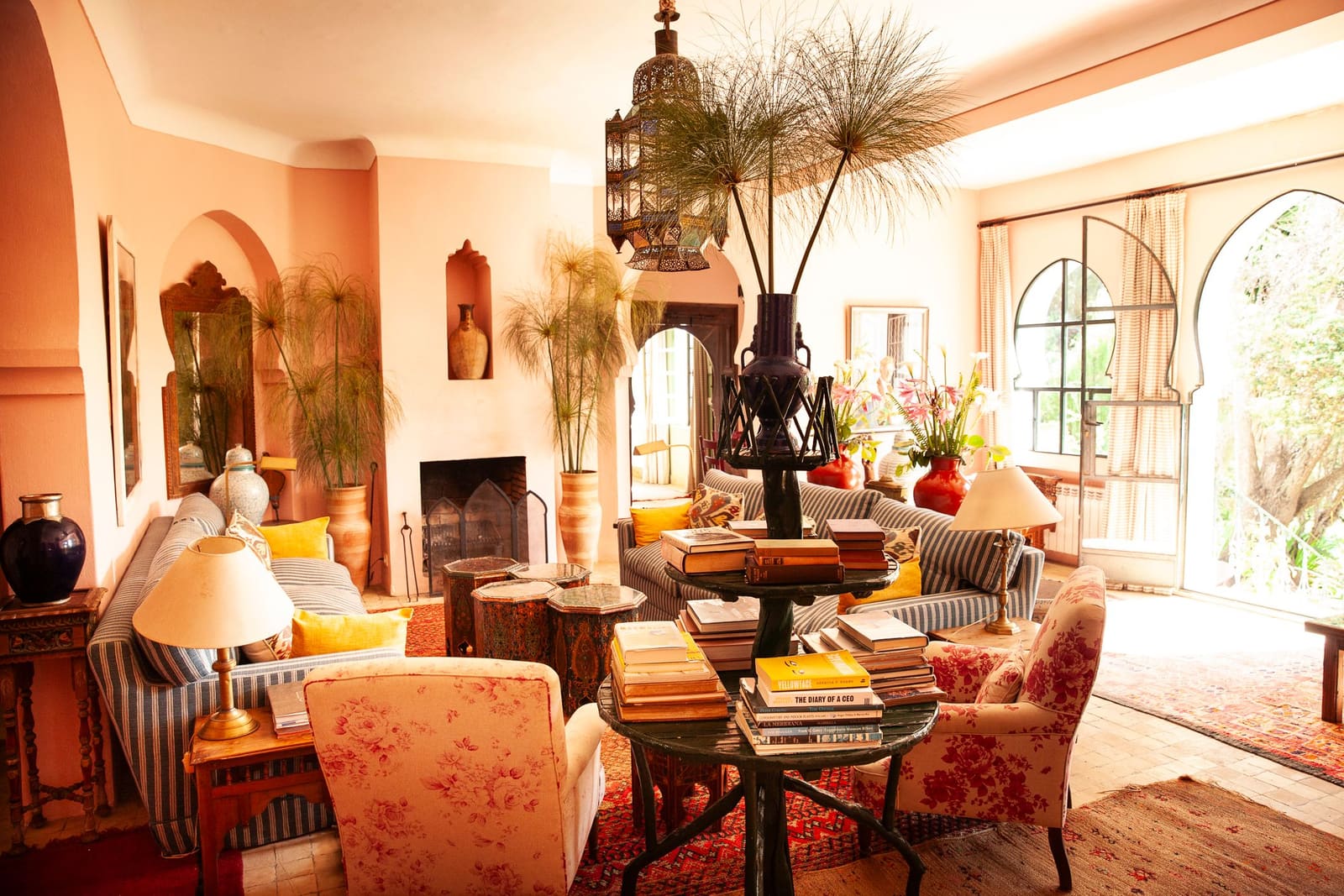
That energy still hums through Dar Sinclair. Built in the 1920s as an escape fantasy, the house sprawls across multi-level terraces where agapanthus and crinum lilies blur into one another. Tennessee Williams passed through. David Herbert, nicknamed "The Queen of Tangier" by Ian Fleming and others, held court. Paul Bowles, author of The Sheltering Sky, widened the guest list to include Moroccan artists like Mohamed Choukri, a former street child who became a celebrated writer. His Tales of Tangier landed on the club's reading list for the week.
What Happens When You Actually Talk
Fairweather describes a ripple effect when people drop the performance and engage openly. At Dar Sinclair, that meant silent reading sessions in the library, poolside gossip around chevron tiles, early-morning tea huddles, and chess games under shaded arbours. The house cook, Khadija, kept samosas coming.
On the second evening, the group gathered for their main discussion. Choukri's depiction of Tangier's underbelly left them disappointed and disconnected. The response to Egyptian author Omar El Akkad's work proved more layered, and the mood in the room shifted with each new interpretation.
That fluidity is the point. Different readers can flip a narrative entirely, surfacing angles the original text never intended. Travel writing, as one critic put it, remains one of the few genres able to capture the ineffable and the randomly comic. A book club magnifies that, especially when the group itself becomes a kind of ad hoc community.
Fairweather looked around the candlelit table at readers from Rome, Rabat, New York, Naples, Athens, London, and the West Country. She felt proud of the curiosity that had brought near-strangers to this house, and surprised by an unfamiliar sensation: belonging. Not tied to a place, but to a connection.
What Came Next
The retreat sparked a chain reaction. Fairweather co-founded Big Brue, an ideas festival where one of the members now speaks about remote places. Two participants launched a cultural events partnership. Another started a writing course in Venice. One member released a photography book partly inspired by the group's storytelling sessions. Another's reading of a chosen text on King Leopold's Congo fed into her own acclaimed book and led to a travel writing retreat in Nepal.
None of them planned it. The book club developed its own momentum, fueled by tangerine sunsets, long lunches, and endless beaches where conversation flowed as freely as the wine.
A Model That Travels
Fairweather is now organizing a 10-day literary journey around Morocco in 2027, covering Tangier, Marrakech, and the desert, with stops in Skoura, Erg Chebbi, and the Draa Valley. Pricing starts at £4,150, including accommodation, transfers, internal flights, and meals. Dates have yet to be announced.
Other organizers are following similar models. Intensive writing retreats in Marrakech, Bath, and London bring in former Bloomsbury editors and established authors, with day workshops starting at £485. Guided reading retreats in various locations run around £2,300 for a week. A Nepal-based program combining hiking, photography, and writing sessions costs under £6,750 for 10 days, all inclusive. A Venice writing course led by members of the original book club runs £2,500 for four nights.
The formats vary, but the underlying idea stays consistent: travel and literature both work better when shared. A book club that began as a way to survive isolation has become a reminder that curiosity and conversation can build something durable, even among people who started as almost-strangers.