A Landmark Reborn
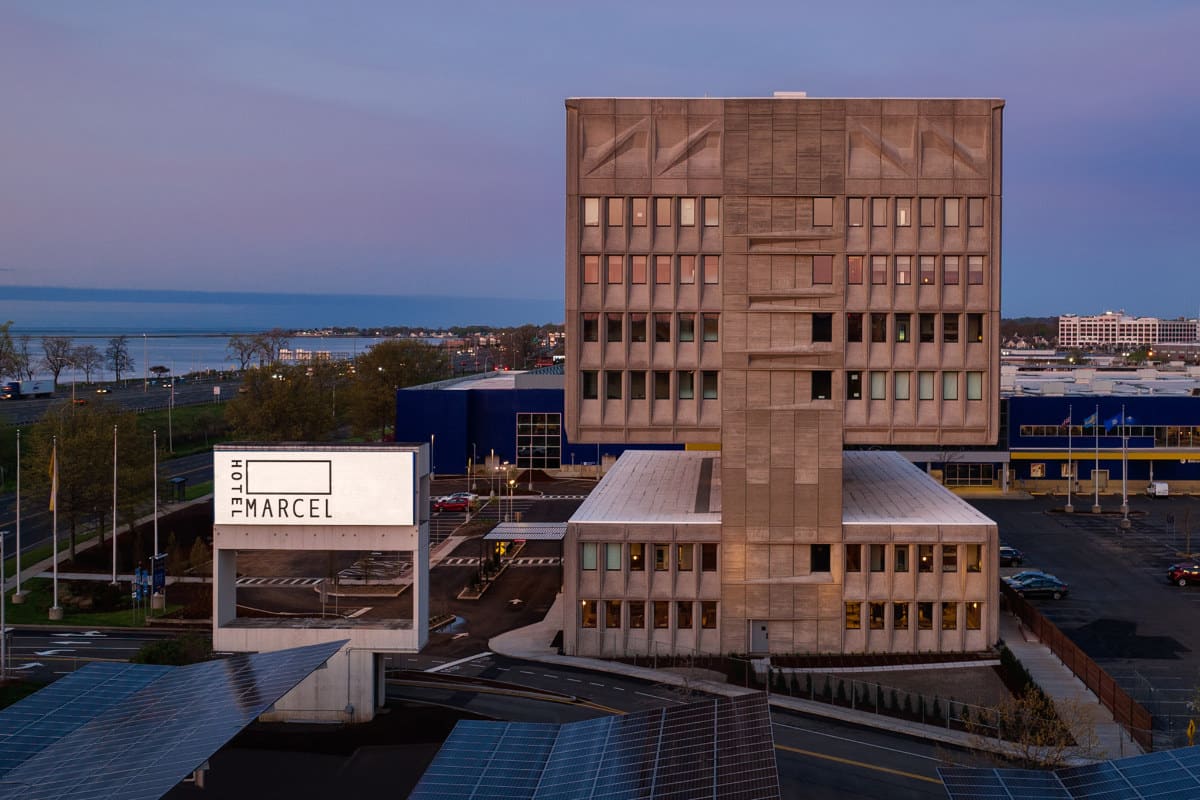
The Armstrong Rubber Company headquarters in New Haven, Connecticut, was never meant to welcome overnight guests. When Marcel Breuer designed the Brutalist structure in 1968, it was an executive office complex, all raw concrete and bold geometry. Today, it is Hotel Marcel, and the transformation tells a story about what adaptive reuse can accomplish when preservation meets serious environmental ambition.
The building is listed on both state and national historic registers. It reopened as a hotel in 2022 after a renovation that kept Breuer's monumental architecture intact while installing infrastructure rarely seen in hospitality. Hotel Marcel operates as the first all-electric, solar-powered, LEED Platinum-certified, zero-emission hotel in the United States. In 2023, it became the country's first hotel to earn Passive House certification, a rigorous European standard for energy efficiency.
More than 1,000 solar panels installed on site generate over 600,000 kilowatt-hours annually. Battery storage backs up the system. Heating, cooling, kitchen equipment, laundry, and lighting all run on electricity, eliminating fossil fuel use entirely. The power-over-Ethernet lighting system cuts consumption further. The engineering is ambitious, but the outcome for guests is straightforward: rooms stay quiet and comfortable despite the hotel's proximity to Interstate 95.
Design That Doesn't Shout
Triple-glazed windows stand five feet tall and block highway noise effectively. Insulation exceeds typical hotel standards. Temperatures remain stable without the constant hum of older HVAC systems. Dutch East Design handled the interiors, drawing on Bauhaus principles and midcentury modernism. Custom walnut beds are made in Connecticut. Breuer-designed Cesca chairs appear in rooms, a nod to the architect's legacy.
The 165 rooms and suites include Historic Suites that preserve original walnut, mahogany, and ebony panelling from executive offices. Open-plan suites add kitchenettes and separate living areas. An art collection throughout the property focuses on contemporary, local, and emerging artists, with a deliberate emphasis on women creators.
A Kitchen Without Gas
BLDG, the hotel's restaurant, extends the sustainability mandate into its menu. Executive chef Megan Gill runs a fully electric kitchen, sourcing ingredients from within 250 miles. Dishes are made in-house, food scraps are composted, and the beverage programme highlights regional breweries and distilleries alongside organic and biodynamic wines. Suppliers are chosen based on their avoidance of pesticides.
A coffee and espresso bar covers morning needs. The approach is practical rather than performative, the kind of operational choice that adds up across a property this size.
What This Model Requires
Passive House certification demands airtight construction, continuous insulation, and ventilation systems that recover heat. Achieving it in a retrofit of a nearly 60-year-old concrete structure required significant engineering. The solar array and battery storage system had to be sized to cover the hotel's full energy load. Electric vehicle charging infrastructure includes 12 universal chargers and 12 Tesla Superchargers. A partnership with Hyundai provides complimentary rides within five miles in electric IONIQ 5 and IONIQ 9 vehicles, including trips to Union Station and Tweed New Haven Airport.
The hotel also offers over 9,000 square feet of meeting and event space, a 24-hour fitness centre, and complimentary parking. The investment in green infrastructure was substantial, and the operational payoff depends on energy savings over time. But the model demonstrates that zero-emission hospitality is technically feasible, even in a listed historic building.
Location and Context
Hotel Marcel sits in New Haven's Long Wharf district, less than ten minutes from Yale University and downtown. The Yale University Art Gallery, Beinecke Rare Book & Manuscript Library, and Yale Peabody Museum are all nearby. Wooster Square, known for New Haven's pizza tradition, is a short drive. Long Wharf Park offers waterfront walking and cycling paths. Union Station is a mile away, making car-free travel from New York straightforward.
The building's Brutalist aesthetic won't appeal to everyone. Raw concrete and angular forms divide opinion. But as a case study in adaptive reuse and environmental performance, Hotel Marcel offers something uncommon: proof that a mid-century office block can be repurposed for a radically different function without compromising either its architectural integrity or its carbon footprint.
What It Signals
The hospitality industry has been slow to move beyond incremental sustainability measures. Reusable toiletries, linen reuse programmes, and composting bins are helpful but modest. Hotel Marcel represents a different scale of commitment. Operating without fossil fuels, generating electricity on site, and meeting Passive House standards in a historic retrofit sets a benchmark that few properties have matched.
The question is whether this model can scale. Solar arrays require space. Battery storage adds cost. Passive House retrofits are complex and expensive. Not every property has the physical footprint, the capital, or the regulatory approundings to replicate what Hotel Marcel has done. But the project shows that technical barriers are not insurmountable. The challenge is economic and organisational, not technological.
For travellers interested in how buildings can adapt to new demands, Hotel Marcel offers a tangible example. The Brutalist shell remains. The function inside has changed entirely. And the environmental performance suggests that preservation and decarbonisation are not competing goals.