A Crisis Washing Ashore
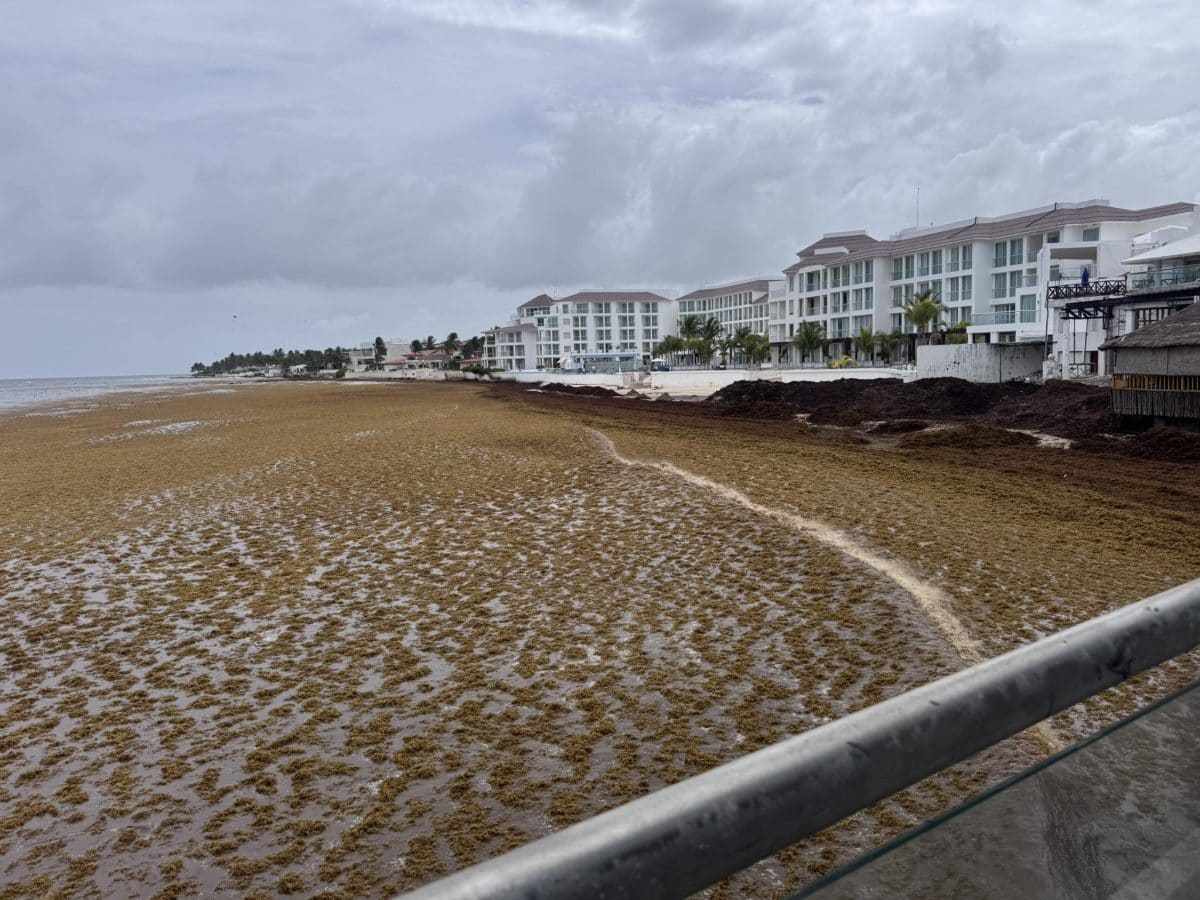
Visitors expecting turquoise water and white sand along Mexico's Caribbean coast are instead finding something else: thick mats of brown algae piling up faster than cleanup crews can haul them away. The phenomenon has reached a scale that forced the federal government to announce a $115 million emergency response, according to Mexico's Ministry of Environment and Natural Resources. The money will fund specialized collection boats, floating containment barriers positioned offshore, and expanded monitoring networks to track incoming seaweed plumes.
Sargassum, a type of free-floating brown macroalgae, has always drifted through Caribbean waters. But the quantities arriving now dwarf historical norms. What used to be seasonal patches have become year-round invasions, with some stretches of coastline receiving fresh deposits daily. When the algae decompose on shore, they release hydrogen sulfide, a gas with the smell of rotten eggs that drives tourists indoors and creates health complaints among beachfront workers.
The timing is particularly painful for Mexico's tourism sector, which depends on coastal destinations for a significant share of visitor spending. Hotels along the Riviera Maya and other affected zones have started reducing room rates to offset declining demand, though officials have not disclosed how steep those discounts have become or how occupancy numbers compare to previous years.
The Scale of the Government Response
The funding package represents one of the largest single commitments any Caribbean nation has made to address the sargassum problem. A portion will pay for vessels designed to scoop algae out of the water before it reaches the beach. Another allocation will go toward constructing and deploying offshore containment booms, fabric or net barriers meant to corral floating seaweed so collection boats can work more efficiently.
The program also includes money for expanded satellite monitoring and coastal observation stations. Real-time tracking of sargassum blooms in open water can give resort managers and municipal crews advance warning, allowing them to position equipment and staff before the heaviest deposits arrive. Mexico's environment ministry indicated that coordination with neighboring countries will be part of the monitoring effort, since algae drift across national boundaries without regard to maritime borders.
Yet the initiative focuses almost entirely on collection and disposal rather than prevention. The vessels, barriers, and tracking systems are reactive tools, addressing seaweed that has already formed and started moving toward shore. They do nothing to reduce the nutrient pollution and warming ocean temperatures that scientists believe are fueling the exponential growth of sargassum in the first place.
What the Industry Wants Instead
Tourism operators and environmental groups have been vocal about the need for a different approach. While they welcome the immediate relief that cleanup equipment can provide, they argue that the root causes demand more attention. Excess nutrients flowing into the ocean from agricultural runoff, untreated sewage, and industrial discharge act as fertilizer for algae. Warmer sea-surface temperatures, driven by climate change, accelerate growth rates and extend the geographic range where sargassum thrives.
Some hoteliers have called for investment in wastewater treatment infrastructure along the coast, better regulation of agricultural practices in watersheds that drain into the Caribbean, and regional cooperation on nutrient management. Others point to pilot projects elsewhere in the Caribbean that have explored harvesting sargassum for use in compost, animal feed, bioplastics, or biofuel. Turning the algae into a resource rather than purely a waste product could create economic incentives for collection while reducing the volume that ends up rotting on beaches.
The challenge is that environmental solutions take years to show results, while the tourism industry needs relief now. A new sewage treatment plant or a shift in farming practices upstream will not clear the seaweed already floating toward shore this week. That tension between immediate crisis response and long-term prevention has shaped the government's decision to prioritize vessels and barriers.
Regional Context and the Bigger Picture
Mexico is not alone in facing this problem. Sargassum blooms have affected nearly every island and mainland coast in the Caribbean over the past decade. Barbados declared a national emergency in 2018 after algae inundated its beaches. The Dominican Republic, Jamaica, and several smaller island nations have all reported similar surges. Scientists tracking the phenomenon have identified a massive belt of sargassum in the central Atlantic, stretching thousands of kilometers and releasing pulses of algae that currents carry westward into the Caribbean Sea and Gulf of Mexico.
The scale of the bloom belt has grown so large that researchers can now monitor it from space using satellite imagery. Data from recent years show that the total mass of floating sargassum in the Atlantic has increased more than tenfold compared to levels recorded in the early 2000s. The reasons for that explosion remain an active area of study, but leading hypotheses center on nutrient inputs from major river systems in South America and West Africa, combined with changing ocean circulation patterns that concentrate algae in a stable zone where it can reproduce continuously.
For travelers, the unpredictability is as frustrating as the seaweed itself. Conditions can vary dramatically from one beach to the next and from one week to another. A resort might be entirely clear one day and buried under algae the next, depending on wind and current. That variability makes it difficult for visitors to plan trips with confidence, and it complicates marketing efforts for destinations that cannot guarantee clean beaches.
What Comes Next
The $115 million program is expected to roll out over the coming months, with vessel procurement and barrier deployment prioritized for the highest-impact zones. Whether the investment will be enough to restore Mexico's reputation as a reliable beach destination remains an open question. If the offshore collection and containment systems work as intended, they could keep the worst of the algae away from the sand. If they prove less effective, or if the volume of incoming sargassum overwhelms the new equipment, the government may face pressure to expand the program or shift strategy.
In the meantime, hotels are adjusting. Some have hired additional staff to rake and haul seaweed manually. Others have installed temporary fencing in the water to create small protected swimming areas. A few have pivoted marketing messages to emphasize pools, spas, and inland excursions rather than beach access. None of these workarounds are ideal, but they reflect the reality that the sargassum problem is not going away on its own.
The broader lesson is that coastal tourism in the Caribbean now operates in a changed environment. The algae blooms are not a temporary anomaly but a recurring feature that destinations will need to manage indefinitely. How well Mexico and its neighbors adapt, both through immediate cleanup and longer-term environmental reform, will shape the future of the region's tourism economy. For now, the government is betting that boats and barriers can buy enough time to keep visitors coming while more permanent solutions are debated and developed.