Full-Height Dividers at a Button Press
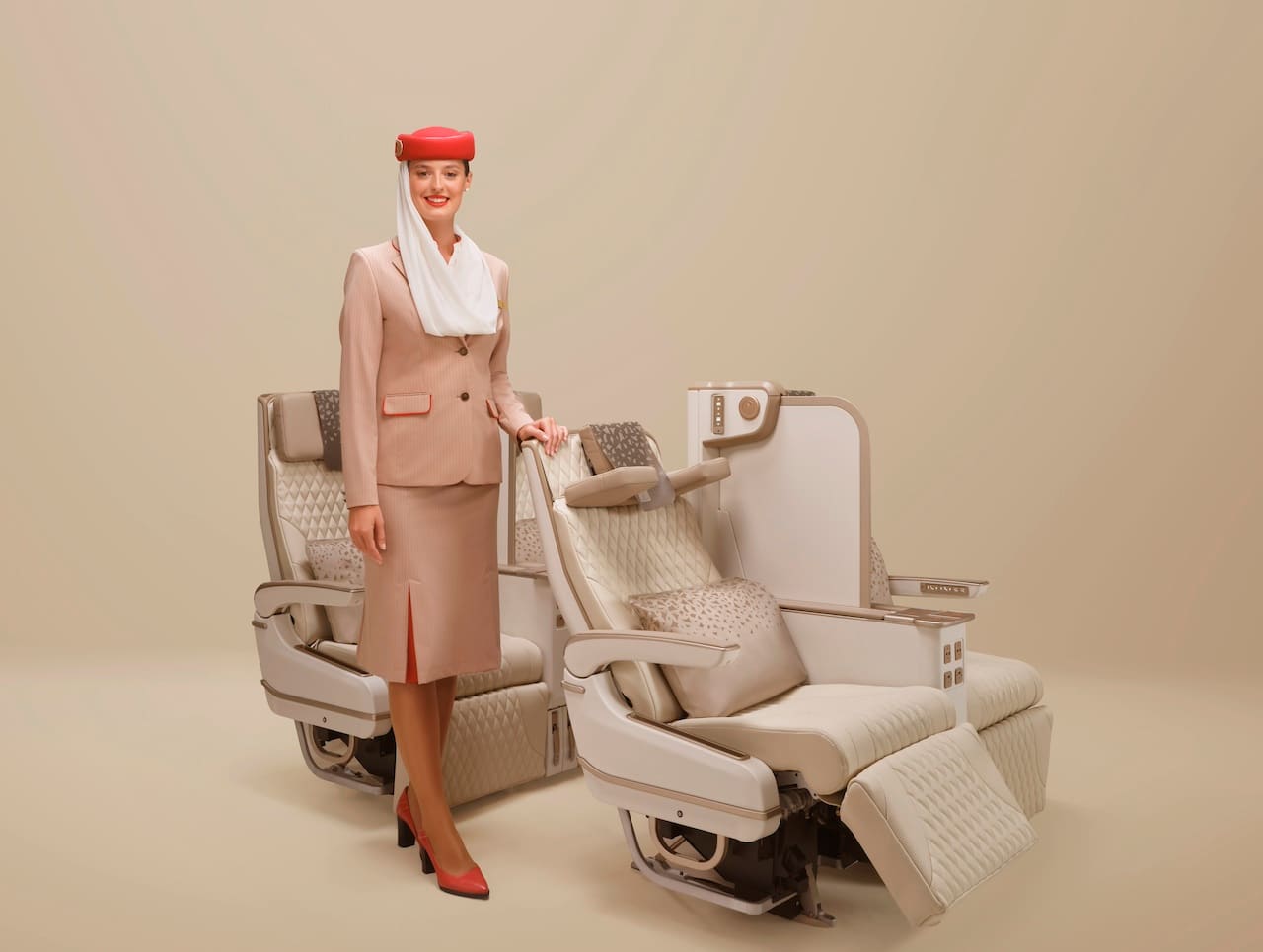
Emirates unveiled a new Premium Economy seat at the Arabian Travel Market trade show on 14 September 2026, built around an electrically powered privacy divider that passengers control from armrest buttons. The full-height screen runs the length of the seat back, letting travellers in the 2-3-2 cabin wall off their berth without asking a neighbour to shift or standing up.
The feature debuts on the carrier's Airbus A350 fleet, which Emirates is taking delivery of through the end of this year. According to the airline, 28 Premium Economy seats will occupy each A350, each measuring 50.8 centimetres wide with up to 99 centimetres of pitch. The seats recline in a cradle motion, meaning the shell tilts backward without encroaching on the row behind.
Beyond the divider, the seat package includes wireless charging, USB-C ports, a 13.3-inch 4K HDR screen, and preset lounge and meal positions accessible through a passenger control unit. Emirates' U-Dream leather headrest, which the airline introduced in Economy earlier this year, also appears in the Premium Economy configuration.
Context Behind the Cabin Refresh
The timing aligns with a broader cabin upgrade cycle at Emirates. In July 2026 the airline began rolling out multi-way adjustable headrests across Economy Class, a project it expects to complete by year-end. The Premium Economy divider continues that trajectory, targeting passengers willing to pay a step above Economy but not ready for lie-flat Business suites.
Privacy has become a design priority in Premium Economy as more carriers expand the cabin. Travellers in the class often sit in centre blocks of three seats, where a middle berth shares armrests and sightlines with strangers for ten or twelve hours. A powered divider removes some of that friction, though it remains to be seen whether other airlines adopt electric screens or stick with fixed partitions.
Emirates frames the investment as a response to strong summer traffic. The carrier said it flew more than 8.6 million passengers between July and August 2026, with arrivals into Dubai in the second half of August up seven per cent over the same stretch in 2025. As of 14 September, Premium Economy is installed on 137 aircraft in the Emirates fleet, and the airline has taken delivery of 18 aircraft since January, with six more A350s due before December.
Fleet Expansion and Network Additions
Emirates is adding frequency and destinations heading into the Northern Hemisphere winter. Helsinki joins the network on 1 October, and the airline plans to deploy its newest aircraft, including the A350s with the electric Premium Economy seats, on key long-haul routes. The carrier did not specify which markets will receive the updated cabin first beyond the A350 rollout.
At the Arabian Travel Market, Emirates signed seven memoranda of understanding with tourism boards spanning the Indian Ocean, Europe, Southeast Asia, and the United Arab Emirates, and renewed agreements with technology and retail partners. The announcements suggest the airline is locking in distribution and co-marketing deals to fill the new capacity.
Service and Amenities
The Premium Economy experience includes a welcome drink on boarding, amenity kits, and meals served on Royal Doulton china with a dedicated beverage menu. Those elements mirror what other Gulf carriers and European long-haul airlines offer in the same cabin, though Emirates emphasises the electric divider and cradle recline as differentiators.
Whether the privacy screen justifies a fare premium will depend on route and demand. On trunk routes where Premium Economy sells close to Business Class prices, the divider may feel incremental. On thinner markets where the gap is wider, it could sway passengers who value personal space but baulk at Business fares.
Emirates has not disclosed seat pricing or the fare differential between Economy and Premium Economy on A350 routes. The airline's existing Premium Economy fares vary widely by market, season, and booking window, so the new product will likely follow similar yield-management patterns.
What the Divider Means for Cabin Design
Electric privacy screens have appeared sporadically in Business and First Class, but their use in Premium Economy is new. The technology adds weight, wiring, and potential maintenance points, costs that airlines typically avoid in sub-Business cabins. Emirates' willingness to install powered dividers suggests the carrier sees a return in customer satisfaction or revenue, or both.
The cradle recline, meanwhile, addresses a common complaint in Premium Economy: seats that tilt backward and press into the knees of the passenger behind. By pivoting the seat pan and back together, the cradle keeps the upper structure within the original footprint. That design is standard in many long-haul Economy seats now, but less common in Premium Economy, where airlines often use simpler tilt mechanisms.
Emirates positions the A350 Premium Economy as the next generation of the cabin, implying further iterations may follow as the airline takes more widebody deliveries. For now, the electric divider and cradle seat set a benchmark that other carriers will either match or explain away.