A Colourful Landmark on a White Island
The soft peachy-pink façade stands out immediately on Nikolaou Nomikou, Oia's main pedestrianised street. Bougainvillea spills down the walls. In a village famous for its whitewashed buildings, the colour alone makes the building a landmark. But the entrance is tucked down a cobbled side street, and once you step through, the noise of the crowds fades fast.
The Museum Project has just 14 rooms and suites. You can book them individually, or take over the whole property as a group. At the centre is a courtyard built around what is thought to be one of the oldest olive trees in the village. The pool sits beneath it, surrounded by carefully chosen furniture and design pieces that reference the building's past. It is the sort of place where an afternoon disappears without effort: a pizza, a swim, the shifting light on the arched walls.
The team is small and the atmosphere is familial. TheoDora Papakatrana runs the hotel, and by the time guests leave, they are usually on first-name terms with her and the rest of the staff. The approach is warm but not stiff. There is a sense that the team wants visitors to experience local culture rather than simply photograph it.
From Captain's House to Naval Museum to Hotel
The building began as a traditional captain's house, owned by one of Santorini's wealthy maritime families whose history stretches back to the 18th century. Their captains sailed across the Mediterranean. After the 1956 earthquake destroyed much of the island, the family left. The house later became the Naval Museum of Santorini.
Restoration began in 1990, and the property reopened two years later under the ownership of the grandchildren of the original family. Today, the Greek Ministry of Culture classifies it as a modern monument.
The interiors have been updated recently, but the original architecture remains visible. Black and red stone, both local materials, form the foundations. The design avoids the predictable Cycladic minimalism that dominates much of Santorini. Instead, the spaces feel tactile and individual. Furniture, lighting and décor have been chosen to sit comfortably against the old stone walls.
Rooms That Feel Removed
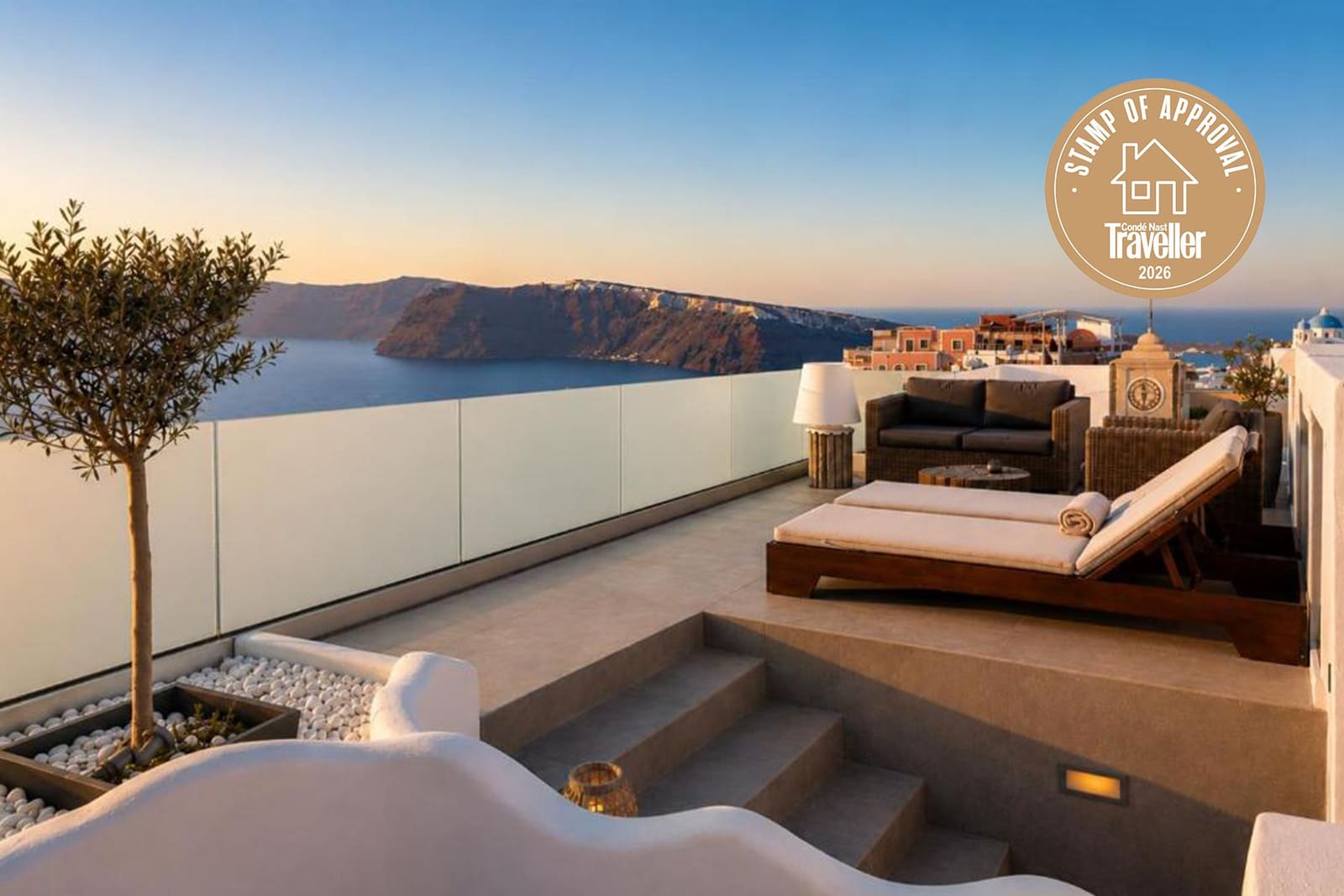
Not all rooms have sea views, but those that do not often come with private poolside terraces. Double sunbeds, shade, quiet. Breakfast arrives as an à la carte spread: Greek yoghurt, pastries, omelettes, pancakes, fresh fruit, coffee, smoothies. Not having to leave your room for breakfast has its appeal.
The sea-view suites offer 360-degree views of Santorini from their balconies. In October, a quieter month, these suites can be booked for around £160 per night. It is a way to watch the famous sunset without the usual crowds.
In the Middle, Yet Apart
What makes The Museum Project work is its relationship with Oia itself. The hotel sits in the centre of Santorini's most visited cliffside village, opposite one of the best lookout points across the caldera. Yet inside, it is wonderfully quiet.
Oia can feel like a race for the best selfie spot. Having somewhere tranquil to return to changes the experience. You can walk out of the door and be in the middle of the village immediately, exploring galleries, shops and restaurants. A few steps in the other direction brings you to an extraordinary view of the caldera. When the crowds become too much, you retreat.
One afternoon, after wandering around Oia, the courtyard felt like a different world. Outside, the village was packed with visitors. Inside, someone was settling into a sunbed with a glass of local wine. The pool was nearly empty. The only sound was the clink of glasses at the bar. It felt like a secret version of Oia, hiding in plain sight.
The Trade-Off
Oia is almost impossibly beautiful, but beauty comes at a cost. Crowds, especially in summer. The Museum Project offers a way to experience both sides: you can be in the middle of everything and still be away from it all. For some travellers, that balance is what luxury really means.
The hotel proves that central location and tranquillity do not have to be opposites. The building's history, its design, and the way the team runs it all contribute to that feeling. It is not about escaping Oia. It is about finding a quieter way to be there.