A Downtown Hub for Vertical Flight
Los Angeles is moving forward with a vertiport at LA Live, the entertainment district anchored by the Crypto.com Arena and the Convention Center. The facility, announced by Archer Aviation and AEG Entertainment, will serve as a launch and landing point for electric air taxis that take off and land vertically. It marks the city's first infrastructure of this kind, designed to bypass the region's notorious freeway congestion.
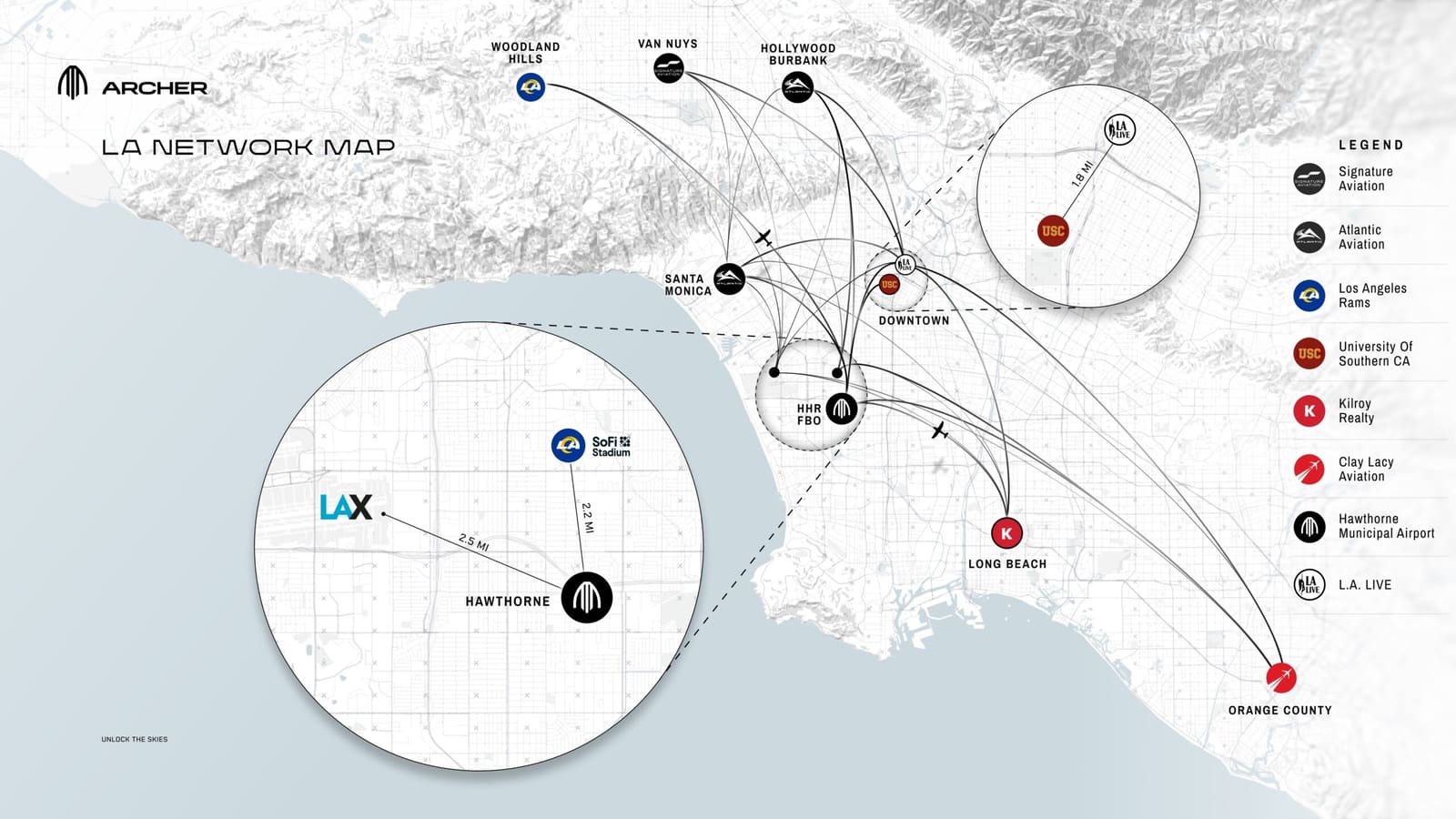
LA Live sits in the heart of downtown, surrounded by the Peacock Theatre, The Novo, and the GRAMMY Museum. Archer founder and CEO Adam Goldstein described the site as a flagship location. The plan calls for air taxi routes radiating from LA Live to Hollywood Burbank Airport, Los Angeles International Airport, SoFi Stadium, and the University of Southern California. Newport Harbor in Orange County is also on the list, positioning the service as both a commuter tool and a tourism link.
The timing aligns with the 2028 Olympic Games, for which Archer has been designated the official air taxi provider. SoFi Stadium, co-hosting the opening ceremony and featuring the largest Olympic swimming pool ever built, is a central venue. The company envisions passengers skipping hour-long drives in favor of flights measured in minutes.
The Aircraft and Its Approval Path
Archer is developing Midnight, a fully electric vertical-takeoff aircraft with seating for four passengers. The company unveiled a Team USA livery for the 2028 Games, featuring a black-and-white fuselage, blue tail, and red accents. The design is sleek and understated, a nod to Olympic branding without excess.
Midnight has a top speed of 241 kilometers per hour. That velocity translates to a 14-minute flight from Hollywood Burbank Airport to SoFi Stadium, a journey that takes roughly an hour by car. A trip to Newport Harbor, popular for dolphin and whale watching, drops from nearly an hour to 12 minutes.
Regulatory approval remains outstanding. Archer must complete the certification process for Midnight before the aircraft can carry passengers. The company is working through the necessary steps with federal aviation authorities, though no timeline for final approval has been made public.
Feasibility and Infrastructure Questions
The LA Live vertiport is not yet a certainty. Archer and AEG must conduct feasibility studies examining land use, airspace capacity, power infrastructure, and community impact. Electric vertical-takeoff aircraft require charging infrastructure and airspace coordination that differs from traditional helicopters or fixed-wing planes. The studies will determine whether the site can support the operational demands of a functioning vertiport.
Nick Baker, president and COO of AEG Global Partnerships, framed the project as a way to improve the experience for fans attending major sports and entertainment events. He emphasized the need for collaboration between infrastructure and technology, particularly in a district that hosts high-density crowds. AEG operates multiple venues at LA Live, and the vertiport would add a transportation layer to an area already designed for large-scale events.
Community impact is a variable. Noise from vertical-takeoff aircraft, though quieter than helicopters, will require assessment. Power demand for charging a fleet of electric air taxis adds another layer of infrastructure planning. The feasibility studies will address these concerns before construction begins.
A Network Beyond the Olympics
Archer's ambitions extend past the 2028 Games. The company is building a network that treats air taxis as a regular mode of transportation, not a novelty tied to a single event. Routes to airports, stadiums, universities, and coastal destinations suggest a service aimed at both business travelers and tourists.
The model depends on frequency and reliability. If flights operate like scheduled shuttles rather than on-demand charters, the vertiport could shift how people move through Los Angeles. The region's geography, sprawling and clogged with traffic, makes it a natural test case for urban air mobility.
Other cities are watching. Electric vertical-takeoff aircraft are in development globally, but few metropolitan areas have committed to vertiport infrastructure. Los Angeles, with its Olympic deadline and traffic challenges, offers a high-profile proving ground. Success here could accelerate adoption elsewhere; setbacks could slow the industry.
What Still Needs to Happen
The path from announcement to operation involves regulatory clearance, infrastructure construction, and public acceptance. Archer must finalize Midnight's certification, AEG must complete feasibility studies, and both partners must secure permits and funding. The 2028 timeline is tight, leaving little room for delays.
Public reaction will matter. Air taxis face skepticism about safety, noise, and cost. Archer has not disclosed ticket prices, but early urban air mobility services in other markets have skewed expensive. Whether the service becomes accessible to a broad audience or remains a premium option will shape its long-term viability.
Los Angeles is betting that electric flight can solve a problem its freeways cannot. The vertiport at LA Live is a first step, but the real test comes when passengers board Midnight and decide whether the experience is worth the fare.