A Flight-Tracker Model for Trains
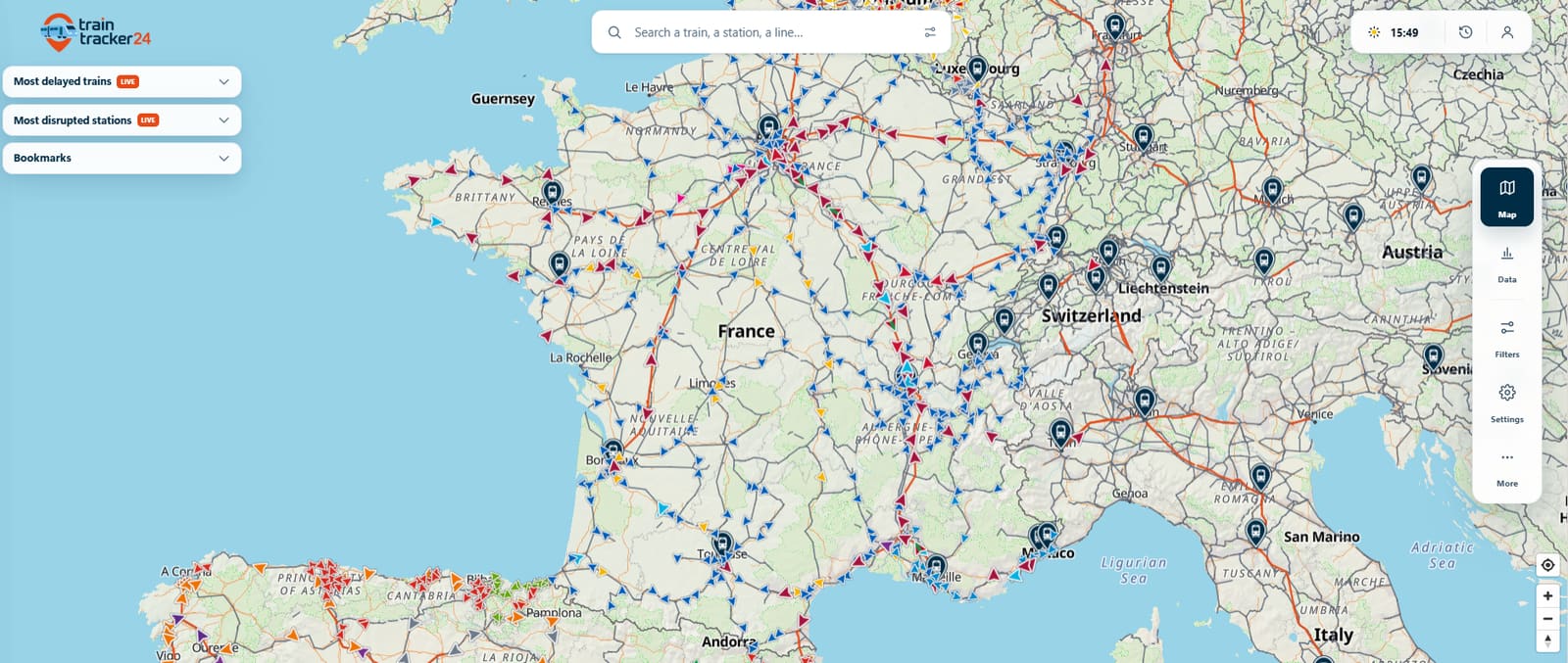
Standing on a cold platform with no idea when your train will actually arrive is a familiar frustration for rail travelers. A new tool launched in August aims to fix at least the information gap. TrainTracker24 works much like Flightradar24, displaying trains as small colored arrows moving across a map in real time, with updates every 20 seconds.
The platform currently covers France, Spain and Belgium, tracking trains operated by national rail companies as well as international services including Eurostar and Italy's Frecciarossa. Users can watch a train make its entire journey from departure to arrival, switch to satellite view to see the landscape it passes through, and click on individual trains to pull up detailed information.
Each train displays its number, scheduled stops, whether it's running on time, total distance and journey duration. The interface is straightforward: pick a train, follow its progress, check if it's delayed. For anyone who has ever refreshed a departure board obsessively, it's a simple but satisfying upgrade.
What's Onboard and What's Not
Beyond tracking location, the platform answers practical questions that matter when you're planning a trip or already on board. Does the train have air conditioning? Power sockets? Space for bicycles? Is it accessible for passengers with reduced mobility, and are there priority seats?
TrainTracker24 shows where different classes are located on the train and what type of locomotive and carriages are in use. A service tab breaks down these details clearly, so you know what to expect before you board. It also flags any disruptions or engineering works along the route, listing affected stops and the dates when work is scheduled.
Delays and cancellations appear in real time, alongside broader statistics on how many trains are currently active and overall punctuality rates. The information comes from open data provided by train operators, regional authorities and infrastructure managers.
Station Stats That Tell a Story
Stations are interactive on the map. Click on one and you get live departure and arrival boards, plus a detailed profile that includes passenger numbers and punctuality records. The data varies in granularity, but it offers a snapshot of how different hubs perform.
Brussels-Central, for example, has a punctuality rate of 93.8 percent and sees an average of 58,877 weekday boardings. Lille recorded more than 25 million passengers in 2024, but in June this year only 75.8 percent of its northbound long-distance TGV services arrived on time, compared with 90.3 percent for regional trains in the Hauts-de-France network.
Paris Gare du Nord, one of Europe's busiest stations, handled over 257 million passengers in 2024 and posted an 89.7 percent punctuality rate in July. Madrid's network has an overall punctuality rating of 3.2 out of 5, with nearly 87,500 passengers traveling daily.
These numbers matter because they show patterns. A station might be well-connected but plagued by delays on certain routes. Another might have fewer passengers but run more reliably. For regular travelers, that context helps shape decisions about which trains to take and when.
Who It's For
The core features are free. You can track trains, check station information, view punctuality data and explore the map without paying. Paid options add extras like a personalized journey map, live updates on disrupted services, the ability to sort trains by delay frequency, and more technical infrastructure details such as track types and expert analysis.
Rail enthusiasts will find plenty to dig into, but the tool is also practical for everyday travelers who just want to know if their train is on time and whether the station at the other end has bike rental or luggage lockers. The platform confirms those details, along with whether there's a taxi rank nearby.
Filters let you narrow the view by operator or highlight specific types of stations, including high-speed hubs, stations without active rail service, and operational stations that are closed to the public. It's a level of detail that turns a simple tracking tool into a broader resource for understanding how rail networks function.
Expanding Across Europe
TrainTracker24 plans to add more countries as interest in rail travel continues to grow across Europe, particularly for night trains and cross-border routes. The resurgence in sleeper services and long-distance rail has created demand for better information tools, and live tracking fills a gap that many passengers didn't realize they needed until it existed.
The platform won't improve station lighting or make delays disappear, but it does make waiting less uncertain. Knowing where your train is and why it's late doesn't solve the problem, but it shifts the experience from frustration to something closer to control. For travelers who prefer trains to planes, that's a meaningful shift.