Infrastructure Struggles to Keep Pace
European airspace carried more aircraft than ever this summer, yet the system's underlying fragility became increasingly visible. Between early June and the end of August, air navigation infrastructure processed an average of 35,959 flights daily, marking a 2.4 per cent rise from the previous year, according to the European Organisation for the Safety of Air Navigation.
The busiest single day arrived on 10 July, when 37,640 aircraft movements crossed the network. Sixty-six daily traffic peaks were recorded throughout the season, spanning airlines, airports, control centres and national systems. Yet behind these numbers lies a less comfortable reality: roughly 681,000 flights faced air traffic flow management delays over the three-month period, equivalent to about one in five departures.
Capacity Gaps Drive Most Delays
Staffing shortfalls and capacity constraints accounted for nearly half of all en-route delays, while severe thunderstorms contributed 43 per cent. Industrial action represented just one per cent. France alone was responsible for a third of delays linked to air traffic management difficulties, while Greece's control system struggled under the weight of record passenger volumes that tested its operational limits.
The average delay per flight stood at 3.27 minutes, down 17 per cent year on year, and arrival punctuality improved to 72.6 per cent. Yet the sheer volume of affected flights underscores the gap between network demand and what existing infrastructure can reliably handle. Around 7,400 flights were delayed each day on average.
Conflict Reshapes Traffic Patterns
Ongoing hostilities in the Middle East continued to reshape how aircraft move across the continent. Eurocontrol estimated earlier in the year that the conflict had cut flights between Europe and the region by 59 per cent, while approximately 1,150 daily services were rerouted to bypass closed airspace and active conflict zones.
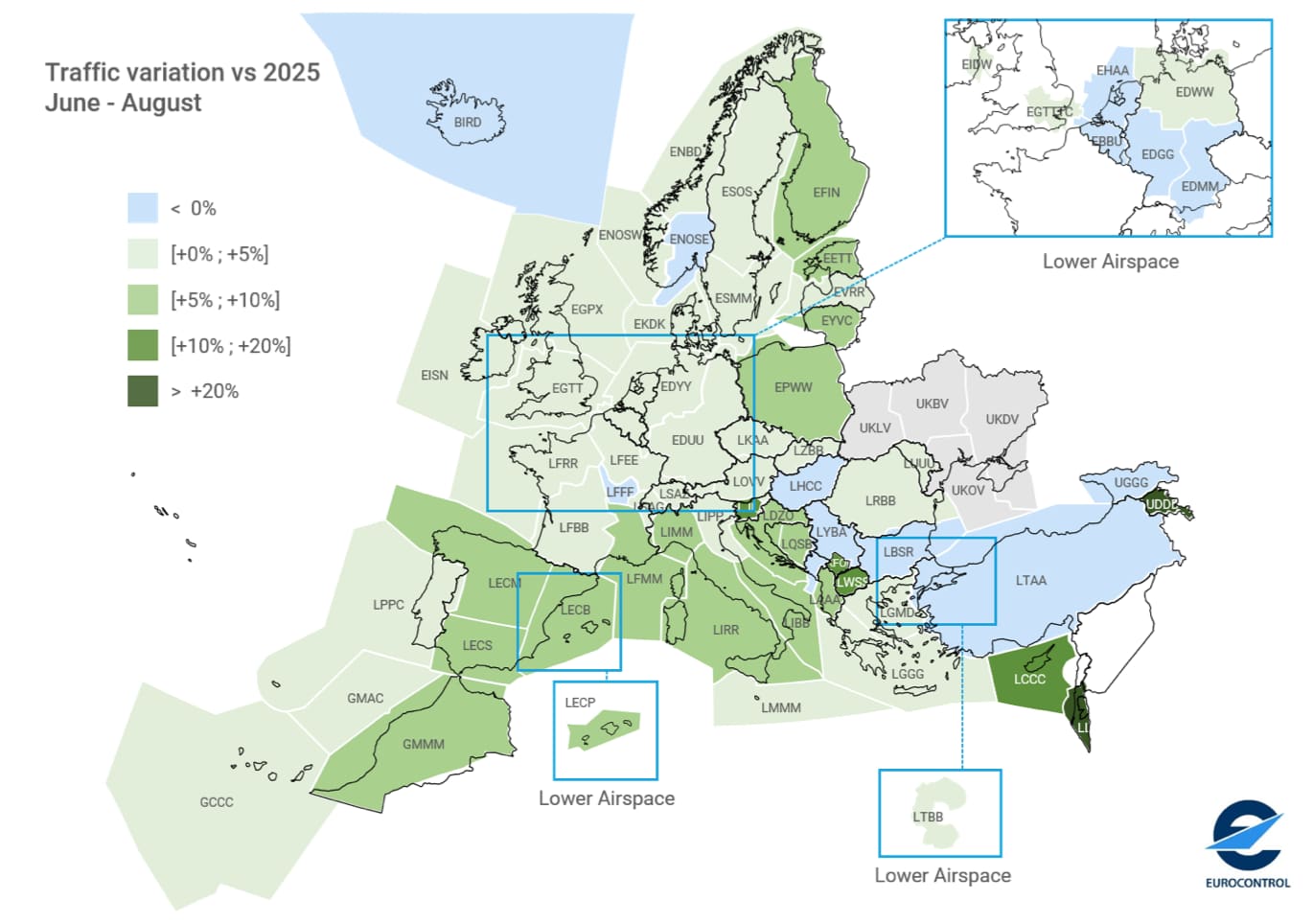
That reconfiguration redistributed traffic unevenly. Bulgaria, Hungary, Romania and Türkiye recorded lower flight counts, while Albania, Croatia, Cyprus, Greece, Montenegro, North Macedonia, Serbia and Slovenia saw strong growth. Southwestern Europe also registered sustained increases, as carriers adjusted routes and schedules to navigate geopolitical constraints.
Progress Remains Uneven Across the Network
Of the 68 area control centres operating across Europe, 45 are currently on track to meet the bloc's capacity targets by year-end, according to Eurocontrol. Another ten remain broadly on schedule but continue to face disruption from adverse weather and the fallout from Middle East tensions. Thirteen centres are expected to miss their targets entirely.
Fourteen countries recorded their highest-ever daily traffic levels for combined arrivals and departures this summer. Armenia, Georgia, Ireland, Italy, Moldova, Portugal, Slovakia, Spain and Türkiye were among those setting new benchmarks. Carriers including Aegean, Air Serbia, easyJet, Jet2.com, Pegasus, Royal Air Maroc, Ryanair, Sky Express, SunExpress, Turkish Airlines and Wizz Air also logged record traffic volumes.
What Comes Next
Eurocontrol is now reviewing the summer's operational data to prepare for 2027, focusing on network planning, workforce levels, airspace modernisation and capacity expansion. The organisation faces a familiar challenge: demand continues to climb faster than the system's ability to absorb it without friction.
The record-breaking season offers a clear lesson. Growth alone is not success if a significant share of passengers and crew experience delays tied to preventable capacity shortfalls. Whether Europe's fragmented air traffic management system can consolidate resources and close infrastructure gaps before next summer remains an open question.