A Tower in the Fields
Drive through the flat agricultural land of An Nhon Bac in central Vietnam, and a single shape breaks the horizon. Phu Loc Champa Temple sits on a hilltop, fifteen metres of weathered brick rising above rice paddies and vegetable plots. The structure dates to the 12th century, built during the height of the Champa kingdom that controlled much of the coast between the 2nd and 15th centuries.
The tower's square base supports walls marked by vertical pilasters, false doorways, and the pointed arches that define Cham temple design. Early French researchers who surveyed the site called it Tour d'Or, the Golden Tower, after the amber light that washes over the brickwork at certain times of day. The name stuck in colonial records, though locals have their own.
What Sets It Apart
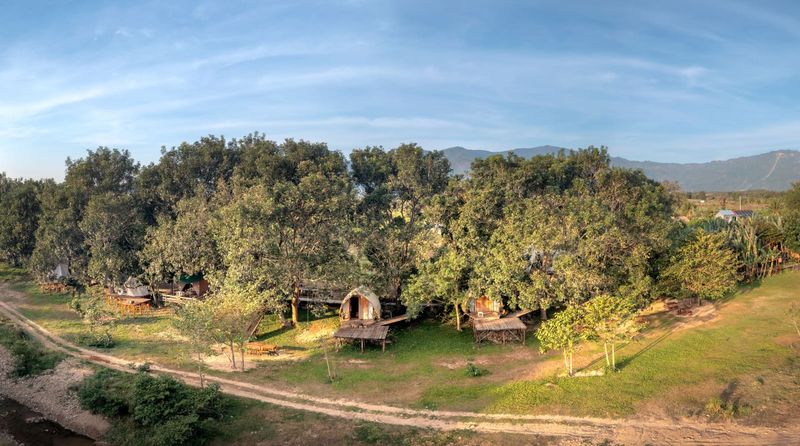
Most Cham ruins in Vietnam sit inside or near towns. Urbanisation has wrapped around sites like Po Nagar in Nha Trang or My Son near Hoi An, turning them into tourist stops with ticket booths and paved paths. Phu Loc escaped that. The temple still occupies its original hilltop, surrounded by working farmland. No gift shops, no crowds.
That isolation gives the site something harder to find elsewhere: context. Stand at the base and you see what the builders saw, a commanding view over the plains. The Cham built their temples on high ground for religious reasons, aligning structures with Hindu cosmology, but the strategic advantage is obvious. From this vantage point, you could watch trade routes, monitor rival territories, and assert control over the surrounding villages that supplied the kingdom's rice and labour.
The Cham Footprint
Champa was never a single unified state. It functioned as a loose collection of principalities, often at war with each other as much as with neighbouring powers like the Khmer Empire and the Vietnamese kingdoms to the north. The Cham were skilled sailors and traders, moving goods between China, India, and Southeast Asia. Their temples, scattered along the coast from Quang Binh to Binh Thuan provinces, mark where power and wealth concentrated.
Phu Loc's design reflects the mature period of Cham architecture, when Hindu influence from India had been absorbed and adapted. The false doors represent symbolic exits for deities. The pilasters and arches echo Indian temple forms but use local materials and construction techniques. Cham builders worked almost entirely in brick, binding blocks with a plant-based resin that has kept many structures standing for a millennium.
Visiting Practicalities
Getting to Phu Loc requires intent. The temple lies in Binh Dinh Province, roughly 30 kilometres north of Quy Nhon, the region's main city. There is no public transport to the site. Most visitors rent a motorbike or hire a car. The road up the hill is unpaved in sections, manageable in dry season but potentially tricky after rain.
There is no entrance fee and no formal opening hours. The site is unguarded, which means you are free to explore but also responsible for your own safety. The brick is fragile. Climbing on the structure or removing pieces, something that has happened enough to erode details, damages what remains.
The lack of infrastructure cuts both ways. You will not find water, toilets, or shade. Bring what you need. The upside is the experience itself. Early morning or late afternoon offers the best light and the coolest temperatures. On a weekday, you might have the place entirely to yourself.
What Remains, What's Gone
Time and weather have worn Phu Loc down. The tower's summit, once capped with decorative elements, is now a rough platform. Interior carvings, if they existed, have eroded or been looted. What survives is the core structure and the faint outlines of the decorative program that once covered the exterior.
Restoration work has been minimal. Vietnamese authorities have stabilised the base to prevent collapse, but there has been no attempt to reconstruct missing sections or recreate lost details. That restraint preserves authenticity, even as it means visitors see a ruin rather than a polished monument.
The trade-off is worth considering. Reconstructed sites can feel sanitised, their rough edges smoothed away. Phu Loc retains its rough edges. The cracks in the brick, the weeds growing from crevices, the uneven steps worn by centuries of feet, all of it tells a story about age and survival.
Why It Matters Now
Vietnam's tourism industry has grown rapidly, and with it, pressure on heritage sites. Popular destinations struggle with overcrowding, litter, and the physical wear that comes from millions of annual visitors. Phu Loc, by virtue of its remoteness, has avoided that pressure so far.
But remoteness is not protection. The temple sits on unguarded land, vulnerable to vandalism and theft. Development pressures in Binh Dinh Province are increasing as Quy Nhon grows. The farmland around the temple could, in theory, be sold and built on. Whether Phu Loc will remain isolated or become another stop on a heritage circuit depends on decisions local authorities have not yet made public.
For now, the temple offers something increasingly rare: a chance to encounter a piece of the past without mediation, interpretation, or crowds. That experience has value, both for travellers seeking it and for the broader question of how we preserve history without turning it into a commodity.