A Different Kind of Welcome
The first sign that this wouldn't be an ordinary evening came when a plastic jug of mezcal started circulating through the van. It was just past five in the afternoon, and a group of international visitors was heading north from Oaxaca City toward San Gabriel Etla, a village of about 500 people in the hills. November 1 marks Day of the Dead, and while the capital decorates its shop windows with sugar skulls and marigolds, the real celebration happens in places like this.
San Gabriel Etla sits in the municipality of San Juan Bautista Guelache, a Zapotec community where families still observe the holiday much as they have for generations. The premise is simple: on this one night, those who have died can cross back to visit the living. Families prepare ofrendas, small altars displaying photographs of deceased relatives, and gather for a meal that honors both the past and the present.
For outsiders, gaining access to this kind of celebration requires an invitation. A local tour operator arranges small-group visits, coordinating with families willing to host strangers at their table. The arrangement compensates hosts and gives travelers a chance to witness something that doesn't happen in city plazas or tourist zones.
Dinner with Strangers
By six in the evening, the van pulled up to a modest home where a family of eight was waiting. Inside, the table was set for more than twenty people, a mix of three generations and a dozen visitors who'd never met before that night. The meal centered on three dishes traditional to the holiday: pan de muerto, a sweet bread baked specifically for Day of the Dead; tamales wrapped in corn husks; and pozole, a hearty hominy stew.
Conversation moved between Spanish and English as family members explained the recipes and the significance of each element. The mezcal jug sat near the head of the table, refilled whenever it ran low. For visitors accustomed to keeping holidays private, the openness felt unusual. This wasn't a performance for tourists; it was a family gathering that happened to include strangers.
After the meal, the father gathered a small group around the jug for a final toast. Then everyone filed out onto the street and walked uphill toward the village church, where a basketball court had been transformed into a gathering space.
The Procession Begins
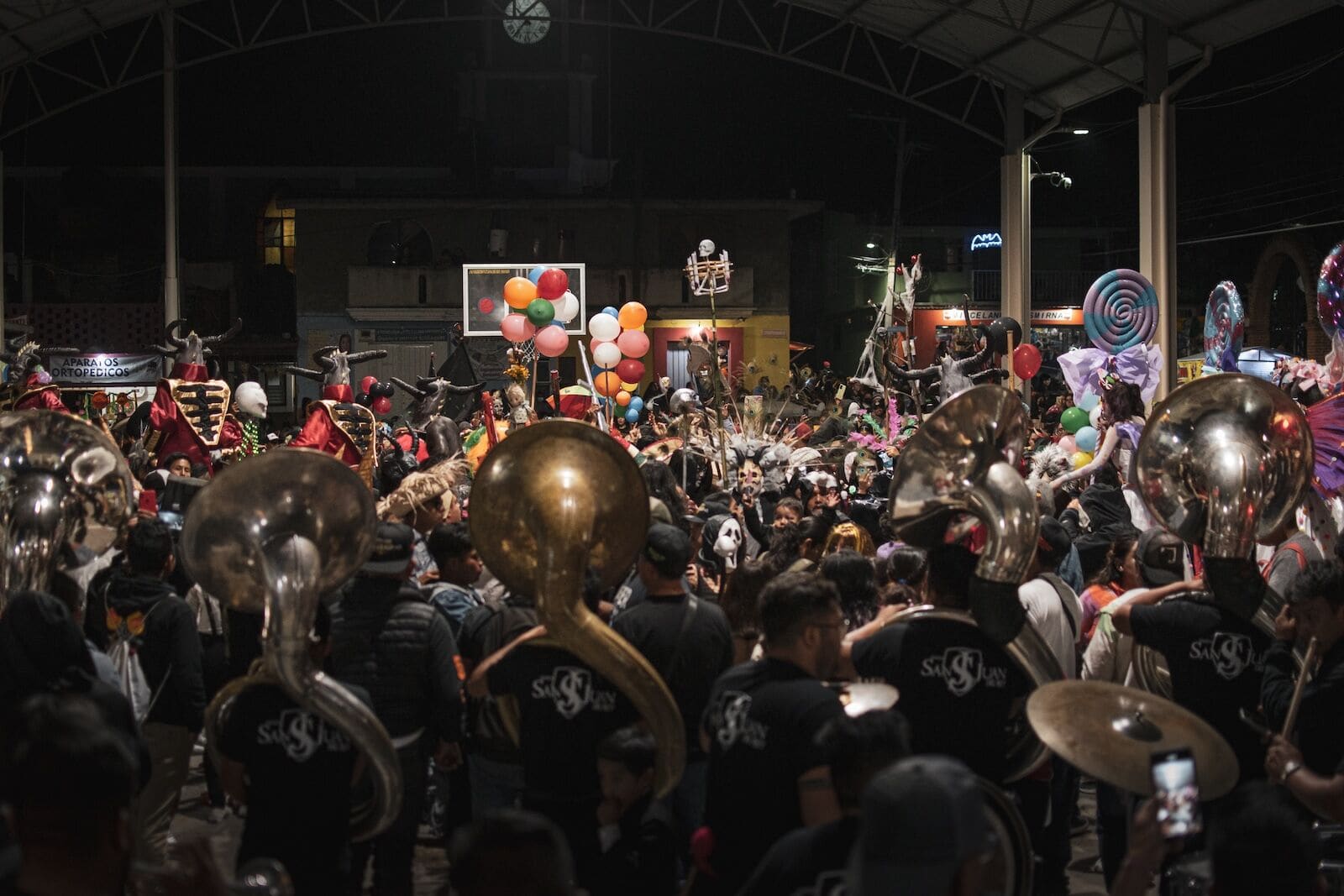
A brass band was already warming up when the group arrived. Around 250 people filled the court, most wearing masks or face paint. Performers on stilts moved through the crowd, their legs sliding between bodies with surprising agility. Each family seemed to carry its own mezcal jug, pouring drinks for friends and neighbors.
Then, without warning, the band launched into an upbeat tune and the entire crowd erupted. People jumped, bumped into each other, and danced in a way that felt more like controlled chaos than choreography. The stilt performers wove through the crowd, acting as informal dance leaders. The energy lasted about twenty minutes before the band stopped abruptly and everyone began filing out onto the street.
The procession moved a few hundred feet to someone's backyard. The band set up again, this time behind the crowd, and the stilt performers took their positions. Before the dancing resumed, a short theatrical performance played out, depicting the crossing between the world of the living and the dead. Then the music started again and the jumping resumed.
From House to House
The pattern repeated at least four more times over the next few hours. Each stop featured a performance, sometimes theatrical, sometimes musical, followed by ten or twenty minutes of intense dancing. At one house, a local theater troupe wove political gossip into their songs. At another, the performance focused on family stories and local history.
Time became difficult to track. Mezcal glasses stayed full, the music never stopped for long, and the crowd moved as a single organism from one backyard to the next. By the time the procession reached the end of the street, it was well past midnight.
The return trip turned into a full parade. Bands from neighboring villages joined in, elaborate costumes appeared, and food stalls along the roadside sold beer and mezcal to anyone running low. The procession wound its way back to the basketball court, where the party continued until sunrise.
What Visitors Should Know
For travelers interested in experiencing Day of the Dead outside Oaxaca City, a few practical considerations matter. Tour operators typically meet groups earlier in the day for a briefing and offer optional face painting in traditional styles. Some visitors worry about cultural appropriation, but local hosts generally welcome participation as long as it's respectful. There's no obligation to wear costumes or paint, though many people do.
Dress tends to be casual but festive. Shops throughout Oaxaca sell masks and traditional clothing in the weeks before the holiday. Comfortable shoes matter more than elaborate outfits, given the amount of walking and dancing involved.
The mezcal flows freely, and while no one is pressured to drink, it's a central part of the celebration. Visitors who don't drink alcohol can still participate fully; families also serve agua fresca and other non-alcoholic options.
Safety isn't typically a concern. Tour operators stay with their groups throughout the night, and the villages that host visitors are accustomed to the arrangement. The atmosphere is festive, not rowdy, and families with young children celebrate alongside everyone else.
Beyond the City Limits
Oaxaca City offers plenty of Day of the Dead activities, from elaborate altars in public spaces to parades and markets. But the holiday's roots are in smaller communities, where families still gather in homes rather than plazas and where the celebration feels less like a spectacle and more like a living tradition.
San Gabriel Etla is one of several villages near Oaxaca that welcome visitors during Day of the Dead. Each community has its own customs, but the basic structure remains similar: a family meal, processions through the streets, performances that blend theater and music, and dancing that lasts until dawn.
For travelers, the experience offers something difficult to find in more tourist-heavy destinations. It's a chance to observe a tradition that hasn't been packaged or simplified for outside consumption, and to be welcomed, however briefly, into a community's most important night of the year.