A Steady Climb in the Inland Empire
Ontario International Airport pulled in more than 3.4 million passengers between January and June 2026, a 1.9 percent rise from the same stretch last year. It is the highest half-year count the airport has posted since local authorities took back control a decade ago, a milestone that underscores the facility's growing appeal in one of the busiest aviation corridors in the United States.
The gain comes largely from international routes. Travelers flying to or from destinations outside the country jumped nearly 46 percent, topping 346,000 over the six-month span. That momentum reflects both new service and a shift in how people choose their departure point when LAX and other mega-hubs feel crowded or inconvenient.
Domestic traffic held relatively flat at just over three million passengers, edging slightly below 2025 levels but staying consistent month to month. June alone brought close to 660,000 travelers through the terminal, a figure that speaks to the airport's ability to maintain volume even as seasonal patterns shift.
Who Flies Where
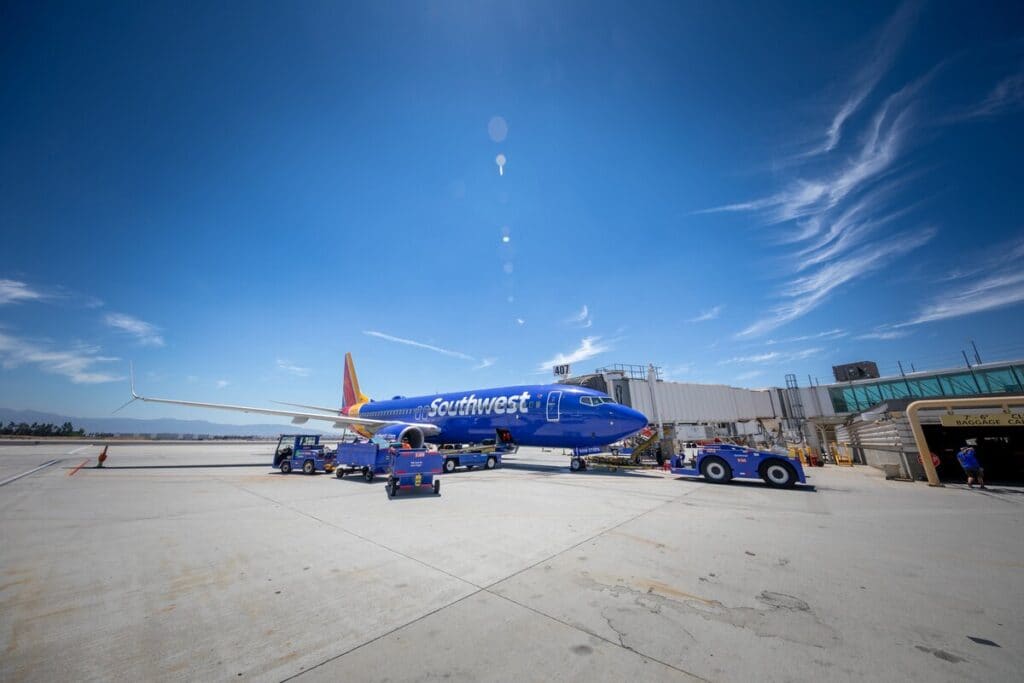
Southwest Airlines carried the largest share of passengers in June, claiming 36.5 percent of the total. American Airlines followed at 14.4 percent, with Alaska, Frontier, and Delta rounding out the top five. Together, these carriers offer nonstop connections to cities across the United States, plus service to Mexico, Central America, and Taiwan.
The route map is still narrower than what travelers find at nearby LAX, but the trade-off comes in speed and simplicity. Security lines move faster, parking is easier to navigate, and the overall footprint feels manageable. Those advantages have earned Ontario second place among mid-sized airports in a recent J.D. Power customer satisfaction survey, a ranking that airport leaders cite when pitching new service to airlines.
Alan D. Wapner, president of the Ontario International Airport Authority Board of Commissioners, pointed to partnerships with carriers and cargo operators as a key driver. The airport is jointly owned by the City of Ontario and San Bernardino County, a governance structure that gives local officials direct input on expansion and service decisions.
Freight Gains Ground
While passenger numbers capture headlines, cargo operations tell a parallel story of growth. The airport handled more than 428,000 tons of air freight in the first half of 2026, up 7.6 percent from the prior year. June alone saw over 71,000 tons move through the facility, an eight percent increase.
Freight tonnage specifically rose 11.2 percent year to date, a sign that shippers value Ontario's location at the edge of the Inland Empire. Warehouses and distribution centers cluster nearby, and highway connections to the Port of Los Angeles, the Port of Long Beach, and Interstate 15 make it straightforward to move goods by truck once they land. That logistics advantage has turned the airport into a regional hub for e-commerce fulfillment and perishable imports.
The cargo surge also reflects broader shifts in supply-chain strategy. Companies that once relied solely on ocean freight now blend air cargo into their networks to cut lead times, and Ontario benefits from that recalibration. Its runway can handle wide-body freighters, and the airport authority has invested in apron space and ground-handling infrastructure to support higher volumes.
Why Travelers Pick Ontario
More than seven million passengers pass through the airport each year, drawn by a value proposition that hinges on convenience rather than route density. The terminal layout is compact, rental-car counters sit steps from baggage claim, and the on-site parking garage rarely fills to capacity. For travelers living in Riverside, San Bernardino, or eastern Los Angeles County, the drive to Ontario can be thirty or forty minutes shorter than the trek to LAX.
That time savings matters for business travelers catching early flights and for families juggling car seats and luggage. The airport has leaned into that niche, marketing itself as a stress-free alternative and working with airlines to add frequencies on popular routes. Recent additions include seasonal service to vacation destinations in Mexico and year-round flights to secondary cities in the western United States.
Local ownership has also allowed faster decision-making. When the airport was controlled by Los Angeles World Airports, Ontario competed for attention and capital with LAX and Van Nuys. Since the transfer in 2016, the authority has been able to prioritize projects that directly benefit Ontario passengers and cargo customers, from terminal upgrades to incentive packages that attract new carriers.
What Comes Next
The first-half results set a baseline for the rest of 2026, and airport officials expect momentum to continue. International traffic remains the wild card. If airlines maintain or expand service to Asia and Latin America, the growth trajectory could steepen. If economic headwinds or fuel costs prompt route cuts, the gains may flatten.
Cargo performance looks more predictable. E-commerce demand shows no sign of slowing, and Ontario's infrastructure investments position it to capture a larger share of West Coast freight. The airport is also exploring partnerships with logistics firms to build cold-storage facilities for pharmaceutical and perishable shipments, a segment that commands higher fees and requires specialized handling.
For now, Ontario occupies a sweet spot in the Southern California market. It is big enough to attract major carriers and handle significant cargo volumes, yet small enough to offer the streamlined experience that travelers increasingly prize. Whether that balance can hold as the airport grows will depend on how well local leaders manage expansion without sacrificing the simplicity that made Ontario attractive in the first place.