A Strategic Pivot
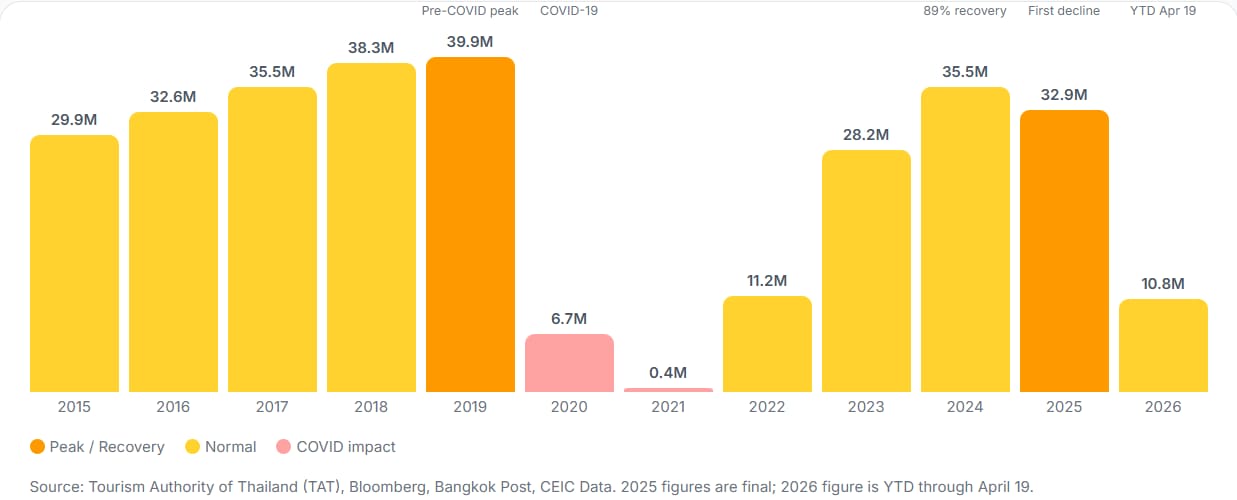
Thailand is setting its sights on 33 million foreign visitors by 2027, but the number itself tells only part of the story. The Tourism Authority of Thailand has outlined what it calls a "Value over Volume" approach, a signal that the country is recalibrating its tourism strategy after years of chasing arrival figures. The focus now is on attracting travelers who spend more, stay longer, and return often.
The shift reflects a broader reckoning in popular Asian destinations wrestling with overtourism and thin margins. Rather than simply opening the gates wider, Thai officials say they want to improve service quality, strengthen destination management, and lean into digital tools to enhance the visitor experience. The goal is to lift Thailand's reputation as a place worth paying for, not just passing through.
Natthriya Thaweevong, Permanent Secretary for Tourism and Sports, framed the strategy in economic terms. Success, she said, is not measured by visitor numbers alone but by the revenue generated and how those benefits reach communities and businesses across the country. Tourism, she added, should be a stable and sustainable engine for the economy.
Reaching Beyond the Usual Markets
Part of the plan involves courting travelers from places Thailand has not traditionally targeted. Officials have named Belarus, Brazil, and South Africa as new source markets they hope to tap. The move suggests an effort to diversify visitor origins and reduce reliance on a handful of major markets.
China remains the largest source of arrivals, sending 2.86 million visitors between January and mid-July 2026, according to the Ministry of Tourism and Sports. Malaysia followed with 2.25 million, then India with 1.31 million, Russia with 1.06 million, and South Korea with just over 630,000. But those figures also reveal vulnerability. When a single market dominates, any downturn there ripples through the entire sector.
Thai officials are also in discussions with Chinese airlines about adding more flights, a practical step toward making the country easier to reach from its biggest source market. Air connectivity often determines where people go, and Thailand is competing with neighbors like Vietnam and Indonesia for those seats.
Domestic Travel as a Parallel Priority
While international arrivals grab headlines, Thailand is also pushing hard on domestic tourism. The target is 203 million internal trips in 2027, a figure officials plan to reach partly through incentive programs developed with private sector partners. The idea is to get Thai residents traveling more frequently, spreading tourism revenue more evenly across the calendar and the map.
Domestic tourism has long been a stabilizer for countries with large populations and disposable income. It is less volatile than international travel, less affected by visa rules or exchange rates, and it keeps money circulating within the economy. For Thailand, a country of nearly 70 million people, that internal market is not a sideshow.
The Numbers So Far
Thailand welcomed just over 14 million foreign tourists in the first five months of 2026, maintaining a pattern of stability across recent years. The country recorded 14.76 million arrivals in the same period in 2024, 14.36 million in 2025, and 14.03 million in 2026. Officials have framed that consistency as a win in a volatile global tourism environment.
More recent data shows 17.36 million foreign visitors between January 1 and July 18, 2026, generating an estimated 838.73 billion baht in tourism revenue. That figure, however, represents a slight decline of more than three percent compared to the same period the previous year. The dip is modest but notable in a region where growth is often the baseline expectation.
Policy Experiments and Big Bets
Thailand has been trying out a range of tactics to sharpen its competitive edge. One notable change was the decision to permit afternoon alcohol sales for the first time since 1972. The move came after sustained lobbying from the hospitality industry and aligns Thai law with the rhythms of modern travel and dining. It is a small regulatory shift, but one that removes a friction point for visitors and businesses alike.
The country is also set to host Tomorrowland, one of the world's largest electronic music festivals, for the first time in December 2026. The Tourism Authority of Thailand has described the event as a milestone in positioning the country as a leader in global tourism and creative experiences. Whether the festival delivers on that promise will depend on execution, but it signals an appetite for experimentation and a willingness to court younger, culture-driven travelers.
The Balancing Act Ahead
The tension between volume and value is not unique to Thailand, but it is particularly acute there. The country has built much of its modern economy on tourism, and that dependence creates pressure to keep the numbers climbing. At the same time, overcrowding in popular spots like Bangkok, Phuket, and Chiang Mai has sparked complaints from residents and concerns about environmental degradation.
The "Value over Volume" strategy is an attempt to thread that needle. But it requires more than slogans. It means investing in infrastructure, training workers, enforcing standards, and sometimes saying no to development that might bring quick money but long-term harm. It also means convincing travelers that Thailand offers something worth paying more for, in a region where affordability has long been part of the pitch.
Whether 33 million arrivals in 2027 is the right target, or whether the focus on quality will actually reshape how tourism operates on the ground, remains to be seen. What is clear is that Thailand is trying to rewrite its tourism playbook at a time when the old one is showing its age.