A Landscape That Doesn't Fit the Safari Mould
Most people picture Botswana's safari circuit in shades of green and gold: the papyrus channels of the Okavango Delta, the woodland edges of Chobe. The Makgadikgadi salt pans, by contrast, arrive in white and ochre. Stretching across northeastern Botswana, these prehistoric lake beds are vast, flat, and mostly empty. During the dry season, the ground fractures into geometric patterns. When rains come, shallow water transforms the pans into temporary wetlands that draw flamingos and pelicans.
The landscape itself is the attraction. Visitors sleep under some of the clearest night skies in southern Africa, walk across ground that crunches underfoot, and watch horizons that seem to curve with the earth. It is a place that rewards patience rather than checklist spotting.
The Zebra Migration Few People Know About
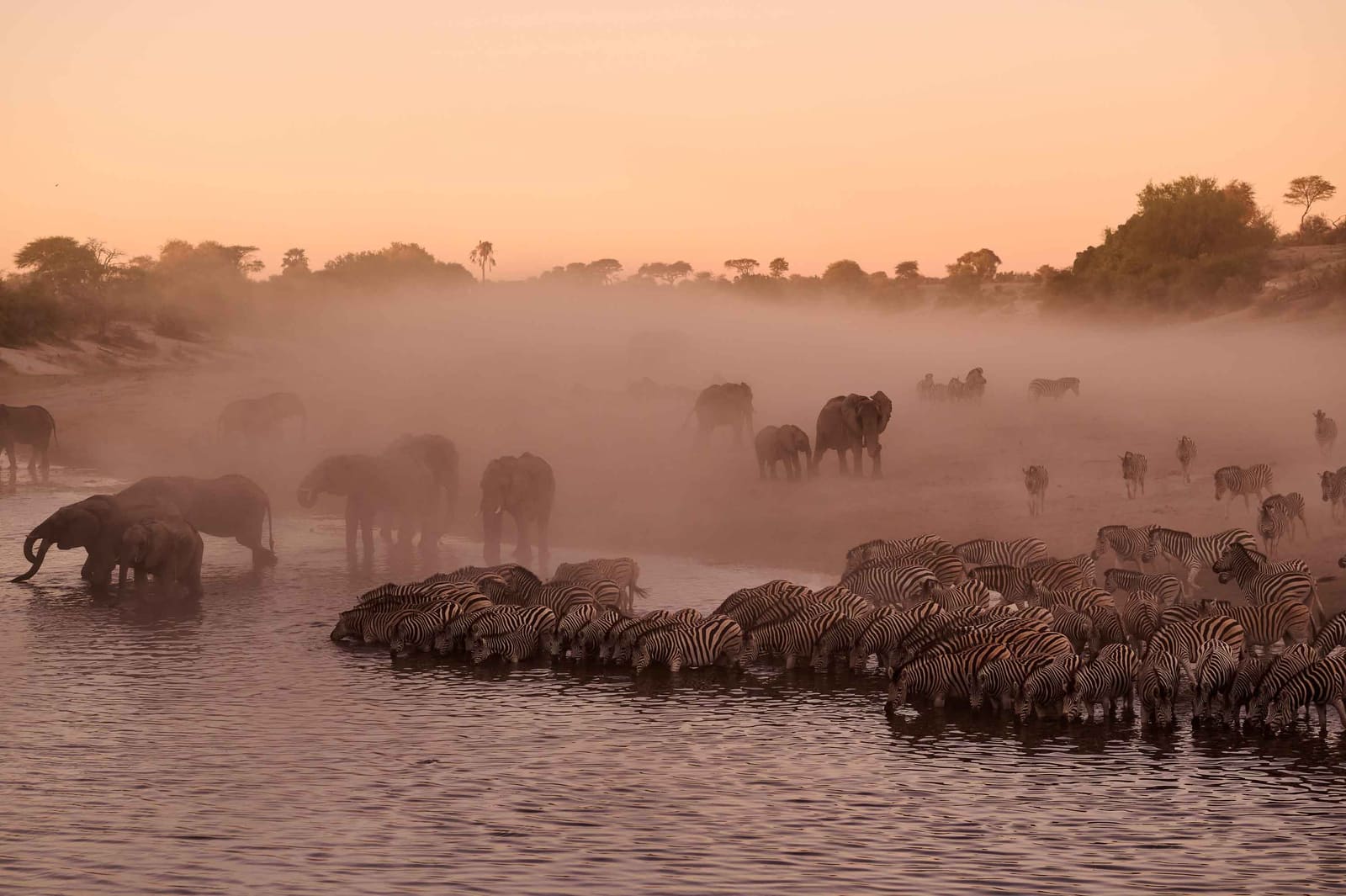
Between November and March, roughly 25,000 zebras move through the Makgadikgadi region in what is considered one of Africa's longest terrestrial wildlife migrations. The animals travel between the Okavango Delta and the Makgadikgadi and Nxai Pan National Parks, following seasonal rains and fresh grazing. The route stretches more than 250 kilometres.
Unlike the Serengeti's famous crossings, this migration unfolds with little fanfare. Zebras trickle across dried riverbeds and sparse grasslands, often accompanied by wildebeest and smaller numbers of other herbivores. Predators follow, but the spectacle is quieter, more dispersed. Sightings depend on timing, rain patterns, and a degree of luck.
The migration was only formally documented in recent years. Conservationists fitted zebras with GPS collars to track their movements, revealing a pattern that had likely persisted for centuries but remained largely unrecorded. The finding underscored how much remains unknown about wildlife behaviour in less-studied regions.
Camping on the Pans
Accommodation in the Makgadikgadi area ranges from mobile campsites on the salt flats to semi-permanent lodges near the park boundaries. Some operators offer guided walks onto the pans at dawn or dusk, when the light is softest and temperatures more forgiving. Others arrange overnight stays directly on the cracked surface, with bedrolls laid out under open sky.
The experience is minimalist. There are no trees, no shade, and often no other people within sight. At night, the absence of light pollution reveals the Milky Way in full arc. Guides point out constellations and explain the significance of certain stars in local Tswana culture. The silence is near-total, broken only by the occasional call of a distant jackal or the snap of cooling earth.
Water is scarce, and visitors must carry everything in. The environment is unforgiving during the day, with temperatures climbing above 35 degrees Celsius in summer. Most camps operate seasonally, closing when the pans flood or become inaccessible.
Beyond the Big Five
The Makgadikgadi ecosystem supports wildlife adapted to arid conditions. Brown hyenas patrol the edges of the pans. Bat-eared foxes hunt insects in the scrubland. Springbok and gemsbok graze on sparse vegetation. Birdlife spikes during the wet season, when water pools attract thousands of flamingos and other waterbirds.
The area does not compete with the Okavango or Chobe in terms of density or variety. Large predators are present but elusive. Elephants pass through occasionally, following ancient paths. The appeal lies elsewhere: in the starkness of the setting, the sense of exposure, the feeling of standing on ground that was once a lake the size of Switzerland.
Getting There and Practical Considerations
The Makgadikgadi pans sit roughly 200 kilometres southwest of the town of Kasane, near Botswana's border with Zimbabwe and Zambia. Most visitors arrive by road from Maun, the gateway to the Okavango Delta, a journey of about three hours. Self-drive is possible but challenging; the roads are rough, and navigation requires experience. Most travellers book through operators who arrange transport, permits, and guides.
The best time to visit depends on priorities. The dry season, from May to October, offers easier access and clearer skies. The wet season brings the zebra migration and birdlife but also heat, humidity, and the possibility of flooded roads. Park fees apply, and camping permits must be arranged in advance through Botswana's Department of Wildlife and National Parks.
Mobile networks are unreliable. Visitors should carry sufficient water, sun protection, and a satellite phone or emergency beacon. Medical facilities are hours away.
A Safari That Asks More of You
The Makgadikgadi experience demands a shift in expectations. There are no guaranteed sightings, no air-conditioned vehicles, no sundowner cocktails delivered to your tent. What it offers instead is space, silence, and a landscape that feels both ancient and indifferent.
For travellers weary of crowded game drives and scripted itineraries, the salt pans present an alternative. The zebra migration, when it happens, is a bonus rather than the centrepiece. The real draw is the chance to stand in the middle of a prehistoric lake bed, surrounded by nothing, and feel the scale of it.