Museums Built on Mystery
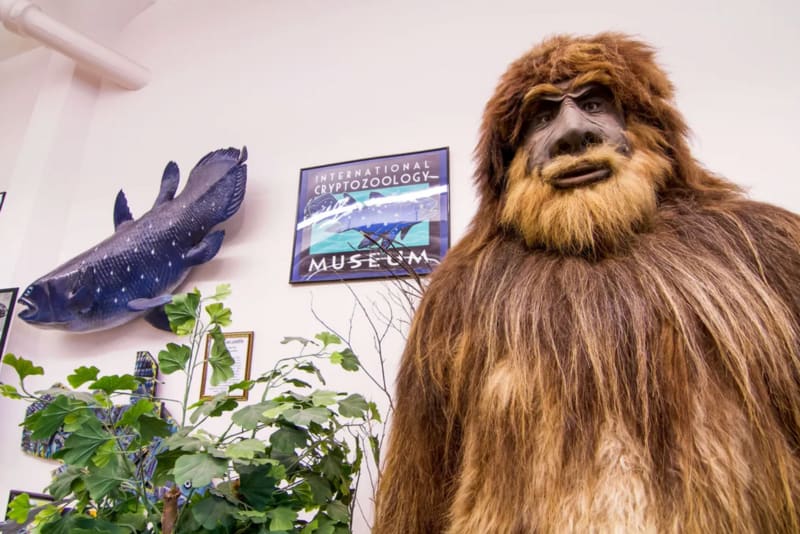
The International Cryptozoology Museum reopened in Bangor, Maine, this April after two decades in Portland. Its new home at 490 Broadway houses over 10,000 items related to creatures whose existence remains scientifically unproven. An eight-and-a-half-foot replica called the Crookston Bigfoot anchors the collection. Outside, an 800-pound wooden sentinel named Elwood greets visitors.
Loren Coleman, who founded the museum, began collecting cryptozoology materials in 1960. His collection spans continents and creature types, from Bigfoot casts to a life-size coelacanth, the fish once thought extinct that turned up alive in 1938. The coelacanth sits there as proof that cryptids occasionally graduate into confirmed species.
A second major museum opened in June. The North American Cryptid Museum in Plano, Texas, occupies space inside Dark Hour Haunted House at 701 Taylor Drive. Admission ranges from 16 to 47 US dollars depending on package. The museum recreates cryptids from all 50 states plus Canada, Mexico, and Puerto Rico through life-sized sets based on eyewitness descriptions. The owner describes the approach as celebrating pop cryptids rather than pursuing scientific validation.
What Makes a Cryptid
Belgian-French biologist Bernard Heuvelmans coined the term cryptid in 1983. He defined it as a creature that is truly singular, unexpected, paradoxical, striking, emotionally upsetting, and capable of mythification. That definition explains why Bigfoot qualifies but an undiscovered beetle does not. Cryptids must inspire awe.
Communities have turned that awe into infrastructure. Point Pleasant, West Virginia, built a museum, a 12-foot polished steel statue, and an annual festival around Mothman, the winged creature with glowing red eyes reported between November 1966 and December 1967. Sightings stopped after the Silver Bridge collapsed during rush hour on 15 December 1967, killing 46 people. Some residents believe the creature was warning them. Sceptics suggest it was an owl.
The Mothman Museum at 400 Main Street opens daily from 10am to 5pm, extending to 6pm on Fridays and Saturdays. Admission costs 4.50 dollars for visitors aged 11 and over, 1.50 dollars for younger children. Newspaper clippings, props from the 2002 film adaptation starring Richard Gere, and memorabilia fill the space. The museum also offers mini golf and an escape room.
The annual Mothman Festival takes place on 19 and 20 September 2026. Festival admission is free; museum entry remains separate.
Evidence and Enthusiasm
Not all cryptid destinations lean into spectacle. The North American Bigfoot Center in Boring, Oregon, takes an evidence-focused approach. Cliff Barackman, known for the television programme Finding Bigfoot, founded the centre at 31297 SE US-26. Staff members participate in active research. Exhibits include plaster casts of alleged footprints, anatomical reconstructions, infrared photographs, film footage, and audio recordings. A life-sized Sasquatch replica named Murphy serves as the photo backdrop.
Expedition Bigfoot in Cherry Log, Georgia, claims the largest collection of Bigfoot artefacts in any museum. Owners David and Malinda Bakara have assembled 4,000 square feet of newspaper documentation, sketches, and casts of handprints and footprints gathered by researchers worldwide. One unusual item stands out: a cast of a buttock print allegedly from a Yeti. Visitors receive free biscuits.
The West Virginia Bigfoot Museum in Sutton displays impressions and castings from around the world. Its café serves a sandwich called the Bigfoot Dog. In Bailey, Colorado, the Sasquatch Outpost maps state sightings and hosts an annual Bigfoot Adventure Weekend. Keystone, South Dakota, is home to a Guinness-certified chainsaw-carved Bigfoot statue, the largest in the world.
Regional Legends
Dave Shealy has spent his life studying the Skunk Ape, Florida's answer to Bigfoot. His Skunk Ape Research Headquarters sits at 40904 Tamiami Trail East in Ochopee, deep in the Everglades. USA Today readers voted it the number one roadside attraction in Florida and number two in the United States in 2024.
The Skunk Ape earns its name from an odour witnesses describe as rotting rubbish, methane, or skunk. Males reportedly stand six to seven feet tall and weigh around 450 pounds. Both sexes are covered in long reddish or black hair. Shealy saw his first Skunk Ape at age 10 in 1974. His research headquarters functions as museum, gift shop, petting zoo, and campground. His field guide suggests baiting the creature with lima beans and deer liver.
In Sutton, West Virginia, the Flatwoods Monster Museum documents a 12 September 1952 encounter. Several Flatwoods residents saw a bright object land on a nearby farm. When a group investigated, they encountered a tall figure with a round red face surrounded by a spade-shaped hood. The creature hissed. The museum operates Monday to Friday from 9am to 5pm and weekends from 10am to 4pm inside the Braxton County Visitors Centre. Admission is free.
Why People Visit
These destinations attract hundreds of thousands of visitors annually. Some come as believers. Others come as sceptics. Many simply appreciate the mystery. The museums offer more than kitsch. They document how communities weave the unknown into local identity, how folklore becomes infrastructure, and how unproven creatures generate real economic activity.
The TNT Area six miles north of Point Pleasant on Route 62 is where the first Mothman sightings occurred. Rows of World War II-era igloo-shaped bunkers still stand. Some visitors claim to see the image of Mothman in cracks in the bunker walls. The site became a Superfund location in 1983 and remains under environmental cleanup. Visitors should exercise caution.
Cryptozoology museums occupy a space between science and storytelling. They preserve eyewitness accounts, catalogue alleged physical evidence, and acknowledge that belief does not require proof. A life-sized coelacanth replica reminds visitors that science occasionally catches up to folklore. Until then, the museums remain open.