Concerts as Travel Magnets
International flight searches to Paris for the period covering 11 September to 17 October rose 11 per cent compared with the same window last year, according to data from Amadeus. Actual bookings climbed five per cent. The window matches Céline Dion's 16-date residency at La Plenitude Arena in Nanterre, her first extended run since publicly disclosing her diagnosis of Stiff-Person Syndrome, a rare neurological disorder that affects muscle control and vocal cords.
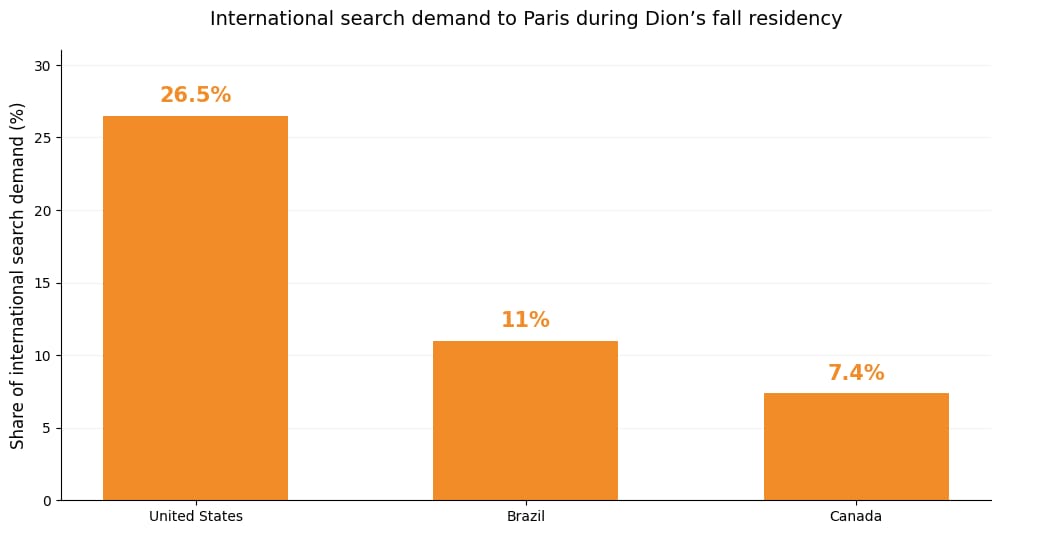
The strongest demand comes from the Americas. The United States accounts for 26.5 per cent of international searches and a similar share of bookings, while Brazil, Canada, and Mexico push the continent's total booking share close to 40 per cent, according to Amadeus figures compiled through mid-August.
Asia-Pacific markets show sharp percentage gains, though from smaller bases. Thailand leads with bookings up 200 per cent year-on-year, while Japan, Australia, South Korea, and India together represent 18.4 per cent of international bookings during the residency dates.
European travellers are searching but not yet booking in the same proportion. Italy, Spain, the United Kingdom, Poland, and Portugal together make up 26.5 per cent of international flight searches, with growth between 19 and 116 per cent across southern and eastern Europe. Yet their combined booking share sits at only five per cent. Amadeus suggests that proximity may explain the gap: European visitors have more rail and road options, which the booking platform does not track.
Domestic French demand tilts heavily south. Eight of the ten busiest domestic air-origin cities lie in the south of France and account for nearly 79 per cent of domestic bookings, with Toulouse leading at 30.3 per cent.
Longer Stays, Higher Revenue
Paris hotel bookings for stays of six to 13 nights rose six per cent compared with the prior year. Revenue per available room climbed 13 per cent. The figures suggest that travellers attending the concerts are treating them as anchors for longer trips rather than quick weekend visits.
The data cannot definitively isolate the concert as the sole driver. September and October fall into shoulder season, a period that has been gaining favour among travellers seeking lower prices and smaller crowds. Still, the timing of the surge aligns closely with Dion's performance schedule, and industry observers point to recent precedents.
Taylor Swift's 2023 Eras tour generated measurable spikes in hotel occupancy and local spending across dozens of cities. The 2025 Oasis reunion tour in the United Kingdom is estimated to have added between £940 million and £1 billion to the economy, filling hotels and straining transport networks in Manchester, London, and other venues.
Madrid Sees a Similar Pattern
Madrid recorded a five per cent rise in combined domestic and international flight bookings for 9 September to 4 October, a window that includes both the Spanish Grand Prix and dates from Shakira's Las Mujeres Ya No Lloran tour. Domestic bookings jumped 28 per cent, while international bookings edged up four per cent.
The international growth is led by Japan, Canada, Mexico, and the Netherlands, a mix that mirrors the global reach of both Formula 1 and Latin pop. The Spanish Grand Prix traditionally draws motorsport fans from across Europe and Asia, while Shakira's tour appeals to audiences in Latin America and among diaspora communities.
The modest international increase compared with the sharp domestic gain suggests that Spanish travellers are seizing the chance to visit Madrid for events they might otherwise skip, while international visitors may be folding the events into broader European itineraries.
Event-Driven Travel as a Planning Tool
The pattern emerging from Paris and Madrid reinforces a shift in how people choose destinations. Live performances, sporting fixtures, and cultural moments are no longer secondary considerations that happen to coincide with a trip. Instead, they are becoming primary reasons to book flights and hotels, particularly when the event is rare or tied to an artist with a devoted following.
This shift has practical implications for cities and tourism boards. Events that once served mainly to fill hotels during quiet periods now drive demand across multiple sectors, from restaurants to local transport. The economic benefit extends beyond the venue itself, as attendees often arrive early or stay late to explore.
For travellers, the calculus is changing as well. A concert or race can justify the expense of a long-haul flight, especially when combined with a few extra days in a city they might not have prioritised otherwise. The data from Amadeus suggest that this behaviour is spreading across income levels and regions, not confined to a narrow slice of high-spending fans.
Whether the effect persists through the remainder of the year will depend on the calendar. Paris and Madrid have benefited from a convergence of marquee names and favourable timing. Other cities with major events scheduled for autumn may see similar bumps, or the pattern may prove specific to a handful of global stars and fixtures. Either way, the link between live entertainment and travel demand is now visible in the booking data, not just anecdotal reports.