A Shift in What Drives Travel
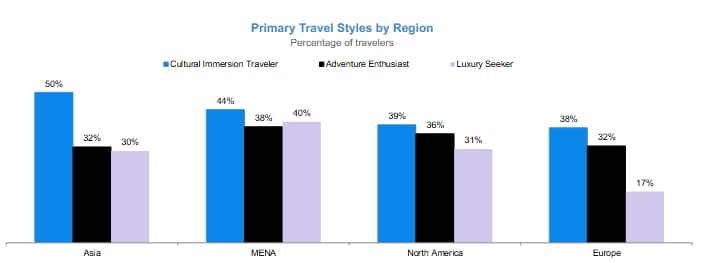
The appeal of cultural immersion has moved ahead of luxury and adventure as the primary motivation for travelers, according to data from Skift Research's State of Travel 2026 report. The trend appears consistent across continents, suggesting a broader realignment in how people think about their trips.
In Asia, half of all travelers now cite cultural immersion as their main priority, compared to 32 percent who identify as adventure seekers and 30 percent drawn primarily by luxury. The pattern holds elsewhere: 42 percent of travelers in the Middle East and North Africa prioritize cultural experiences, along with 39 percent in North America and 36 percent in Europe.
The numbers point to a growing interest in connection and context over status or adrenaline. While premium travel remains strong in absolute terms, the relative shift suggests that many travelers are asking different questions about what makes a trip worthwhile.
Where the Money Goes
When it comes to actual spending, food and gastronomic experiences lead by a wide margin. Seventy-one percent of respondents said dining was the category most likely to appear in their travel budgets, well ahead of adventure and nature experiences at 48 percent. Arts, culture, and history ranked third at 42 percent.
Health and wellness tied with live events and entertainment at 36 percent, while sports lagged at 24 percent. The spending priorities reflect a blending of categories: travelers are willing to pay for culture, but they are also paying for the sensory and social dimensions that come with it, particularly around food.
The emphasis on dining extends beyond Michelin stars or celebrity chefs. Street food, home-cooked meals, and regional specialties all feature prominently in how travelers understand and engage with a place. Food has become shorthand for authenticity, even if the pursuit of that authenticity can sometimes feel circular.
The Search for the Real Thing
Authenticity has emerged as a central concern, with 43 percent of respondents saying experiences are what they value most about travel. The term itself is slippery, often standing in for a sense of place that feels unmediated or uncontrived. Whether that is actually achievable, especially in destinations shaped by decades of tourism, is another question.
At the same time, travelers are leaning more heavily on AI and digital tools to plan their trips. The apparent contradiction, seeking the genuine while relying on algorithms, reflects the way technology has become embedded in the travel process. Personalization is expected, even if it comes from a machine.
Jean-Jacques Morin, group deputy CEO at Accor, noted that traveler behavior is shifting toward AI-driven personalization alongside a growing interest in sustainable choices. The two trends are not necessarily in tension, but they do require different kinds of infrastructure and messaging from the industry.
Social Media as Discovery Engine
Sixty-three percent of travelers now use social media as a source of travel inspiration, and 56 percent turn to it for ideas about activities, dining, and experiences. Forty-five percent use platforms to compare accommodation options, a role traditionally held by review sites and travel agencies.
The speed at which social media can elevate a destination is both an opportunity and a problem. A location can go from obscure to overrun in a matter of weeks, and the perception of overtourism, whether accurate or exaggerated, can follow quickly. Once a place is labeled crowded or spoiled, it becomes harder to attract the very travelers who might have appreciated it in its quieter phase.
The cycle is self-reinforcing. Platforms surface content based on engagement, which tends to favor novelty and visual impact. The result is a constant churn of new destinations, each promoted as the next undiscovered gem until it is no longer undiscovered. For travelers seeking authenticity, the dynamic creates a perpetual sense of being just a step behind.
Implications for Destinations
As destinations shift their focus from visitor volume to spending per visitor, understanding what travelers are willing to pay for becomes more important. The data suggests that cultural programming, culinary infrastructure, and experiences that feel rooted in place are likely to command higher budgets than generic attractions or purely luxury amenities.
That does not mean luxury is irrelevant. High-end accommodations and services still have a market, but they are increasingly expected to offer something beyond comfort. Travelers want context, narrative, and connection, even when they are paying premium rates.
The challenge for destinations is managing the tension between accessibility and exclusivity, between promoting a place and protecting it from the consequences of that promotion. Social media has accelerated the timeline, but the underlying dynamics, balancing growth with sustainability, are not new. What has changed is the speed at which a destination can tip from desirable to undesirable in the public imagination.
Cultural immersion may be the leading priority now, but priorities shift. The question is whether the infrastructure and approach that destinations build around this trend can adapt when the next wave of traveler expectations arrives.