A Region Built on More Than Bubbles
Prosecco has a branding problem. Mention the name and most people think of bottomless brunch, not a serious wine region with topography so challenging that grapes are still picked by hand on slopes too steep for machinery. The Conegliano Valdobbiadene zone, granted UNESCO recognition in 2019, represents a small fraction of total production but holds the region's most dramatic terrain and oldest winemaking heritage.
The area's accommodation history predates wine tourism by centuries. After 1345, when Venice allowed its elite to purchase mainland property, noble families built summer retreats throughout the Veneto to escape lagoon humidity. They called the practice villeggiatura. Many of those estates remain operational today, now welcoming overnight guests instead of patrician owners.
Staying Inside Working Wine Estates
Several properties sit directly on active vineyards, offering proximity to production most wine regions reserve for harvest volunteers. Locanda Sandi occupies a restored farmhouse within Villa Sandi's estate, one of the area's largest vineyard holders. The Moretti Polegato family has farmed here since the 1920s, and their Palladian headquarters in Crocetta del Montello dates to 1622. The inn itself, located separately in Valdobbiadene, features six individually decorated rooms plus two contemporary garden cottages. Its restaurant draws locals for lumache prepared with a house recipe, grilled meats, and estate wines including Cartizze, produced from the zone's highest and smallest subregion.
Relais Borgo Taurino represents the newest addition to the accommodation landscape, opening in summer 2026 inside a 19th-century farmhouse that once served as a public bull station. The property belongs to Cantina Fasol Menin, where Giulia and Alessandro Tramet have managed operations since 2020 as part of a broader estate relaunch. All 15 rooms incorporate reclaimed wood from original structures and traditional Venetian flooring. The top suite includes a private hammam carved into textured stone. Chef Simone Selva and sommelier Davide Momoli run the culinary program, with Ristorante Trame scheduled to open this autumn. The winery's tasting room sits three minutes away through the vines.
La Ghiandaia opened at the end of 2025 on the Scomigo di Conegliano biodynamic estate of L'Antica Quercia, established by Claudio Francavilla's family after he purchased the land in 2001. The early-1900s farmhouse conversion offers eight rooms with panoramic views and two superior suites, one with a Jacuzzi and one with a private sauna. The estate spans more than 30 hectares, anchored by oak trees aged 200 and 400 years.
Historic Buildings with Contemporary Service
Duca di Dolle occupies a former Camaldolese hermitage in Rolle, a hamlet so architecturally significant it became the first Italian borgo protected by the Fondo Ambiente Italiano in 2004. Poet Andrea Zanzotto once described it as a postcard sent by the gods. The Baccini family acquired the property in 2011, converting the old monastery into nine double rooms, two apartments, and two vineyard suites designed by architect Silvio Stefani. The estate produces six varieties of Duca di Dolle Spumante using natural farming methods. Non-guests can book tastings in the ground-floor tasting room, the courtyard, or inside an original Cavana, a traditional Venetian thatched hut set among the vines.
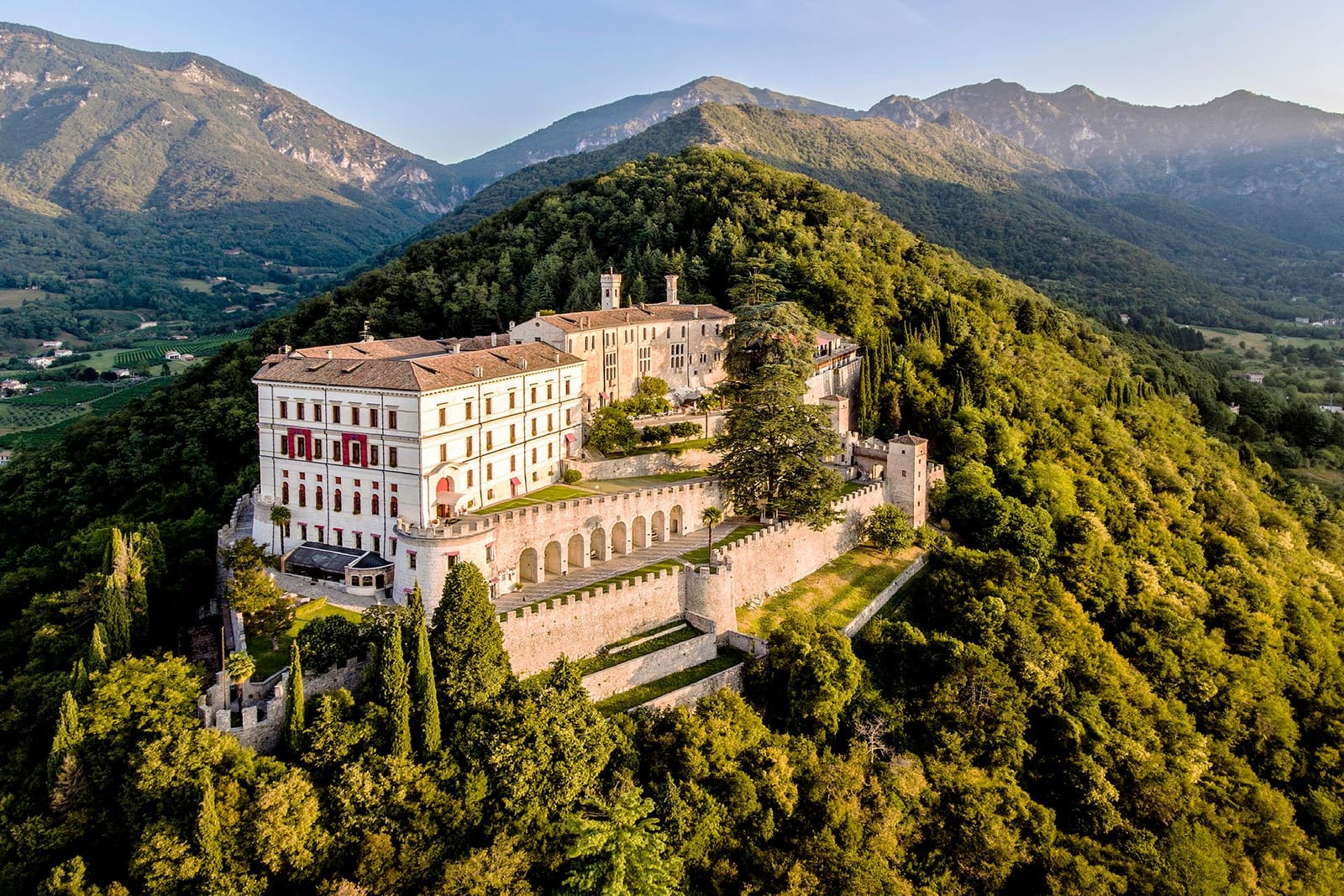
CastelBrando began as a Roman fortification, evolved through medieval expansion, and takes its current name from the Brandolini family. Now a national historic monument, it holds 50 rooms split between the castle proper and a section in the village below. The Royal suite spans two levels connected by spiral staircase, with Venetian furnishings and a walk-in closet. The main draw for many visitors is the 2,000-square-meter spa built into the castle's oldest wing, centered on a Roman bath discovered during renovations. Its original hypocaust heating system remains functional. A standard visit lasts over three hours and includes indoor and outdoor hydro-pools, five saunas, a Kneipp path, and a Himalayan salt cave.
Asolo and Follina
Hotel Villa Cipriani sits in Asolo, one of Italy's most beautiful villages and former home to Caterina Cornaro, the deposed Queen of Cyprus who held Renaissance court here until 1510. Giuseppe Cipriani, founder of Harry's Bar in Venice, took over management in 1960, transforming it into one of the era's most fashionable addresses. Current owners Massimo Zanetti and his wife Sigrid bought the property in 2012 and spent years restyling its 28 rooms. Vintage Vietri sul Mare bathroom tiles remain. The Duse Suite features Venetian hand-painted walls, while Terrace Junior Suites open onto private terraces overlooking both hills and pool. Chef Marco Pinelli, who joined in 2025, continues serving Giuseppe Cipriani's Venetian classics, including tagliolini au gratin and baccalà mantecato. Restaurant tables face the English garden, part of the American Horticultural Society's Garden of Excellence circuit since the 1990s.
Hotel Villa Abbazia in Follina sits across from the Cistercian Abbey of Santa Maria, whose Romanesque cloister completed in 1268 ranks among the Veneto's finest. The Relais & Châteaux property splits across an 18th-century palazzo and an Art Nouveau villa, with 18 rooms featuring maximalist floral wallpaper, bold stripes, and antique furnishings. Restaurant La Corte has held a Michelin star since 2013 under Chef Giuseppe Francica, who sources produce from the property's garden. Giovanni Zanon manages the wine program, focusing on small, local, biodynamic producers. Casa Coste Piane, a Valdobbiadene estate known for col fondo Prosecco made using pre-tank methods, appears regularly on the list.
What the Region Offers Beyond Wine
The UNESCO designation covers only Conegliano Valdobbiadene Prosecco Superiore, not the larger Prosecco DOC zone that spans nine provinces. Adjacent Asolo Prosecco Superiore, though not UNESCO-listed, produces wines with a distinct taste profile. Understanding these geographic distinctions matters less than recognizing what the landscape enables: a density of family-run hospitality rooted in agricultural tradition rather than resort development.
Most properties described here operate on a smaller scale than conventional hotel infrastructure allows. Rooms number in the single digits or low double digits. Dining programs emphasize estate produce and local suppliers. Architecture preserves original elements rather than replacing them. The approach reflects both regulatory limits on development within protected zones and owner preference for maintaining working estates over maximizing room count.
Travelers accustomed to full-service resorts may find amenities limited. Few properties offer fitness centers, business facilities, or 24-hour room service. What they provide instead is direct access to production landscapes and meals prepared with ingredients grown meters from the kitchen. Whether that trade-off appeals depends entirely on what you value in accommodation.