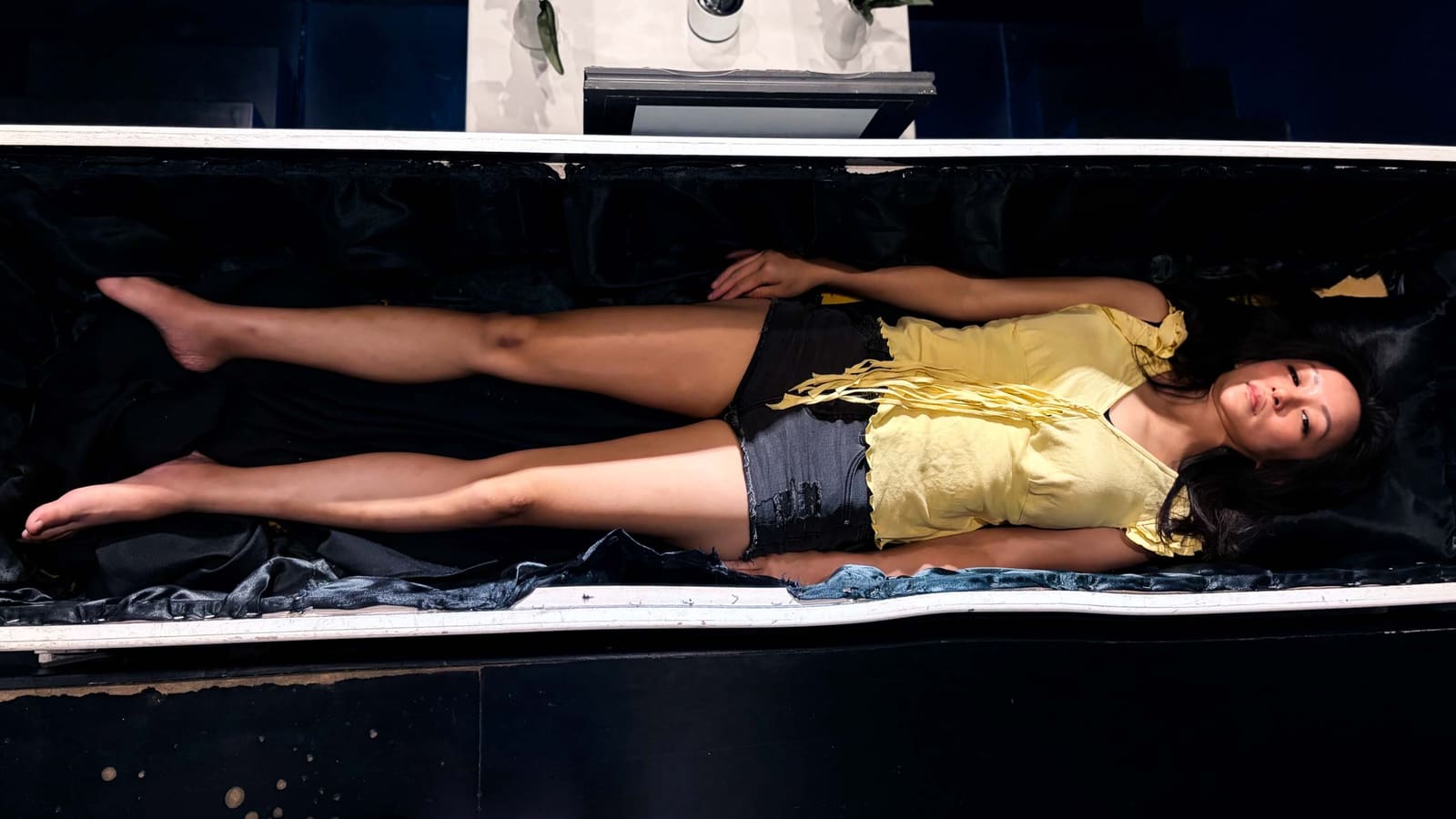
An Unexpected Ritual
Bangkok was supposed to be about street food and temples, not lying in a wooden coffin. Yet that is where one woman found herself after her mother received a third cancer diagnosis, searching for a way to hold the weight of uncertainty without breaking under it.
Death awareness cafés have emerged across Thailand's capital in recent years, spaces where visitors confront mortality through deliberate ritual. The practice centres on lying in a coffin while a facilitator guides participants through meditation on impermanence. It is not therapy in the clinical sense, nor is it religious ceremony, though it draws from Buddhist philosophy about acceptance and letting go.
For someone grappling with the possibility of profound loss, the ritual offered something conventional grief counselling had not: permission to stop pretending everything would be fine.
What Happens Inside
The café itself resembles a quiet tearoom more than a funeral parlour. Wooden coffins line one wall, each sized for a single person. Participants remove their shoes, lie down inside, and close their eyes. A lid is placed over the coffin, though not sealed. The darkness is complete.
What follows varies by person. Some cry. Others sit in silence, letting thoughts surface without trying to shape them into anything coherent. The practice lasts around ten to fifteen minutes, though time feels elastic in the enclosed space.
Facilitators emphasise that the exercise is not meant to frighten but to clarify. By rehearsing death, participants often report a sharper sense of what matters in life. The coffin becomes a container for emotions that have nowhere else to go, a place to acknowledge fear without being consumed by it.
The Thai Context
Thailand's relationship with death is more visible than in many Western cultures. Funerals are communal events, often lasting several days. Monks chant about impermanence. Families gather not only to mourn but to reflect on the cycle of life, a perspective rooted in Theravada Buddhism.
Death awareness cafés extend this openness into a format accessible to visitors unfamiliar with Thai customs. The ritual does not require religious belief or fluency in Buddhist teachings. It asks only that participants show up and lie still.
For travellers, the experience can feel jarring. Western cultures often treat death as a failure to be postponed or a private sorrow to be managed quietly. Thai practice, by contrast, integrates mortality into everyday conversation. The cafés make that integration tangible.
Why It Resonates Now
The concept has gained traction partly because modern life offers few structured ways to process grief before loss occurs. People wait until someone dies to confront their feelings, by which point the emotional weight can be overwhelming.
Anticipatory grief, the sorrow that arrives when someone is still alive but their future is uncertain, occupies an uncomfortable middle ground. It lacks the rituals of mourning and the closure of resolution. Death awareness cafés provide a rare space for this in-between state.
The practice also appeals to a generation more willing to discuss mental health openly. Younger visitors, in particular, report finding value in rituals that acknowledge emotional difficulty without pathologising it. Lying in a coffin is strange, yes, but it is also honest.
The Personal Reckoning
For the woman whose mother faced cancer a third time, the coffin became a place to admit what she had been avoiding: that she might lose her mother, and that no amount of optimism or planning would prevent it. The ritual did not make the fear disappear. It made the fear smaller by giving it a shape.
Afterwards, she sat in the café with tea, surrounded by others who had just emerged from their own coffins. No one asked what anyone else had thought about. The silence was enough.
Travel often promises escape, a break from the parts of life that feel too heavy. But some journeys work differently. They move towards difficulty rather than away from it, seeking not distraction but a way to hold what cannot be fixed.
What Visitors Should Know
Death awareness cafés are concentrated in central Bangkok, with a few operating in Chiang Mai. Sessions are typically offered in Thai and English, with facilitators trained to handle strong emotional reactions. Some cafés request advance booking; others accept walk-ins.
The experience costs between 200 and 500 baht, roughly five to thirteen pounds. Photography inside the coffins is generally discouraged, though some cafés allow it with permission. Visitors are advised to approach the ritual with openness rather than scepticism; those who treat it as a novelty tend to leave unmoved.
The practice is not suitable for everyone. People in acute mental health crises or those with severe claustrophobia may find the enclosed space distressing rather than clarifying. Facilitators usually screen participants briefly beforehand.
A Different Kind of Souvenir
Most people leave Bangkok with photographs of golden spires and market stalls. Some leave with something harder to carry: a clearer sense of what they are afraid of, and a tentative belief that they can live with that fear.
The coffin ritual does not solve grief. It does not make cancer go away or guarantee that difficult conversations will become easier. But it creates a moment, brief and strange, where the unthinkable becomes thinkable. And sometimes, that is enough to keep moving forward.