A City at Its Limit
Last April, a tour bus near Barcelona's Sagrada Familia came to an abrupt stop. Protesters surrounded it, sprayed it with water pistols, and plastered a banner across the windshield: "Let's put out the tourism fire." The scene made headlines, but it was hardly an isolated incident. Across Spain, from the Canary Islands to Málaga, residents have taken to the streets in growing numbers, their patience worn thin by decades of tourism-driven displacement.
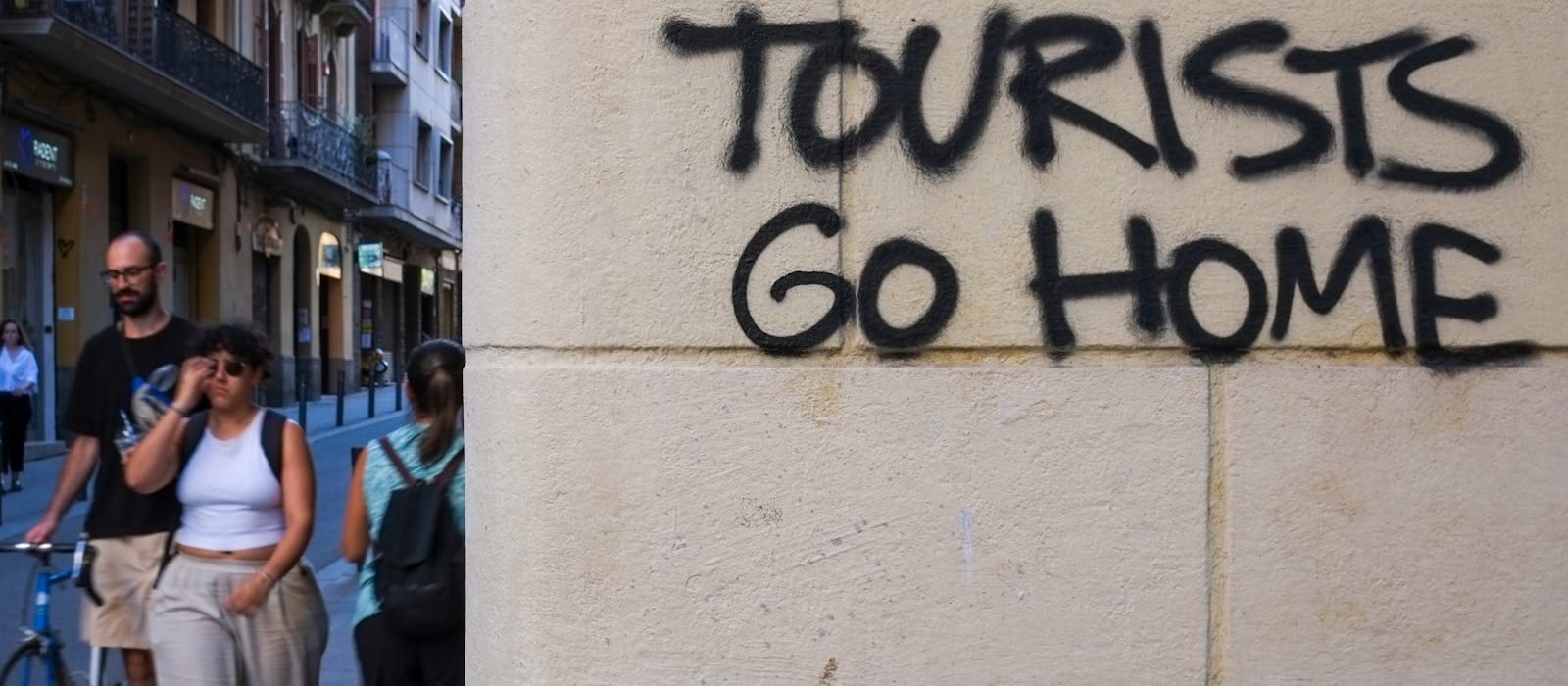
The graffiti tells the story more bluntly. "Tourists go home" appears on apartment buildings in city after city, a visible marker of frustration that has been simmering for years. But the anger is not aimed at individual travelers. It is directed at a system that has prioritized visitor spending over the people who actually live in these places.
How Tourism Reshapes Cities
Barcelona's transformation has been gradual but relentless. After international travel rebounded from pandemic restrictions, tourists returned in force. But the infrastructure to support them had already been built over decades, often at the expense of residents. Housing became scarce as apartments were converted to short-term rentals. Public spaces were repurposed for events like the America's Cup and Formula One races, which brought little tangible benefit to neighborhoods.
The result is a city where many locals feel like outsiders. Rent has climbed beyond reach for workers in the tourism sector itself, which offers mostly seasonal, low-wage jobs. Environmental strain has increased. The same patterns have played out in other Mediterranean cities, where the economic model depends heavily on a constant flow of visitors.
From Protest to Policy Demands
Early resistance began in the mid-2010s, when neighborhoods like Barceloneta first organized against displacement. Today, groups such as the Neighbourhood Assembly for Tourism Degrowth have moved beyond simple opposition. They have drafted specific proposals to reshape the city's economy.
At a major demonstration last July, activists presented a manifesto with 13 points. The demands included ending public subsidies for tourism promotion, tightening regulations on short-term rentals, reducing cruise ship traffic, and improving labor conditions with stable schedules and fair wages. They also called for economic diversification, urging the city to invest in sectors that provide more secure employment and benefit residents directly.
The language matters, too. Activists prefer the term "touristification" over "overtourism," arguing that the latter makes it sound like a matter of crowd control. The real issue, they say, is structural. It is about how wealth flows out of communities and into private hands, how public resources are redirected to serve an industry that offers little in return to the people who live there.
Who Bears the Cost
Tourism's impact is not evenly distributed. The people most affected are tenants, migrants, seasonal workers, and young people with limited political power. These groups face rising rents, unstable jobs, and shrinking access to public space. They are the ones pushed out when apartments become Airbnb listings, or when neighborhoods are redesigned to accommodate more visitors.
The movement has broadened in response. What started as anti-tourism activism now addresses housing policy, labor rights, climate action, and the defense of public space. The issues are interconnected, and the protests reflect that. Residents are not simply asking for fewer tourists. They are demanding a different kind of economy, one that prioritizes community wellbeing over growth for its own sake.
This past April, the Southern Europe against Touristification Network met in Barcelona to coordinate efforts across multiple cities. A demonstration is planned for mid-June across several locations in Southern Europe. The momentum is building, not fading.
What Research Misses
Much of the academic work on tourism focuses on visitor management, sustainable practices, or economic empowerment. Less attention goes to the people living in tourist hotspots, or to the labor conditions that underpin the industry. Studies rarely examine how tourism concentrates wealth, deepens inequality, or creates precarious work environments.
Policy follows the same pattern. Initiatives tend to focus on managing crowds or transport, not on limiting growth or addressing power imbalances. The result is a patchwork of measures that do not solve the underlying problems. Cities continue to rely on tourism because the political will to diversify is weak, and because the industry has powerful advocates.
The question of what kind of jobs tourism creates is often ignored. The sector is promoted as a driver of prosperity, but the reality for many workers is low pay, irregular hours, and little security. International organizations and city governments celebrate job creation without asking whether those jobs allow people to live with dignity.
A Broader Struggle
Dismissing these protests as "tourismphobia" or local selfishness misses the point. The movement is part of a larger fight for social justice. It challenges the idea that economic growth should come at the expense of residents, that cities exist primarily to serve visitors and investors.
Rethinking tourism means rethinking what cities are for. It means asking who benefits from current policies and who pays the price. It means acknowledging that a model built on constant growth is unsustainable, not just environmentally but socially.
Barcelona and other Spanish cities are testing ground for these questions. The protests are not going away. They reflect a deeper shift in how residents understand their relationship to the places they live. The water pistols and graffiti are symptoms, not the disease. The real issue is a system that has failed to balance the needs of visitors with the rights of the people who call these cities home.
What happens next will depend on whether policymakers are willing to listen. The activists have already laid out their demands. The question is whether cities will continue down the same path, or whether they will take the harder step of reimagining what a tourism economy could look like if it served everyone, not just the few.