A Different Tempo
Long-distance trains impose their own rhythm. The Rocky Mountaineer, which connects Vancouver to Jasper over two days, averages 48 kilometres per hour through the Canadian Rockies. There are no stops between departure and arrival, no wifi for most of the route, and limited mobile service. The premise is simple: slow down, look out the window, and accept that a cocktail before noon is reasonable behaviour.
The train leaves Vancouver early, heading east through British Columbia towards Alberta. Passengers leave their luggage at the hotel; it reappears that evening in Kamloops, the overnight stop roughly halfway to Jasper. The second day covers the remaining distance, arriving in the alpine town by early evening.
The Gold Leaf service, the higher of two tiers, includes glass-dome panoramic windows, a separate dining carriage, and a covered outdoor viewing platform. The platform matters more than it sounds. Feeling the air temperature shift as the train climbs, or smelling the brakes on a steep descent, adds texture that sealed glass cannot provide.
The Fraser River Corridor
Much of the first day follows the Fraser River, a major waterway in British Columbia that flows from the Rockies to the Pacific. The river is central to First Nations communities and supports some of the world's largest salmon runs. It also carves a path through otherwise inaccessible terrain, which is why the railway uses it.
The landscape near Vancouver is flat and agricultural, producing about half of British Columbia's crops. Livestock graze in green fields. In the distance, Mount Baker rises across the border in Washington State, its peak snow-covered even in warmer months.
As the train moves inland, the river narrows and the terrain becomes more dramatic. Hell's Gate, named by 19th-century explorer Simon Fraser, is the tightest section of the Fraser. The rock walls close in and the water accelerates through rapids. Fraser found it intimidating enough to give it a foreboding name; it is now a tourist site.
Bald eagles appear regularly along the river. The train moves slowly enough, and through remote enough country, that wildlife sightings are common. White-tailed deer stand near the tracks. Bighorn sheep ignore the passing carriages. On the second day, a black bear scrambles into the bush after being startled by the train horn.
Lytton and the Dry Interior
The landscape changes as the train approaches Lytton, one of the driest places in Canada with less than 25 centimetres of annual rainfall. It also holds the national record for the highest recorded temperature. The vegetation thins and the hills turn ochre.
Freight trains share the route, some stretching up to five kilometres in length with hundreds of brightly coloured boxcars clinging to the rock face. The railway is a working corridor, not a scenic line preserved for tourists.
Osprey nests sit atop telephone poles along the river. These nests, among the largest in North America, are built from sticks and decorated with blue and orange rope scavenged from the riverbank. Ospreys can reuse the same nest for up to 70 years, adding to it each season. The train slows at points of interest like this, giving passengers time to watch without stopping.
Into the Mountains
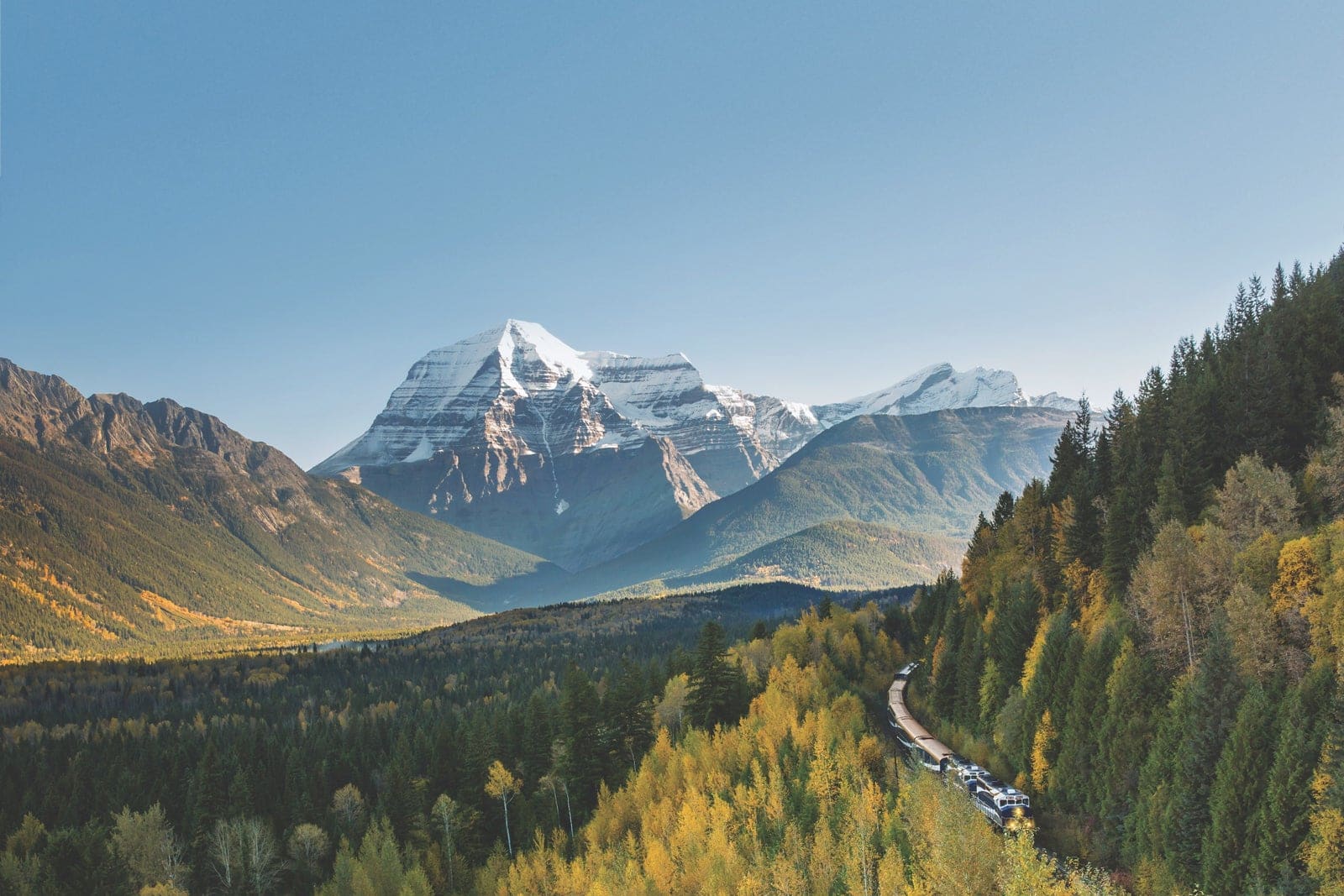
After the overnight in Kamloops, the second day begins with a shift in vegetation. Ponderosa pines, western hemlock, Douglas firs and trembling aspens replace the sparser interior growth. The peaks of the Rocky Mountains begin to dominate the horizon.
Pyramid Falls cascades nearly 100 metres down a forested mountainside, swollen by snowmelt. The train slows to let passengers take it in. The waterfall is only visible up close by rail; there are no roads.
Mount Robson, the highest peak in the Canadian Rockies at nearly 4,000 metres, appears as the train heads northwest towards the British Columbia and Alberta border. The summit is often obscured by cloud, but on clear days it is unmistakable.
The train crosses the Continental Divide at Moose Lake, a turquoise body of water framed by dense forest and sharp peaks. The atmosphere changes as the route enters Alberta. The mountains feel closer, the forests thicker, the valleys narrower. This is Jasper National Park.
What the Train Does Well
The Rocky Mountaineer operates entirely in daylight, which means no sleeping berths and no night travel. Passengers stay in hotels at the start, the midpoint and the end. This choice prioritises scenery over distance covered.
Food is sourced locally and served as a three-course lunch each day. The menu on this trip included seared albacore tuna with greens and olive tapenade, followed by chocolate torte. The quality is higher than expected for a moving train.
The lack of connectivity is deliberate. Without wifi or reliable mobile service, there is little to do except watch the landscape change. For some travellers, this is the point.
The train does not stop for photo opportunities, but it slows down. At scenic points or wildlife sightings, the speed drops enough for passengers to take in the view without the blur of motion. The average speed of 48 kilometres per hour means there is time to notice details: a burnt-out church that looks a century old, thrift stores in Gold Rush towns, back gardens in remote settlements.
People along the route wave at the train. Truck drivers sound their horns. It is the kind of interaction that happens when a train is slow enough to be acknowledged, rather than a streak of metal passing through.
The Appeal of Two Days
A two-day journey between Vancouver and Jasper could be covered by car in seven or eight hours, or by plane in just over an hour. The train takes roughly 20 times longer than driving. The trade-off is access to terrain that roads do not reach and a pace that allows for observation rather than transit.
The Journey Through the Clouds route is one of several operated by Rocky Mountaineer, a private rail company that runs seasonally between April and October. The Silver Leaf service offers large windows and meals at your seat. The Gold Leaf service adds the dome car and outdoor platform.
Pricing reflects the positioning as a luxury experience rather than transport. A Silver Leaf package starts from £1,379 per person; Gold Leaf from £1,871. Both include meals, non-alcoholic drinks, and the overnight hotel in Kamloops. Alcohol is available throughout the journey.
The clientele skews older, though not exclusively. The appeal seems to be the combination of comfort, scenery and enforced slowness. There is no schedule to keep beyond boarding in the morning and disembarking in the evening. The train dictates the pace, and passengers adapt.
Jasper at the End
The train arrives in Jasper in early evening, pulling into the small station as the light begins to soften. Jasper is a mountain town with a population of around 4,000, surrounded by national park on all sides. It is quieter than Banff, less developed, and more reliant on the railway for its identity.
Stepping off after two days of slow movement feels oddly disorienting. The train imposes a particular mindset: passive observation, regular meals, incremental progress through unchanging wilderness. Returning to normal speed takes adjustment.
The Rocky Mountaineer is not a practical way to travel if the goal is simply to reach Jasper. It is a way to experience the distance itself, to make the journey the subject rather than the interval between departure and arrival. Whether that is worth the time and cost depends on how much value you place on watching the world move past at 48 kilometres per hour, with a vodka in hand and nowhere else to be.