When the Guidebook Becomes a Black Box
A decade ago, destination marketing meant billboards, brochures, and a well-optimized website. Today, it means teaching machines how to recommend your city.
Nearly seven in ten travelers now say AI-generated summaries give them enough information to book a trip without digging further, according to Amadeus research covering global travel behavior. That shift is forcing tourism boards to reckon with a new gatekeeper: algorithms that decide which destinations surface in a traveler's search and which disappear from view.
The challenge is not just visibility. It is legibility. If a destination cannot structure its information in a way that AI systems understand, it risks being filtered out before a human ever sees it.
The Planning Process, Rerouted
AI has moved beyond novelty and into the everyday mechanics of trip planning. Forty-two percent of travelers use it during research, while another 36 percent turn to AI for inspiration, asking tools to surface ideas they might not have found on their own. Another third use AI while traveling, pulling up recommendations or logistics on the go.
Chatbots designed for travel have tripled in adoption over the past five years, rising from 6 percent to 18 percent. The tools are no longer experimental. They are becoming default.
A traveler planning a weekend city break might now ask an assistant to build an itinerary around food markets, contemporary art, or low-impact activities, bypassing the traditional loop of guidebook sites, review platforms, and official tourism pages. The question is not whether travelers will use these tools. It is whether destinations will be present when they do.
From Search Engines to Generative Engines
Tourism boards have spent years optimizing for search engines, learning how to rank higher on Google and appear in the right queries. That skill set is still relevant, but it is no longer enough.
The new frontier is what Amadeus calls generative engine optimization, or GEO. While traditional SEO helps websites get found, GEO focuses on making information interpretable by AI systems that generate answers rather than list links.
A destination promoting itself for hiking, for example, needs to communicate more than scenic photos and vague promises. It needs structured data: trail difficulty, seasonal access, transport links, nearby amenities, and the kinds of experiences available once you get there. That level of clarity helps algorithms pull the destination into a generated response when a traveler asks for hiking recommendations.
The difference is subtle but consequential. A website might rank well in a search engine but still fail to appear in an AI summary if the underlying information is not machine-readable or contextually rich.
Data Gaps and Forward Vision
Tourism boards are also grappling with a data problem. Many still rely on backward-looking metrics, tracking arrivals and spending after the fact. That approach worked in a stable environment. It is less useful now.
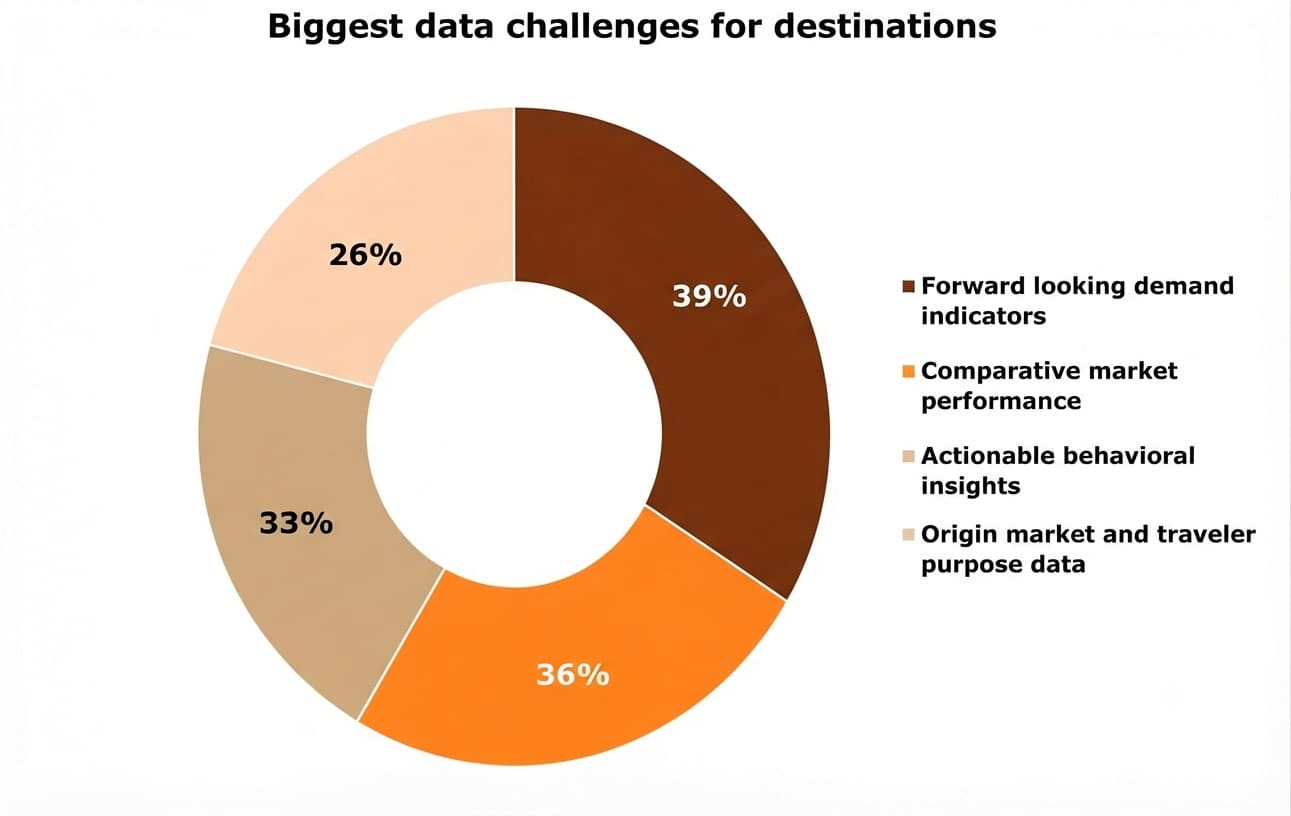
Thirty-nine percent of destination management organizations cite access to forward-looking demand indicators as their biggest data challenge, followed by comparative market performance data and actionable insights into traveler behavior. The need is for predictive intelligence, not just historical tallies.
Abu Dhabi, for instance, analyzes traveler profiles across key source markets, looking at preferred travel periods, accommodation choices, and motivations. That information feeds into both marketing strategy and product development, helping the destination anticipate shifts before they show up in arrival statistics.
The ability to spot emerging markets, adjust investment, and refine messaging in real time is becoming a competitive advantage. Destinations that wait for trends to become obvious are already behind.
What Travelers Actually Want
The research also reveals a shift in what travelers are seeking. After a trip, 41 percent say what they value most is a refreshed mind and a calmer state, while 18 percent describe feeling a clearer, lighter sense of self. Those are not the outcomes listed on a tourism brochure.
When deciding where to go, travelers prioritize freedom and open itineraries, connection with local culture, discovery, and ease. The emphasis is on personal transformation, not checklist sightseeing.
That creates a tension. Destinations still market attractions, landmarks, and activities. But travelers are increasingly choosing places based on how they expect to feel, not just what they expect to see.
Personalization matters here. Seventy-four percent of travelers consider it important during planning, and many are willing to pay more for experiences that save time, reduce complexity, or deliver emotional resonance. A family with young children, a couple seeking wellness, and a solo traveler interested in local food may all visit the same city, but they are looking for entirely different things.
Destinations that continue to promote a single, generalized offer risk missing all three.
The New Role of Tourism Boards
The role of destination management organizations is evolving. They are no longer just promoters. They are becoming orchestrators, responsible for coordinating visitor flows, aligning public and private stakeholders, and building tourism models that work for residents as well as visitors.
That means thinking beyond campaigns and considering the entire visitor journey, from the first spark of inspiration to the experience on the ground. It also means using technology not as a marketing tool but as infrastructure, shaping how information flows and how decisions get made.
Sol Freixa, who leads destination strategy at Amadeus, notes that travelers are no longer satisfied with ticking off landmarks. They want connection, discovery, and personal growth. Meeting that expectation requires destinations to rethink not just how they communicate but what they offer and how they deliver it.
The Risk of Being Left Out
The stakes are real. Destinations that are not represented in AI-generated answers risk fading from consideration, even if they have strong offerings and a loyal visitor base. The issue is not quality. It is discoverability in a new format.
That makes the current moment both an opportunity and a vulnerability. Destinations that move quickly to structure their information, build predictive capacity, and align their offers with evolving traveler motivations will have an edge. Those that assume the old playbook still works may find themselves competing for attention in a game where the rules have already changed.
The shift is not coming. It is here. And for destinations, learning to speak the language of algorithms is no longer optional.