A Mountain Between Myth and Management
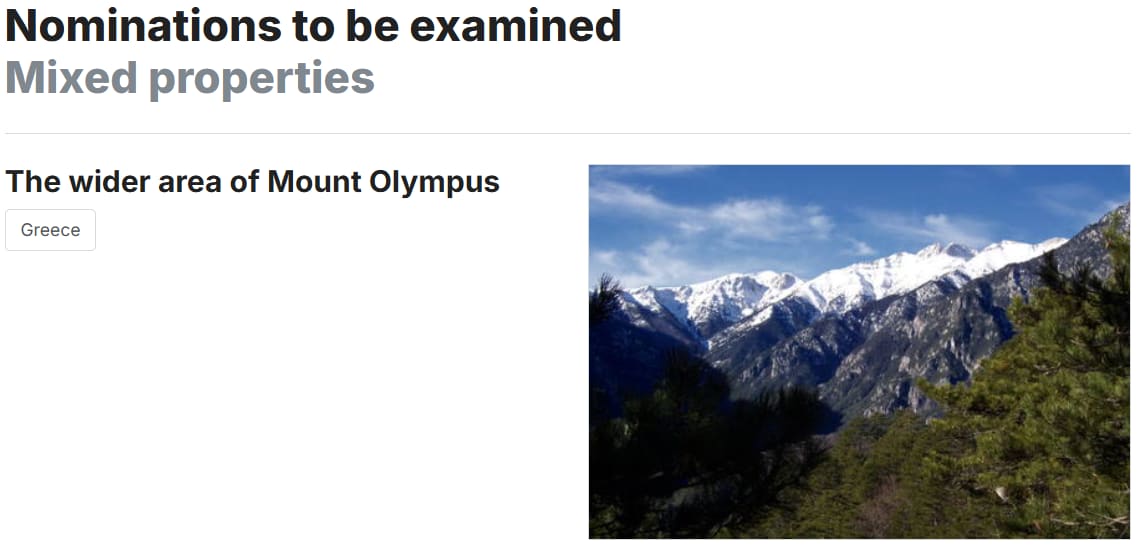
Mount Olympus rises to 2,918 meters, the highest point in Greece and, according to ancient belief, the home of twelve gods who shaped the Mediterranean imagination. Now it faces a different kind of judgment. The World Heritage Committee is expected to decide by 29 July whether the mountain and its surrounding mass merit inscription on UNESCO's list, capping a process that started more than a decade ago.
Greece first placed Olympus on UNESCO's Tentative List in 2014, a necessary step before formal nomination. But advisory bodies pushed back. The International Council on Monuments and Sites and the International Union for Conservation of Nature asked for clearer proof of the site's international geological and ecological importance, as well as deeper documentation of its cultural weight. Greece responded by expanding the submission to include Dion, an archaeological site at the mountain's base that once served as a sacred center for ancient Macedonians.
The delay reflects a tension common to many heritage nominations: how to argue that a place matters not just locally but globally. Olympus carries enormous symbolic freight for Greece. For the rest of the world, the question is whether its biodiversity, landforms, and mythological resonance justify the same protection afforded to places like Yellowstone or the Galápagos.
The Pressure of Popularity
Evangelos Geroliolios, mayor of Dio-Olympos, frames the mountain in personal terms. "Mount Olympus is our life," he said. "It is the place where we grew up, the place we see every day. At the same time, though, it is a place that carries myth, history, biodiversity, unique natural beauty and enormous cultural significance."
But daily life on Olympus now includes a growing stream of hikers, many of whom ignore park rules. Much of the mountain has been a national park for decades, with restrictions on swimming and camping in certain areas. Babis Marinidis, a mountain guide and president of the Alpine Club of Litochoro, told the Associated Press that enforcement is patchy and visitor behavior often careless.
World Heritage status could amplify that problem. Inscription tends to raise a site's profile, sometimes dramatically. Marinidis, once opposed to visitor caps and entrance fees, has changed his mind. "How many people can this mountain, this ecosystem, bear?" he asked. "I believe some limit must be imposed."
The question is not hypothetical. Greece has struggled with overtourism at other heritage sites, from Santorini to the Acropolis. Olympus, with its relatively fragile alpine ecosystem, may be more vulnerable than either.
What Happens Next
The World Heritage Committee meets in Seoul from 19 to 29 July. Three outcomes are possible: inscription, deferral for further work, or outright rejection. Even if Greece's bid succeeds, the real test will come afterward, when the country must balance access with preservation.
Timing adds another wrinkle. Christopher Nolan's film adaptation of The Odyssey is set to release soon, likely drawing fresh attention to Greek mythology and the landscapes associated with it. Whether or not UNESCO grants recognition, Olympus is poised to see more visitors in the coming years.
For now, the mountain waits. Its geology, its forests, and its place in human imagination remain unchanged. What will change, perhaps, is how the world agrees to treat them.