A Path Through Fields and Memory
West Flanders has long been short on unpaved cycling routes. The region's network of bike paths is extensive, but the terrain offers little gravel, and the routes that did exist often crossed private land or protected areas where cyclists weren't officially allowed. That tension between demand and access has made it difficult to piece together a legitimate gravel route, even as interest in the format has grown steadily across Belgium.
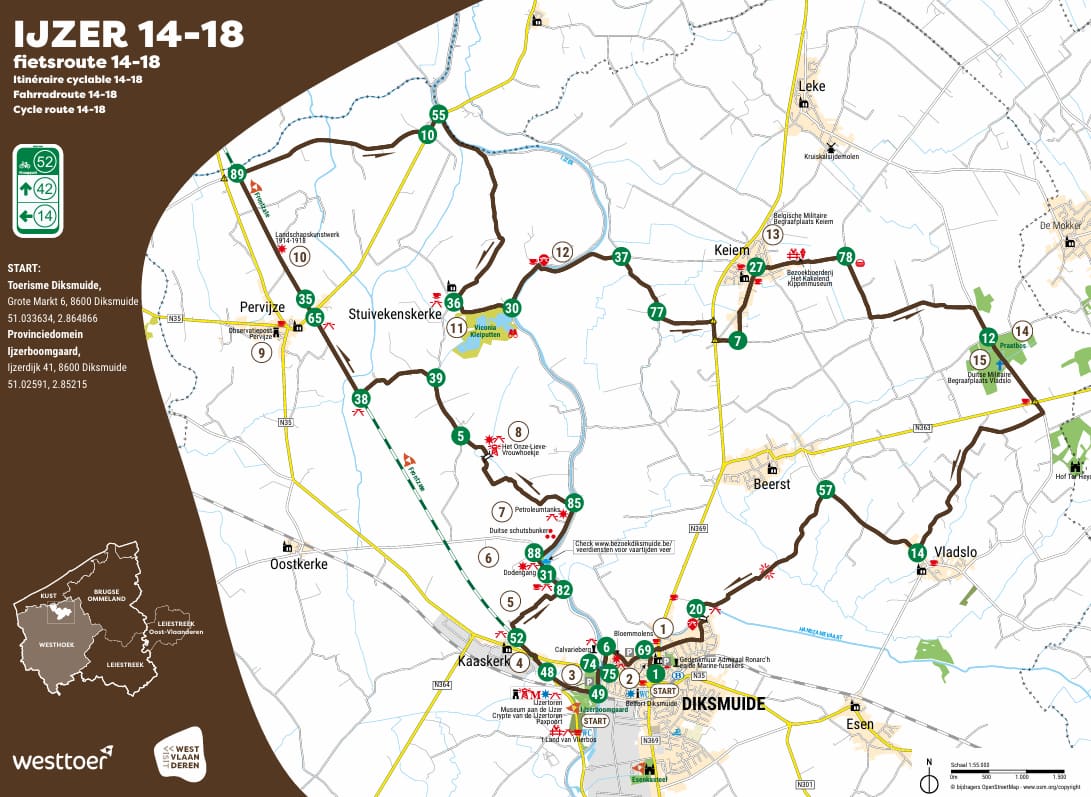
The Frontzate route, which opened recently in Diksmuide, addresses that gap. Stretching 50 kilometers, with roughly half on gravel surfaces, the path was designed with families and novice riders in mind. The elevation gain is minimal, just 12 meters across the entire loop, and the route prioritizes safety and ease of navigation. More experienced cyclists can fold it into longer rides or use it as a foundation for exploring the broader region.
According to Sport Vlaanderen, gravel bike sales in Belgium reached over 23,000 units in 2025, with annual growth of 3,000 to 4,000 bikes, data from mobility federation Traxio show. While mountain bike sales have dipped slightly, gravel bikes have found a niche among riders who want the flexibility to move between paved roads and softer terrain without committing to technical off-road trails.
Monuments Along the Way
The Frontzate route doubles as a historical corridor. Starting from the IJzerboomgaard provincial estate, it passes several World War I landmarks, including the Dodengang memorial and the Trench of Silence. These sites are embedded in the landscape, and the route offers a quieter, slower approach to visiting them compared to driving or taking organized tours.
Diksmuide is already known for its concentration of war memorials, but the gravel path adds a layer of accessibility for those who prefer to explore on two wheels. The route is unguided and unsignposted, relying instead on a downloadable GPX file, which keeps the experience self-directed and flexible.
Several cafés and restaurants punctuate the route. Café de IJzerboomgaard sits at the starting point, followed by Perron 74 at the 11-kilometer mark, Boer Bart at 15 kilometers, and restaurant Zannekin at 36 kilometers. These stops offer practical breaks and a chance to engage with the local food culture, which tends to be straightforward and rooted in regional ingredients.
Building a Network
The opening of the Frontzate path is part of a broader effort to expand cycling infrastructure in West Flanders. Jesse Clarysse of Sport Vlaanderen noted that while commercial platforms and route planners like Strava, Komoot, and RouteYou have provided gravel options in the past, those routes often lacked official status or clear permissions. The new path was mapped with explicit access rights, ensuring that riders won't inadvertently trespass or disrupt conservation zones.
For Diksmuide, the route represents both a tourism asset and a local amenity. Marc De Keyrel, the town's alderman for sports, emphasized the goal of encouraging residents and visitors alike to explore the area actively. He indicated that additional off-road routes are planned for the coming years, suggesting that this path is a pilot rather than a standalone project.
The choice to leave the route unsignposted is deliberate. It reduces visual clutter and maintenance costs while catering to a demographic that's comfortable with digital navigation. The GPX file is freely available online, and the format is standard across most cycling apps and GPS devices.
A Gentler Entry Point
The Frontzate route's flat profile and moderate length make it accessible to a wider audience than many gravel paths, which often assume a baseline level of fitness or technical skill. By keeping the terrain forgiving and the distance manageable, the route lowers the barrier for families, older riders, and those new to gravel cycling.
That accessibility also serves a strategic purpose. As gravel biking continues to grow in Belgium, creating entry-level routes can help sustain interest and broaden participation. It's a recognition that not every rider is looking for a challenge, and that the appeal of gravel cycling often lies in the quieter roads and varied scenery rather than the difficulty.
The route's integration of historical sites adds a narrative dimension that distinguishes it from purely recreational paths. Riders move through a landscape shaped by conflict and remembrance, and the slower pace of cycling allows for a different kind of engagement with that history. It's not a museum visit, but it's not purely exercise either.
West Flanders' investment in gravel infrastructure reflects a shift in how regions think about cycling tourism. Rather than relying solely on road cycling or mountain biking, gravel routes occupy a middle ground that appeals to a growing segment of travelers who want flexibility, access to rural areas, and a sense of discovery without the intensity of technical trails. The Frontzate path is a modest step in that direction, but it's one that could shape how the region develops its outdoor offerings in the years ahead.