A Carnival Six Decades in the Making
West London is about to transform into a riot of colour and sound. The Notting Hill Carnival, which first took to the streets in 1966, returns for its 2026 edition from Saturday 29 to Monday 31 August. The festival draws over two million visitors and features some 50,000 parade performers across three days of music, dancing, and community celebration.
The event remains free to attend, though a handful of ticketed experiences are available this year. What began as a community gathering has grown into the largest street festival in Europe, championing Caribbean culture through soca, calypso, and reggae music that spills from dozens of sound systems along the route.
Saturday: Steel Pan Showdown
The weekend opens with the Panorama Steel Band competition at Emslie Horniman's Pleasance Park. From 4pm to midnight, bands compete in a national contest, each delivering a ten-minute pan composition. Tickets cost £20 per person for this seated event, one of the few ticketed elements of the weekend.
Steel pan music, with its distinctive metallic resonance, forms the backbone of carnival's sonic identity. The competition draws bands from across the UK, each vying for the title in front of judges and an audience that knows the tradition inside out.
Sunday: Families and First Light
Sunday morning begins before dawn with J'Ouvert, the traditional paint-and-powder celebration that kicks off carnival proper. Starting at 6am near Sainsbury's by Canal Way Roundabout, participants cover themselves and each other in vivid pigments until 9am, a raucous prelude to the day ahead.
The official opening ceremony follows at 10am on Great Western Road at the MAS Judging Point. New for 2026, the Judging Zone Grandstand opens to the public with tickets from £30, giving spectators a front-row view of the elaborate costumes and choreography as parade groups pass by for evaluation.
Sunday is billed as family day. The children's parade takes over the streets, while Dutty Mas adds another layer of mayhem with brightly coloured paints and even melted chocolate. Sound systems around Powis Square run from noon to 7pm, pumping out reggae and house tracks.
At 3pm on both Sunday and Monday, the music stops for 72 seconds. The silence honours the 72 people who died in the Grenfell Tower fire, a tragedy that sits close to the heart of this community. The pause is brief, but it anchors the weekend in memory and solidarity.
Monday: The Main Event
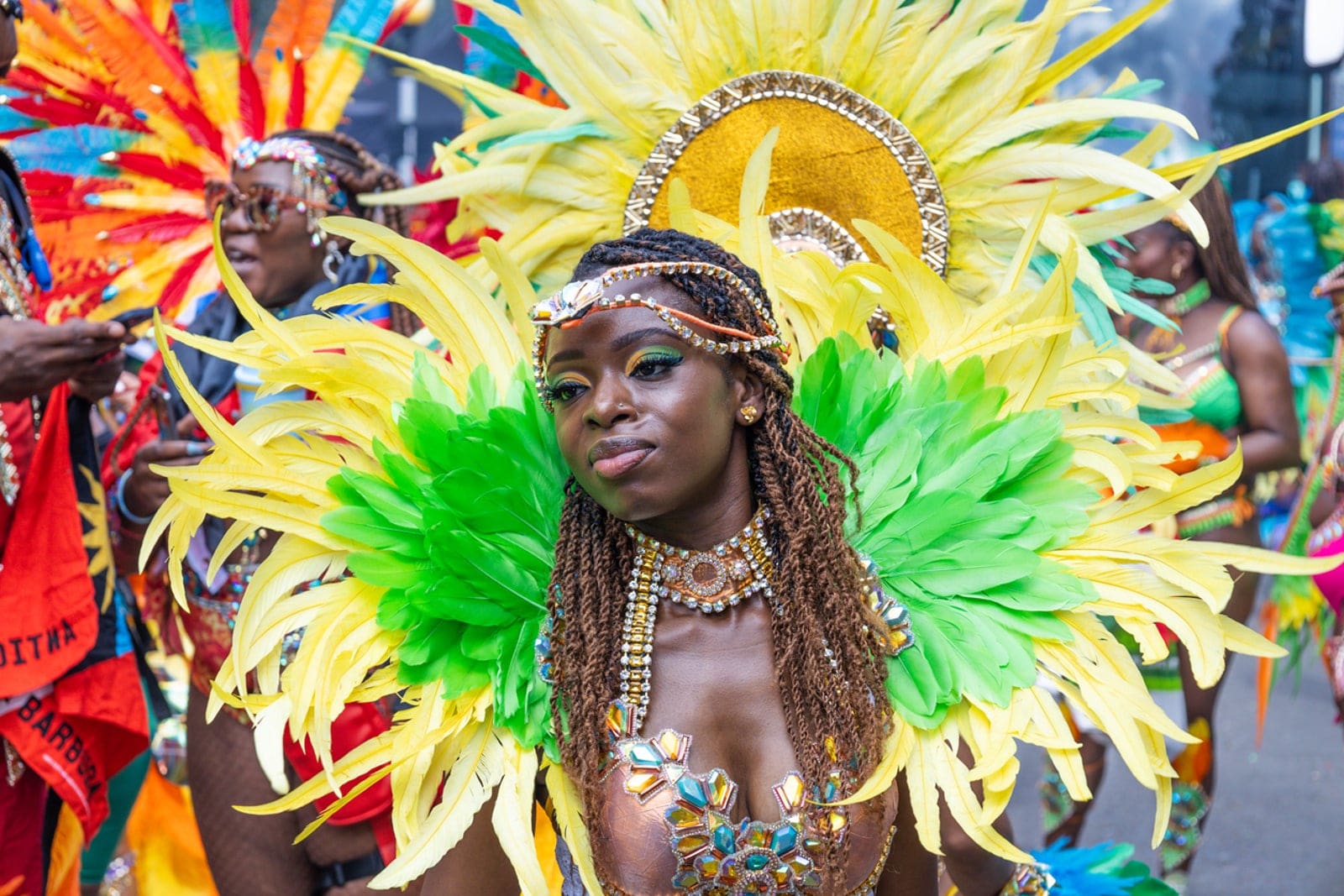
Bank holiday Monday is Adults Day, and it's when carnival reaches full intensity. The parade starts at 10.30am, winding through Notting Hill and Kensington along a three-and-a-half-mile route. Performers in feathered headdresses and sequined costumes dance behind floats, while spectators line the streets several rows deep.
The route begins near Westbourne Park tube station, moves down Chepstow Road to Westbourne Grove, then loops up to Ladbroke Grove and back via Kensal Road. An official map tracks the parade's progress in real time, useful for those trying to catch specific groups or avoid the densest crowds.
Food stalls appear at intervals along the route, selling Jamaican jerk chicken, Trinidadian roti, and other Caribbean staples. The queues can be long, but the food is part of the experience, fiercely spiced and served with minimal ceremony.
Sound systems at Powis Square continue from noon to 7pm on Monday, and ticketed after-parties carry the festivities into the night. The carnival may be free, but the surrounding economy of late-night events and pop-up bars keeps the momentum going well past the official close.
Getting There and Getting Around
Transport to carnival requires a bit of planning. Ladbroke Grove station will be closed on both Sunday and Monday. Notting Hill Gate and Royal Oak operate as exit-only from 11am, with Royal Oak closing entirely at 6pm. Westbourne Park is also exit-only from 11am. Holland Park closes at 3pm after operating as exit-only from 11am.
Transport for London recommends arriving via Paddington station on the Elizabeth line, which offers connections from Stratford and avoids the bottlenecks closer to the route. Shepherd's Bush is a 20-minute walk from the carnival area and typically less congested. Kensal Green and Kensal Rise remain open but expect queues, with a formal queuing system at Kensal Rise from 6pm onward.
Road closures throughout Notting Hill mean buses and taxis cannot reach the heart of the action. There is no Night Tube or Overground service on Sunday or Monday evening, so plan your departure accordingly. Cycling is an option, but finding somewhere to lock up near the route can be a challenge.
What Makes It Work
Notting Hill Carnival thrives on a kind of organised chaos. There is structure, a route, a schedule, but the event resists the polish of a corporate festival. It remains community-led, with local groups and Caribbean cultural organisations driving the planning and participation.
The costumes alone take months to prepare. Mas bands, short for masquerade bands, design and construct elaborate outfits that blend traditional Caribbean motifs with contemporary flair. On parade day, these creations are judged at the MAS Judging Point, but they're also simply worn and celebrated by performers who have invested time, money, and creativity into the spectacle.
The music is equally layered. Steel bands play compositions rooted in Trinidadian tradition. Sound systems blast soca and dancehall. Live stages host performances that range from reggae to Afrobeat. The result is a sonic landscape that shifts from block to block, with each corner offering a different tempo and vibe.
A Festival That Belongs to the Streets
Notting Hill Carnival has faced pressure over the years, from debates about policing to concerns about commercialisation. But it remains rooted in the streets of W10 and W11, a public celebration that doesn't require a ticket or a wristband for the bulk of its programming.
That accessibility is part of its identity. Families bring children. Teenagers come in groups. Tourists mix with locals. The crowd is as diverse as London itself, united by a shared willingness to stand in the heat, navigate the crowds, and surrender to the rhythm of the weekend.
The 72-second silence on both days serves as a reminder that this is not just a party. It's a gathering that holds space for joy and grief, for history and future, for a community that has faced loss and continues to celebrate life with defiant energy.
Carnival season in London means one thing: the August bank holiday belongs to Notting Hill, and for three days, the streets pulse with a tradition that refuses to be contained.