A Platform Above the Valley
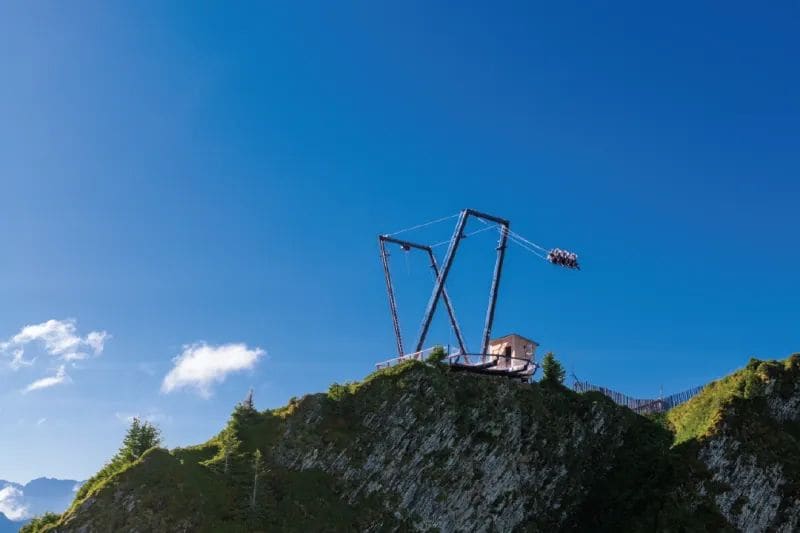
At 2,110 meters, the Grand Chamossaire peak offers a clear view of the Swiss Alps. It's also where Villars ski resort has installed a metal structure shaped like an ibex, holding a swing that sends riders out over the valley below.
The Balanc'Air swing opened this year and can carry up to three people at once. Riders sit on saddle-style seats, get strapped in, and are pulled backward by cables until they're suspended at a 90-degree angle. When the mechanism releases, they swing forward over the drop.
Alexandra Henchoz, who tried the ride with her husband and daughter, said she felt nervous beforehand. "I had a bit of a pit in my stomach," she noted. But once the swing was in motion, the fear shifted. "You feel like a bird flying," she said.
Marc Truffer, 70, called it frightening but added that the view afterward made it worth it.
The Real Work the Swing Is Doing
The attraction isn't just about thrills. It's part of a deliberate effort by Villars to create tourism options that don't depend on snow.
Martin Deburaux, who heads the Villars-Gryon-Diablerets ski area, said the resort is actively working to diversify what it offers. "We are really trying to diversify our offering," he explained.
The numbers tell the story. Villars sees more than 700,000 visitors in winter but only around 100,000 in summer. The resort wants to close that gap, and attractions like the swing are one way to do it.
The urgency isn't hypothetical. Across the Alps, rising temperatures and shifting snowfall patterns are making winter tourism less predictable. Villars has had strong recent winters, but the resort is planning for a future where that consistency can't be guaranteed.
A Shift Across the Mountains
Villars isn't alone in this pivot. Alpine destinations across Europe are rethinking their economic models. The traditional reliance on a single season is giving way to year-round strategies that emphasize hiking, mountain biking, and experiences tied to landscape rather than snow depth.
The swing fits into that framework. It uses existing mountain infrastructure, the same cable cars and platforms that serve skiers in winter, and turns them into assets for warmer months. It's an efficient way to extend the value of what's already built.
But the shift also raises questions about capacity and conservation. Villars has been intentional about where it places new attractions, keeping the swing in an area that already sees heavy visitor traffic while leaving quieter zones undeveloped. That balance, between drawing more people and protecting the environment they come to see, is delicate.
What Visitors Are Looking For
The swing appeals to a particular kind of traveler: someone who wants adventure and mountain views but isn't necessarily interested in skiing. It's a different demographic, one that might visit in July instead of January.
That audience is growing. Mountain tourism is no longer just about winter sports. People are coming for trails, for altitude, for the experience of being in the mountains without needing to strap on skis. Resorts that can tap into that demand, and do it well, stand a better chance of weathering the changes ahead.
The Balanc'Air swing is free with any lift ticket from the Villars-Gryon-Diablerets area, including the regional Magicpass. Visitors can also reserve a spot in advance for 8 Swiss francs to guarantee access. Half the available slots are bookable ahead of time; the other half are kept open for walk-ups.
A Glimpse of What's Coming
The swing is one piece of a larger puzzle. Alpine resorts are investing in new infrastructure, rethinking their calendars, and experimenting with what will keep people coming when snow becomes unreliable.
Some of these experiments will work. Others won't. But the direction is clear: mountain destinations are moving away from a model built entirely on winter and toward something more resilient.
For Villars, the swing is both a draw and a signal. It tells visitors there's something to do in summer. It tells investors the resort is thinking ahead. And it tells the industry that adaptation, not nostalgia, is the strategy.
Whether that's enough depends on how fast the climate shifts and how well resorts can keep up. For now, the swing is spinning, and people are lining up to ride it.