A Vanishing Body of Water
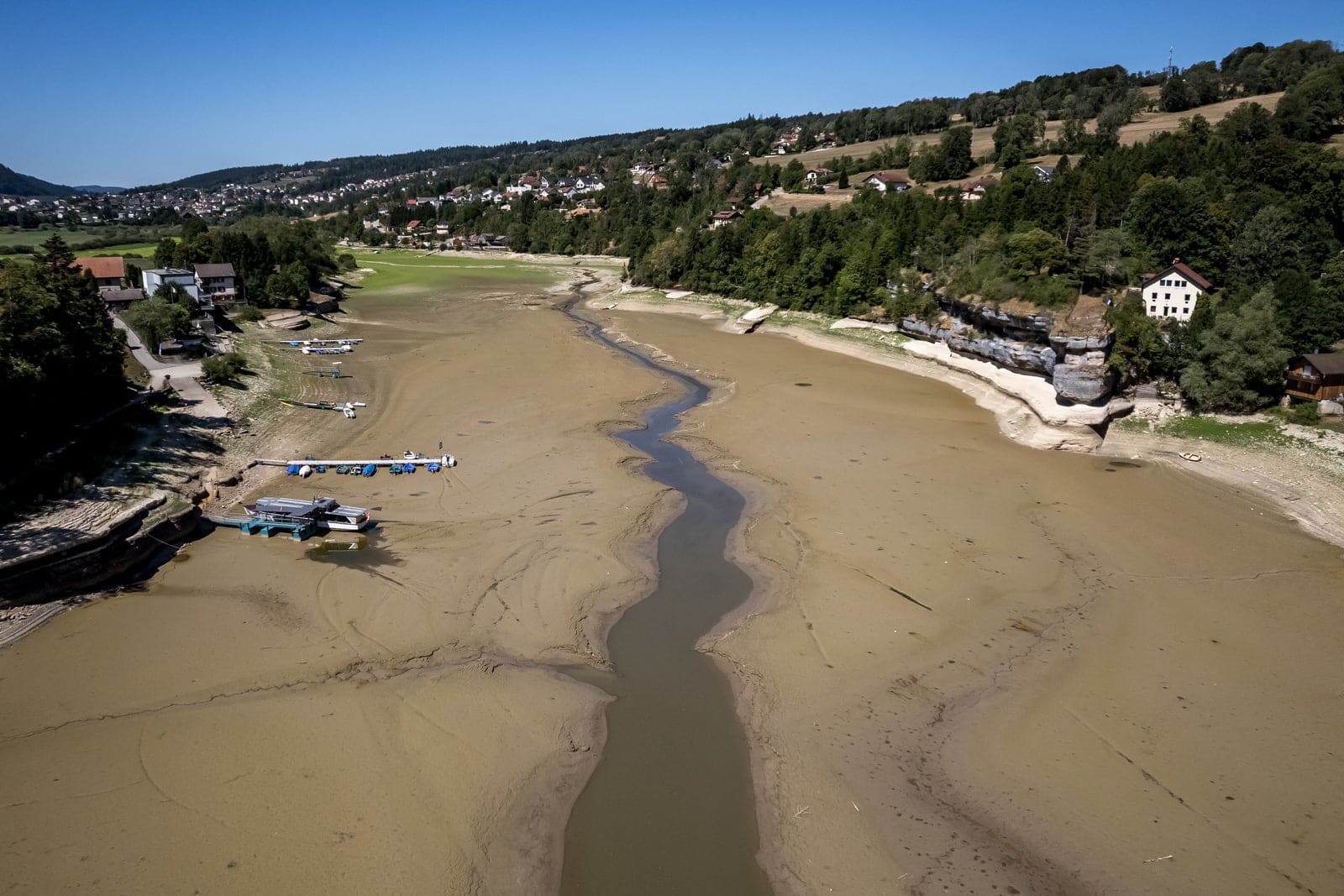
The boats sit motionless on cracked mud, their hulls tilted at odd angles. Where water once lapped against wooden piers, there is now only brown earth stretching toward a thin ribbon of murky liquid at the center. Lake Brenets, a winding body of water that straddles the border between Switzerland and France, has become a scene of desolation this summer.
The lake, fed by the River Doubs, typically draws campers, swimmers, and canoeists during the warmer months. Boat operators ferry thousands of visitors across its surface each season, offering access to the area's signature waterfall and mountain views. This year, however, prolonged drought has left the lake nearly empty. Water levels have dropped more than 9 meters below their usual summer mark, according to local operators, and continue to fall by roughly 22 centimeters each day.
Three successive heatwaves, the most recent still ongoing as of late July, have compounded the problem. Rainfall since April has been about half the normal volume for the region, according to MeteoSuisse, Switzerland's national weather service. The agency has compared the current drought to some of the country's most severe on record, including those in 1976, 2003, and 2018. Forecasts suggest below-average precipitation will persist through mid-August.
Stranded Livelihoods
Yvan Durig operates a tourist vessel named Jumbo through his company, Societe de Navigation des Brenets. The boat now sits high and dry, one of dozens stranded along the exposed lakebed. Durig has laid off his staff and faces the prospect of closing the year at a loss. "It's hitting us hard because we're powerless in the face of this phenomenon," he told reporters.
The lake has experienced droughts before, but Durig notes a shift in their frequency. "These droughts are occurring in rapid succession, something we've never seen before," he said. The pattern suggests a broader change in the region's climate, one that is altering the rhythms of both the landscape and the businesses that depend on it.
The remaining water is confined to a narrow channel at the lake's center, where fish cluster in the shrinking habitat and a pair of swans paddle slowly. The Saut de Doubs, a waterfall that flows from the lake and has long been a draw for visitors, has nearly dried up. Residents who have lived near the lake for decades describe the transformation as jarring.
A Landscape Transformed
Martial Beyeler, a 69-year-old local, remembers the lake in its fuller state. "It's so beautiful when there's water, when it's flowing. It's an idyllic, wonderful place," he said. "It makes me sad to see the place like this."
The drought has also changed the social geography of the area. Beaches that once filled with families are now expanses of dried mud. Hiking trails that wound through forest near the water's edge now overlook a barren basin. The Instagram-worthy vistas that once circulated widely on social media have been replaced by images of abandonment.
For travelers who had planned visits around the lake's natural features, the current state presents a difficult reality. Canoe rentals have been suspended. Swimming areas are inaccessible. Boat tours, a staple of the region's summer economy, have ceased operations entirely. The infrastructure built to support tourism remains in place, but without water, it serves no function.
Broader Implications
The situation at Lake Brenets reflects a wider pattern across Europe, where water scarcity has become a recurring summer issue. Rivers in Germany, France, and Italy have seen similar declines in recent years, affecting everything from hydroelectric power generation to agricultural irrigation. The Alps, which feed many of Europe's major waterways, have experienced reduced snowpack and earlier melt seasons, both of which contribute to lower summer flows.
Switzerland, despite its reputation for abundant alpine water, has not been immune. The country's glaciers have been retreating at accelerating rates, and reservoirs in some regions have reached historically low levels. The MeteoSuisse data indicating that this year's drought rivals the worst on record underscores the severity of the current conditions.
For communities like those around Lake Brenets, the challenge is not only managing a single dry season but preparing for the possibility that such seasons will become more common. Infrastructure designed for predictable water levels may need rethinking. Businesses that rely on seasonal tourism may need to diversify. Ecosystems adapted to certain hydrological cycles may face stress or transformation.
The brown ribbon of water that remains in the center of Lake Brenets is a reminder that even landscapes that seem permanent can change quickly. The boats stranded on the mud, the empty piers, and the silent waterfall all point to a future where the rhythms of water and weather may no longer follow the patterns of the past.