An Unlikely Second Life
The Northern Line doesn't actually end at High Barnet. Not really. Two of its carriages, built in 1959 and painted in crimson and cream heritage livery, now spend their days crawling along a two-mile stretch of track on Alderney, a speck of an island in the English Channel with barely 2,000 residents. They carried Londoners until 1999, then somehow wound up here, moving at the pace of a leisurely walk between a harbour and a lighthouse.
Sitting inside one feels like stepping into a time machine that got its wires crossed. The proportions are pure London commuter stock: low ceiling, curved roof, the kind of moulded seats that have absorbed decades of sighs. But through the windows, instead of Kentish Town or Camden, there's a sweep of Georgian cottages, windswept grass, and the glint of secluded coves. The engine coughs, the wheels rattle, and the whole contraption trundles past Victorian forts and pale quarry scars at roughly the speed of a distracted dog.
The tracks themselves weren't laid for tourists. They're a relic of Alderney's 19th-century breakwater project, built to haul stone from inland quarries to the coast. That the rails now carry bemused visitors in decommissioned Tube stock is the kind of historical accident Alderney seems to specialise in.
An Island Out of Sync
Alderney is only a few miles long, yet it contains what feels like several centuries stacked on top of one another. Roman walls, Napoleonic towers, German bunkers, and an airport where the planes look like they were assembled by hobbyists all coexist in a landscape that refuses to settle on a single era.
Britain is present but warped. Postboxes follow the classic design but are painted blue instead of red. Cars of improbable vintage navigate narrow lanes because the island has no MOT requirement. Normandy, eight miles away, asserts itself in street names and the iridescent quality of light that turns the sky shades of blood orange and rose at dusk.
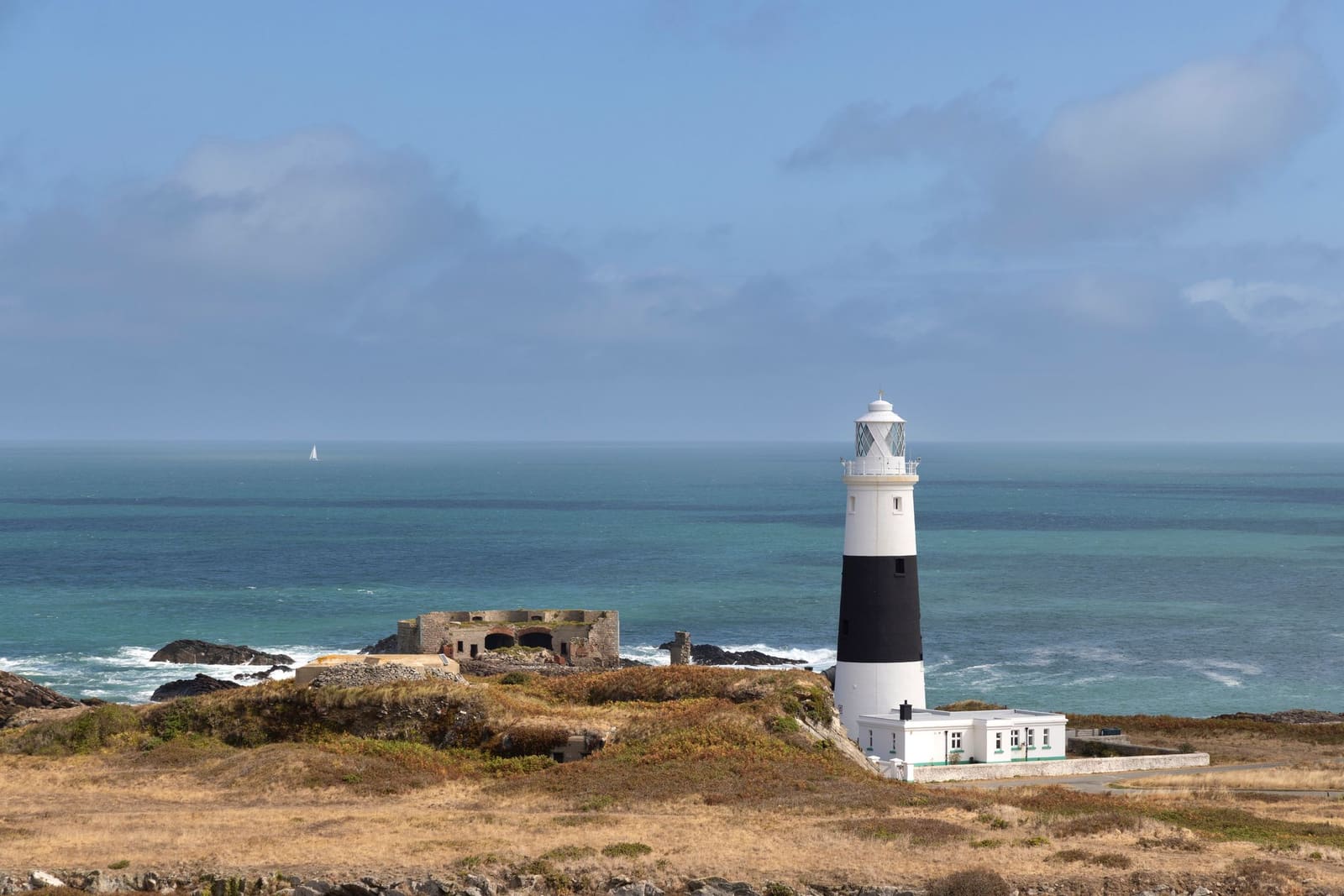
Walking from the railway terminus toward Mannez Lighthouse, the landscape shifts between soft and stark. Sea thrift blooms pink along the rocks. Plants with storybook names, small hare's-ear, sand crocus, bastard toadflax, grow in the short turf. Bracken rises around abandoned concrete. Gorse releases a warm coconut scent. The beauty is constant, but so is the sense that something harder lies beneath.
Layers of Occupation
Alderney rarely lets its scenery stand alone. At one end of the island, the Nunnery, a Roman fortification, has been borrowed and modified by nearly every power that has controlled the place. Nearby, a German anti-tank wall cuts across the softness of the beach like a scar.
The southwestern cliffs hold the island's most difficult history. Alderney was almost entirely evacuated in 1940 before Nazi forces occupied the Channel Islands. Prisoners of war were brought in to build fortifications as part of the Atlantic Wall, held in SS-run camps. The exact death toll remains contested.
Fort Tourgis, built in the 1850s to counter French expansion at Cherbourg, was designed for 350 officers and men. The Germans renamed it Strongpoint Türkenburg and filled it with guns and searchlights. By the 1970s, it had begun to collapse. Plans to convert it into luxury flats have repeatedly failed. Now the entire fortress slowly drowns in weeds and crumbling stone while the sea glitters beyond, indifferent.
The Slower Rhythm
The coastal paths on Alderney can't make up their minds. One moment they cross open heath above white water; the next they drop into green lanes where trees form canopies and the wind disappears. It's a landscape that suits not just passing visitors but also the island's strangest resident: the blonde hedgehog, a pale variation said to have descended from pets released after the war.
At dusk, a small group follows a local wildlife guide named Roland through lanes where the last light catches granite walls and bats loop overhead. In a back garden, with permission, they watch a cluster of pale, purposeful hedgehogs scamper through the grass.
Braye Beach Hotel, a row of gable-topped houses converted into a quiet retreat, offers rooms in cream tones and breakfasts on a terrace overlooking the beach. A 15-minute walk leads to St. Anne, where cobbled lanes rise around the church and bunting flutters year-round above Victoria Street. At the Blonde Hedgehog hotel, chef Stephen Scott assembles what might be the island's best dinner menu: picked crab with crème fraiche, lobster bisque, local sea bass with chestnuts and asparagus.
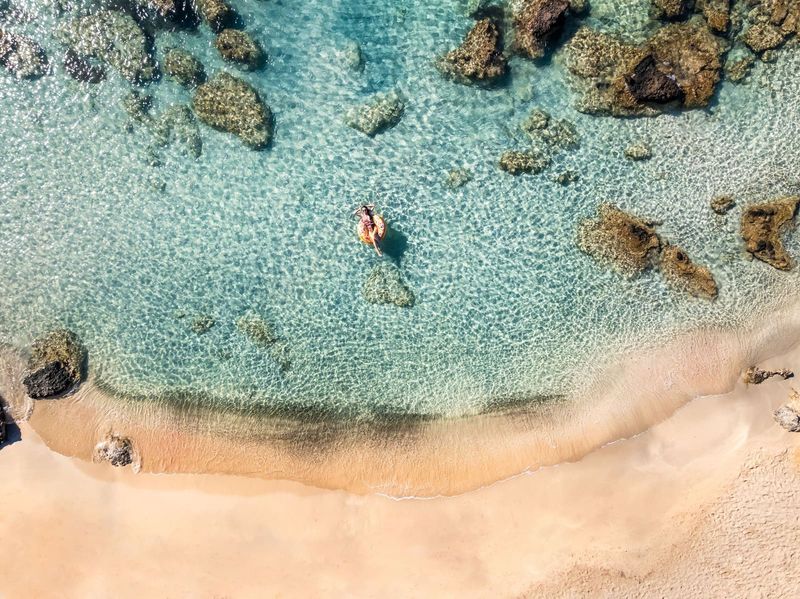
On a Saturday afternoon in high season, Braye Bay is almost empty. The sand is nearly white, the water shifting from plum to turquoise. Walking it alone, the instinct to hurry feels absurd. Nothing on Alderney travels particularly fast. The railway takes its time covering two miles. The entire perimeter can be walked in a day. The planes from Guernsey and Southampton are small enough that passengers can watch the pilot's hands from any of the 18 seats.
A Different Kind of Terminus
The crimson carriages shake off the dirt and memories of their London past with every clatter of the wheels. They run once a week, which makes them perhaps the most antediluvian commute in the British Isles. But that seems about right for an island that has no real interest in keeping pace with the frenetic world beyond.
Harry Beck's Tube map, it turns out, was incomplete. The end of the line isn't High Barnet or Morden. It's here, on a windswept island where old trains go to retire and time moves at whatever speed it pleases.