A Route That Crosses a Continent
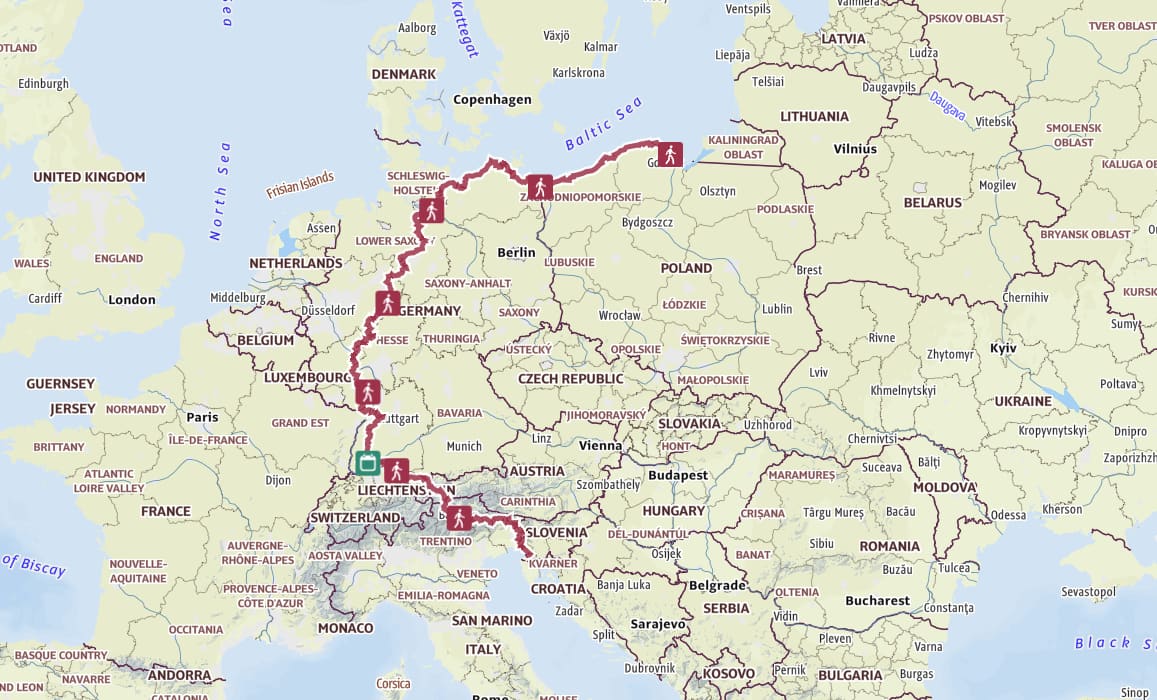
A new long-distance hiking route now stretches from the Baltic Sea to the Adriatic, covering roughly 3,500 kilometres and passing through Poland, Germany, Switzerland, Austria, Slovenia, and Italy. The Wolf Trail does not carve out entirely new paths. Instead, it connects existing long-distance routes into a single, continuous line that can be walked over four to six months.
The trail was designed by outdoor brand Jack Wolfskin and draws on sections of the E1 and E9 European long-distance paths, Switzerland's Nord-Süd Route, and portions of the Via Alpina. The full journey involves around 78,400 metres of cumulative elevation gain, roughly the equivalent of ascending Everest nine times from sea level.
Starting in Hel, a narrow peninsula on Poland's northern coast, hikers follow sandy beaches and coastal forests for 430 kilometres before crossing into Germany. The early stages are relatively flat, passing through Słowiński National Park and the western Polish lowlands. From there, the route moves inland, threading through the plains and heathlands of northern Germany before reaching the Rothaar Mountains and the wine-growing regions of the Palatinate.
Terrain That Builds in Difficulty
The landscape shifts as the route pushes south. After the Black Forest and Lake Constance, the trail enters Alpine terrain in the Allgäu region. The final 558 kilometres between Oberstdorf and Trieste cross the Dolomites and Julian Alps, with passes climbing between 2,500 and 3,000 metres. This section includes UNESCO-listed mountain landscapes and Slovenia's Triglav National Park before descending toward the Adriatic coast.
The trail has been divided into seven sections, each ranging from roughly 390 to 590 kilometres. Hikers can tackle individual segments over a few weeks rather than committing to the full multi-month journey. Access points along the way allow for shorter trips, making the route adaptable to different schedules and fitness levels.
Canadian long-distance backpacker Lauren Roerick tested portions of the trail to assess navigation and practicality. The route is designed for experienced hikers, but section hiking opens it up to a broader range of travellers.
Infrastructure Over Wild Camping
One notable feature of the Wolf Trail is its reliance on existing infrastructure rather than wild camping. Regulations around backcountry camping vary widely across Europe, with some countries prohibiting it outright and others allowing it only in designated areas. To navigate these inconsistencies, the trail has been mapped around approved trekking camps, mountain huts, and accommodation in towns and villages.
This approach aligns with the thru-hiking model, where long-distance walkers follow a continuous route while stopping regularly in communities to resupply. It also means hikers need to budget for lodging and meals, which can add up over several months.
Timing and Weather Considerations
Completing the full trail requires careful planning around the seasons. The northern sections through Poland and Germany are accessible from spring through autumn, but the Alpine stretches present different challenges. Snow and severe weather can close high passes between October and early spring, making timing critical for anyone attempting the entire route in one go.
Hikers starting in late spring can move through the lower elevations before summer, reaching the Alps during the more stable weather of July and August. Those tackling individual sections have more flexibility, though Alpine segments remain best suited to the warmer months.
A Journey Through Contrasts
Beyond the physical challenge, the Wolf Trail offers a slow traverse through varied European landscapes and cultures. The route begins in Baltic fishing communities, passes through German wine villages and Swiss mountain hamlets, and ends in Trieste, a multicultural port city with layers of Italian, Slavic, and Central European influence.
Each section presents a different character. The Baltic coast is windswept and open. The German heartland rolls through farmland and forests. The Alps demand technical skill and stamina. The Adriatic arrival feels earned.
For hikers who have walked the Appalachian Trail or the Pacific Crest Trail, the Wolf Trail presents a European counterpart with its own set of logistical puzzles and rewards. It is not a wilderness experience in the North American sense, but rather a journey through inhabited landscapes where the trail weaves between nature and human settlement.
The route is now mapped and available for hikers to follow. Full GPX files and detailed stage information are being released by Jack Wolfskin, with updates shared through the brand's social channels. Whether completed in one continuous push or broken into shorter trips, the trail offers a new way to cross Europe on foot, following a line that connects coasts, cultures, and mountain ranges into a single, walkable thread.