A Seven-Year Build
The Hitachi-no-kuni Long Trail opened fully in September, connecting six towns and cities across northern Ibaraki Prefecture in a 350-kilometre loop. The route lies roughly ninety minutes from Tokyo by train and represents the longest continuous circuit trail in Japan.
Ibaraki Prefecture launched the project in 2019. Most of the work fell to the Hitachinokuni Trail Club, a volunteer group of around 1,000 members who restored abandoned paths, cleared overgrown sections, and linked existing mountain and cycling routes into a single system. At the opening ceremony in Hitachiomiya on 19 September, Governor Kazuhiko Oigawa described the result as a route that lets people experience the full range of the prefecture's landscapes.
The trail already had a following before it was complete. In a 2025 poll by the Japan Long Trail Association, it ranked as the route people most wanted to walk among the organisation's 29 member trails.
What the Route Covers
The loop passes through Kitaibaraki, Takahagi, Hitachi, Hitachiota, Hitachiomiya, and Daigo. Terrain shifts from coastal stretches and beaches in the northeast to forested valleys and ridges in the centre, with satoyama landscapes scattered throughout. Satoyama refers to the traditional patchwork of woodland, rice paddies, ponds, and small settlements that has defined rural Japan for generations.
Much of the trail sits at moderate elevation and sees little snow, making it walkable year-round. The central section, which crosses the Yamizo mountain range near Daigo, is steeper and more technical. Hikers who tackle it are rewarded with views of Fukuroda Falls, the jagged peaks of Okukuji Nantaiyama, and the cliffs of Ryujinkyo Gorge.
The northeastern section includes peaks such as Eizomuro and Hanazono Yama, as well as stretches of coastline. It also traces part of the ancient Salt Road and passes the Jukkokubori Canal, a waterway built during the Edo period.
In the southeast, open since 2024, the trail starts in Hananuki Valley and climbs Mount Tsuchidake, passing waterfalls and castle ruins before descending to the Kuji River.
Walking, Not Summiting
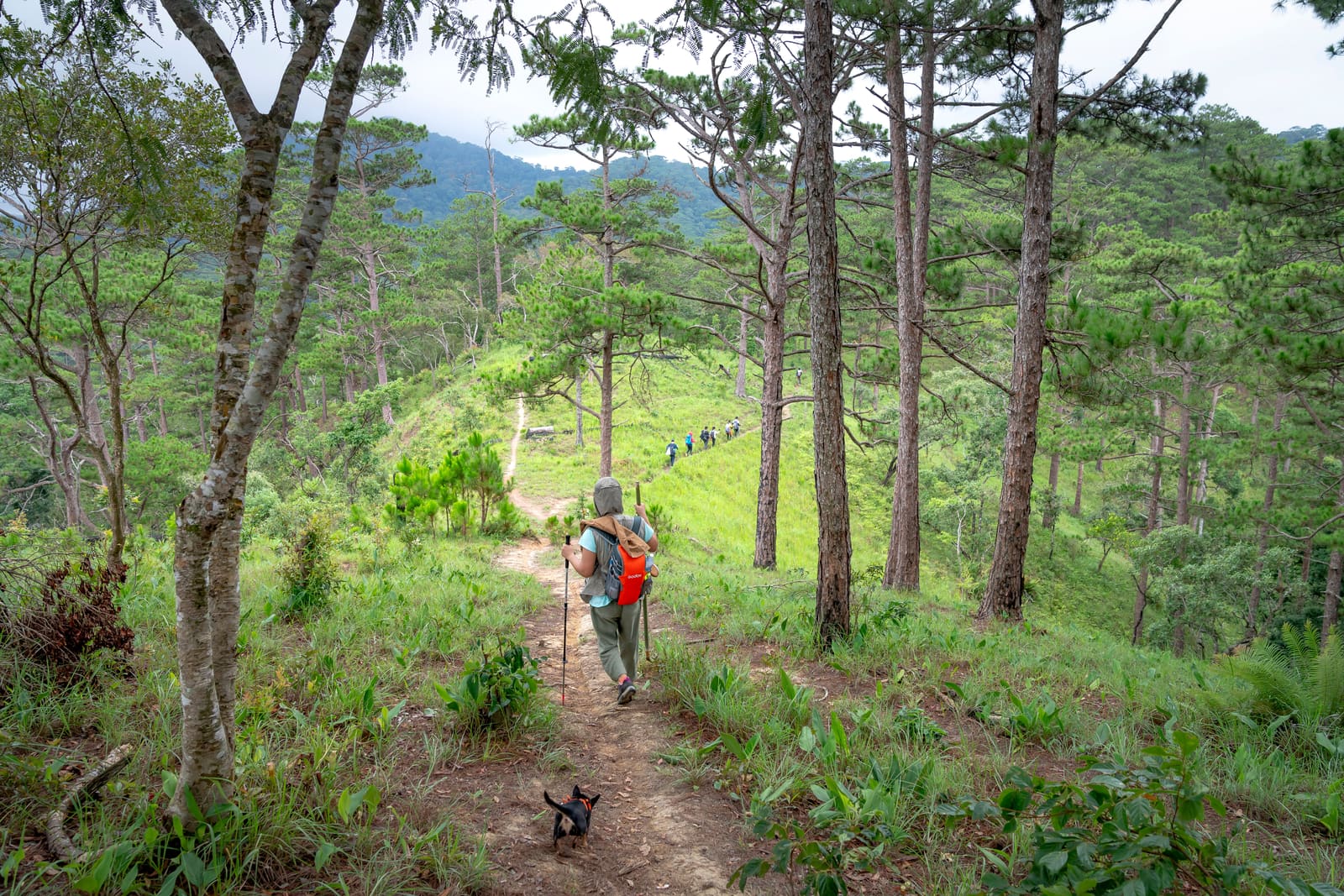
The distinction between hiking and climbing matters here. Climbing focuses on reaching a summit. Hiking treats the journey itself as the objective. The Hitachi-no-kuni trail is designed around that second idea: slow movement through changing landscapes, with no pressure to cover a set distance or hit a particular endpoint.
Adventure racer and trail ambassador Yoki Tanaka spoke at the opening about how long trails engage all the senses. He noted that scenery overlooked in daily life often reveals new detail when your pace or perspective shifts.
Hikers can walk the entire 350 kilometres or choose shorter sections based on interest and fitness. The route is divided into segments that vary in difficulty, and each offers a different slice of the region's culture and history. Some sections pass through villages where travellers can talk to residents, visit workshops for traditional crafts, or sample fermented foods produced locally. Others wind through forests and along ridges where the main company is the weather and the terrain.
A Longer Tradition
Long-distance walking has deep roots in Japan. Pilgrimage routes such as the Kumano Kodo and the Shikoku circuit have been walked for more than a millennium, blending spiritual practice with physical endurance. The modern revival of hiking as wellness tourism draws on that tradition, but the Hitachi-no-kuni trail also reflects a more practical concern: how to keep rural areas visible and economically viable as populations age and young people move to cities.
By linking six municipalities and threading together landscapes that might otherwise remain fragmented, the trail offers a way to experience Ibaraki's diversity without a car. It also creates a reason for visitors to spend time in places that rarely feature on standard tourist itineraries.
The route touches on space exploration history, local mythology, prayer sites, and regional food culture. It is not a curated experience in the theme-park sense, but rather a framework for encountering the everyday and the overlooked.
Practical Considerations
The trail is marked and maintained by volunteers, and conditions can vary. Some sections follow paved roads, others narrow mountain paths. Mobile coverage is patchy in remote areas, and facilities such as toilets and water sources are not evenly distributed along the route.
Accommodation options include guesthouses, small inns, and camping areas, though advance booking is advisable in peak seasons. The trail's official resources provide maps and segment descriptions, but hikers should be prepared for self-navigation in places where signage is sparse.
Weather can change quickly, especially in the mountains. Even on sections walkable year-round, rain can make paths slippery, and visibility can drop in fog. The trail is not extreme by alpine standards, but it is long, and fitness and planning matter.
Who It's For
The Hitachi-no-kuni trail suits people who prefer walking to ticking off sights, who want to move slowly enough to notice what is around them. It is not a luxury experience, and it is not designed to be easy. It is designed to be doable, in sections or as a whole, by anyone willing to spend time on foot in a part of Japan that does not often make the guidebooks.
The loop structure means you can start and finish in the same place, which simplifies logistics. The variety of terrain means you can choose flatter coastal sections if you are less fit, or tackle the central mountains if you want more challenge.
The trail also reflects a broader shift in how rural regions are thinking about tourism. Rather than building resorts or promoting single attractions, Ibaraki has invested in infrastructure that rewards slow travel and repeat visits. The result is a route that serves both locals and outsiders, offering a way to see the prefecture that is grounded in its geography and history rather than imposed from above.