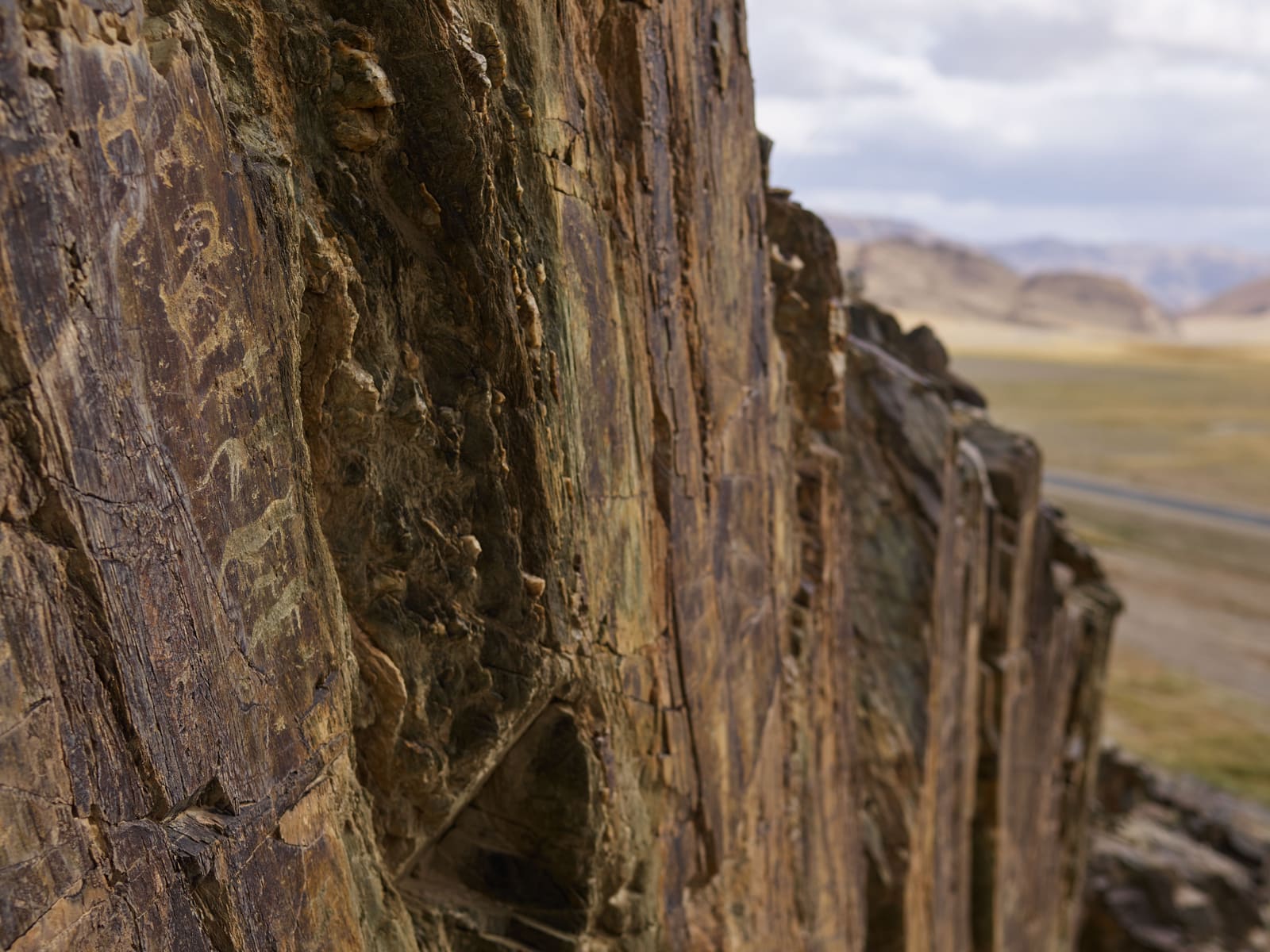
Carved into the Living Rock
Walk the outdoor paths at Alta Museum in northern Norway and you are stepping over something rare: thousands of images chiselled into bedrock by people who lived here when reindeer still migrated across tundra that had only recently emerged from beneath glacial ice. The carvings are not replicas or reconstructions. They are the original surfaces, exposed to weather and light, that Stone Age artists worked with stone tools over a span of several thousand years.
Some of the earliest images date back more than seven millennia, placing them among the oldest examples of rock art anywhere in Northern Europe. The subjects are immediate: reindeer, elk, bears, fish, whales. There are boats, some with crews of stick figures, and scenes that appear to show hunting, fishing, and gatherings whose purpose can only be guessed at. The figures vary in size, style, and clarity. A few are large and deeply incised. Others are faint scratches that require the right angle of sunlight to see at all.
What makes Alta unusual is not just the age or the number of carvings, but the way they accumulated. The land here has been rising steadily since the end of the last Ice Age, a process geologists call isostatic rebound. As the weight of the ice sheets lifted, the bedrock slowly rose, and what had been shoreline became hillside. Each new stretch of exposed rock became a canvas. The oldest carvings sit highest on the slope; the youngest are closer to today's waterline. The result is a vertical timeline, generations of image-making stacked one above the other as the landscape itself changed shape.
Light, Shadow, and a Coat of Red Paint
Seeing the carvings depends heavily on light. On an overcast afternoon, many of the grooves are nearly invisible. But when the sun is low, particularly in the early morning or late evening, the shallow channels cast small shadows that bring the figures into sharp relief. This is especially true in the Arctic summer, when the sun circles the horizon and the quality of light shifts continuously.
In the 1970s, someone decided to make the carvings easier for visitors to see by filling many of the grooves with red paint. The colour was never part of the original work. It was a modern intervention, well-intentioned but ultimately at odds with conservation principles. Over the past few decades, the emphasis has shifted towards protecting the integrity of the rock itself, and the red paint is being gradually removed. Some figures still carry traces of it, a reminder of an earlier era of site management when visibility mattered more than authenticity.
The tension between access and preservation is a live issue at Alta. The carvings are fragile. Foot traffic, weather, and even the growth of lichen all pose risks. At the same time, the site was inscribed on the UNESCO World Heritage List in 1985 precisely because of its cultural and historical significance, and that significance is best communicated when people can stand in front of the rock and see the images for themselves.
What the Images Tell Us
The subject matter reflects a way of life built around seasonal movement and the rhythms of animal migration. Reindeer appear again and again, often in herds. Boats are a recurring motif, some with high prows and rows of paddlers, suggesting both the importance of water travel and the social organisation required to build and crew a vessel. Fish and marine mammals, including what appear to be whales, indicate a diet and economy that drew heavily on the sea.
Human figures are present but often stylised or schematic. Some are shown with arms raised, others holding what might be weapons or tools. A few scenes seem to depict rituals or ceremonies, though interpreting them with any certainty is difficult. The carvings offer no written context, no labels, no explanatory text. They are visual records made by people whose language, beliefs, and daily concerns are otherwise lost.
What is clear is that the act of carving was sustained over an immense stretch of time. This was not a single community or a brief artistic flourish. It was a tradition that persisted across dozens of generations, adapting to changes in climate, coastline, and perhaps culture. The continuity suggests that the site itself held meaning, that returning to carve new images was part of a shared practice, passed down and renewed.
A Landscape Still in Motion
Alta sits well above the Arctic Circle, a town of a few thousand people on the shore of Altafjord. The surrounding landscape is stark and open, with low vegetation and long sight lines. In winter, the sun does not rise for weeks. In summer, it does not set. The carvings were made in a climate that was different but not entirely unlike today's, a place where survival required detailed knowledge of animal behaviour, weather patterns, and the movement of ice.
The museum itself is modest, with indoor exhibits that provide context for the outdoor site. But the real draw is the rock. Wooden boardwalks lead visitors along the hillside, with interpretive signs marking individual panels of carvings. Some of the most striking images are grouped together, while others are isolated, tucked into corners of the bedrock that are easy to miss.
For travellers, Alta is not an easy detour. It is roughly 400 kilometres north of Tromsø, itself a regional hub with limited connections. Getting there typically means a flight or a long drive through sparsely populated terrain. The remoteness is part of the experience. The carvings were made in a place that was, and remains, far from the centres of European population. They speak to a life lived on the edge of the habitable world, where the skills required to read the land and the sea were the difference between plenty and hunger.
Why It Endures
The carvings at Alta have survived because the bedrock is hard and the climate, while harsh, is not chemically aggressive. They have also survived because they were, for much of modern history, simply unknown. The site was not widely recognised until the mid-20th century, and it was not until the 1970s that serious archaeological and conservation work began. That late discovery has been a blessing. The carvings were spared the kind of heavy-handed restoration or tourist development that damaged other prehistoric sites elsewhere in Europe.
Today, Alta is managed with a light touch. The red paint is disappearing. Visitor numbers are limited by geography and season. The boardwalks keep foot traffic off the rock itself. What remains is a place where the past is still legible, not as an idea or a reconstruction, but as a physical surface shaped by human hands thousands of years ago. For anyone willing to make the journey, it is a chance to see art that predates writing, agriculture, and the nation-states that now claim the land where it was made.