A Hobby Born from One Glimpse
Koh Joo Beng didn't plan to become an eclipse chaser. The Singaporean astronomy enthusiast watched his first total solar eclipse in China in August 2008 and found himself unexpectedly moved. It wasn't just the science that struck him but the emotional weight of the moment itself.
Eighteen years later, he's seen 14 eclipses across the globe and co-authored a book on eclipse chasing with his son. The pattern is common: people who see one total solar eclipse tend to pursue more. The term for these travelers is "umbraphile," literally shadow lover, and their numbers are growing.
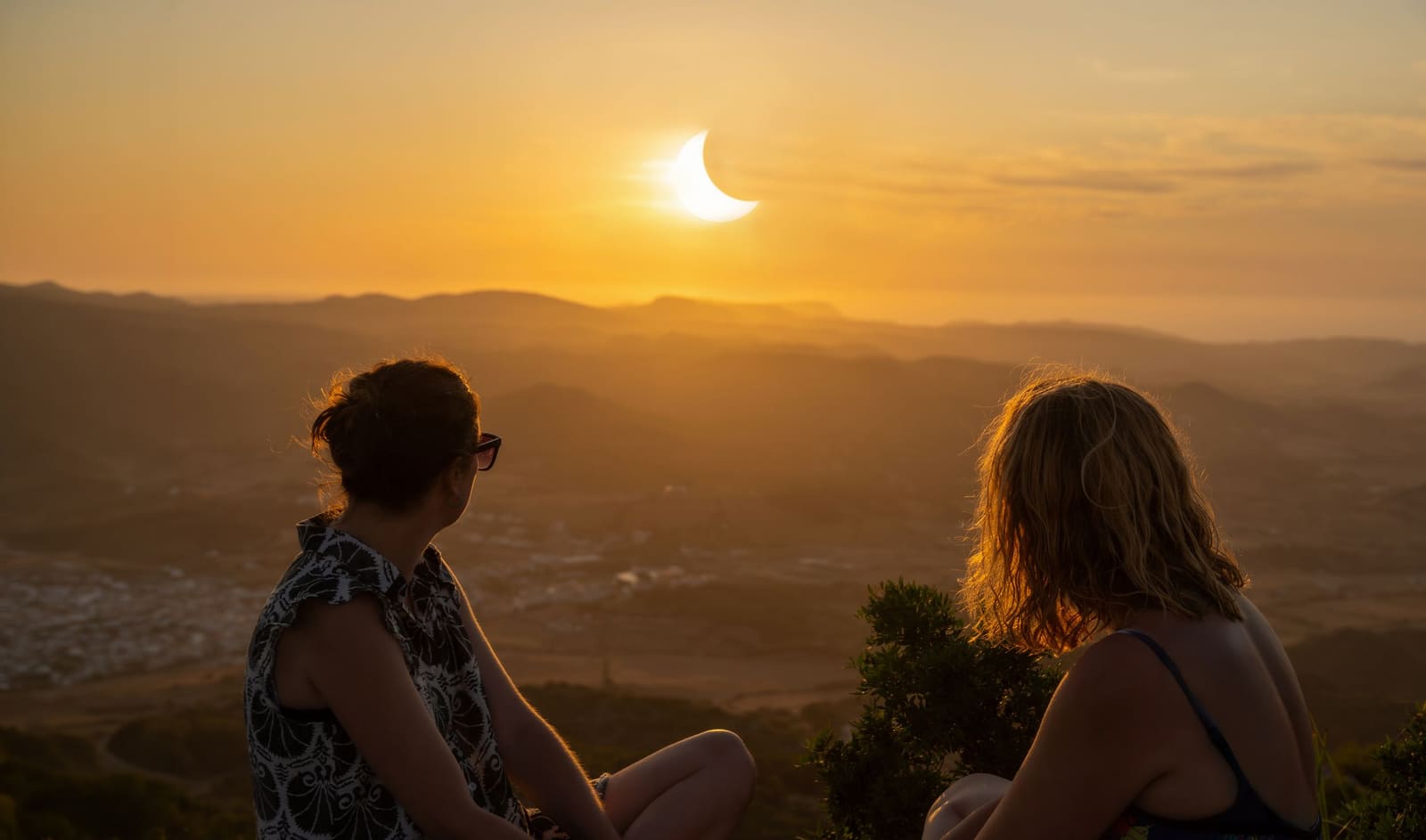
The August 12 eclipse cutting across Greenland, Iceland, and Spain drew significant crowds despite its narrow path. Northern Spain anticipated roughly 460,000 international visitors, with another 128,000 heading to Iceland. Flight bookings to both countries jumped 25 percent year-over-year, according to travel data, with Spanish cities like Bilbao seeing especially sharp increases.
For an event lasting around 90 seconds in most viewing locations, the logistics can seem disproportionate. But umbraphiles describe totality as something that resists explanation until you've stood beneath it.
What Happens During Totality
Marc Rassel, a Minnesota astrophotographer who's been chasing eclipses since 2017, watched this year's event from Spain. He describes the sensory shifts: strange light quality, a 360-degree sunset effect on the horizon, sudden temperature drops, and confused birds resuming their evening calls.
The visual centerpiece is the sun's corona, the outer atmosphere normally invisible against the star's brightness. Once the moon slides fully in front of the sun's disk, viewers can remove their eclipse glasses and look directly at the phenomenon. It's a perspective most people never get on the sun, and seasoned chasers say it's breathtaking every time.
Jamie Carter, a Cardiff-based astronomy journalist, has pursued eclipses from Chile to Australia since his first in 1999. This year he lectured aboard an eclipse cruise to east Greenland, hoping to watch totality among Arctic ice and tundra.
The instinct is to photograph it, but many veterans advise newcomers to just watch. Rassel, despite being an astrophotographer by trade, left his camera packed during his first eclipse in Wyoming in 2017. He wanted the unmediated experience. The advice he's heard repeated in the community: see your first eclipse, then photograph the rest.
The Human Side of the Spectacle
Allyson Bieryla, an astronomer at Harvard's center for astrophysics, watched her first eclipse in Wyoming in 2017. She remembers people cheering, crying, standing frozen with their mouths open. The shared emotion was as striking as the eclipse itself.
Bieryla has since worked to expand access to that experience. She co-launched LightSound, an open-source device that converts the eclipse's changing light into sound, allowing blind and low-vision communities to follow the event in real time.
For Chicago-based astrophotographer Jeff Pfaller, who leads eclipse tours, the 2017 event doubled as a family science lesson. His children skipped their first day of school to watch from a bird sanctuary in St. Louis, where they observed animals behaving strangely as daylight dimmed.
Jessica Madow, a nurse practitioner from Orlando, came to eclipse chasing through her astrophotographer husband. They brought their toddler daughter to New Mexico for the annular eclipse in 2023. The child enjoyed wearing the eclipse glasses and watching crescent-shaped shadows form on the ground. This year the family traveled to Spain, armed with eclipse-themed children's books to build anticipation.
Koh's eclipse trips have become multi-generational gatherings. In 2023, he, his wife, and their sons traveled to Exmouth, Australia, for totality. One son proposed to his girlfriend during the trip. For the August 2026 eclipse, Koh watched from a cruise ship in the Bay of Biscay with over a dozen family members and friends. Sharing the experience, he says, has become more rewarding than the eclipse itself.
Eclipse Tourism as a Travel Strategy
Eclipses pull travelers to places they might not otherwise visit. Madow is planning a trip to Sydney for the 2027 eclipse, an event nicknamed the "eclipse of the century" due to its six-minute duration, the longest until the 2100s. She's never been to Australia and sees the eclipse as the perfect excuse.
Luxor, Egypt, a city with ancient ties to solar worship, is expected to be a major draw for the 2027 event. Carter will be there as part of a tour, and has trips lined up to the Australian outback for the 2028 eclipse. Rassel is eyeing northern Morocco for 2027, while Pfaller is organizing group trips to southern Spain and later New Zealand.
The hobby rewards advance planning. Carter notes a rush of bookings immediately after each eclipse, especially for group tours and accommodations along the narrow paths of totality. Pfaller recommends arriving several days early to avoid traffic jams and suggests booking lodging within the totality path so you don't need to drive on eclipse day.
Weather is the wild card. Pfaller advises checking historical cloud-cover data for the eclipse date, but no amount of preparation guarantees clear skies. Koh has been clouded out of three of his 14 eclipse chases. Even then, he says, the experience has value. The sudden darkness, the temperature plunge, the eerie quiet sweeping over the landscape are memorable in their own right.
Why Keep Chasing
Totality is brief, the travel often complicated, and the weather unpredictable. So why do umbraphiles keep going back?
Rassel puts it plainly: you can't understand it until you're standing there. The strangeness of the light, the visceral reaction of everyone around you, the uncanny beauty of the sun's corona, it doesn't translate through descriptions or photographs.
Koh's first eclipse in 2008 reshaped how he thought about astronomy. What began as scientific curiosity became something closer to pilgrimage. The emotional and even spiritual dimensions surprised him, and they've kept him traveling ever since.
For many chasers, the appeal isn't just the eclipse but the ritual around it: planning trips years in advance, gathering with other enthusiasts, introducing friends and family to the experience, and visiting corners of the world they'd never considered.
It's a peculiar form of travel, centered on a celestial event that lasts less time than a pop song. But umbraphiles insist those minutes justify the effort. And once you've seen one, the calendar of future eclipses starts to look less like a list of dates and more like a travel itinerary.