A Route Returns
On August 10, the first international train in more than thirty years rolled between Finland and Sweden. The service links Oulu, Finland's fourth-largest city and a key northern port, with Haparanda, a small Swedish town at the mouth of the Torne River that once thrived on fur and timber exports. The 128-kilometre route traces the northeastern rim of the Bay of Bothnia, a stretch of coast that has seen no scheduled cross-border rail traffic since the early 1990s.
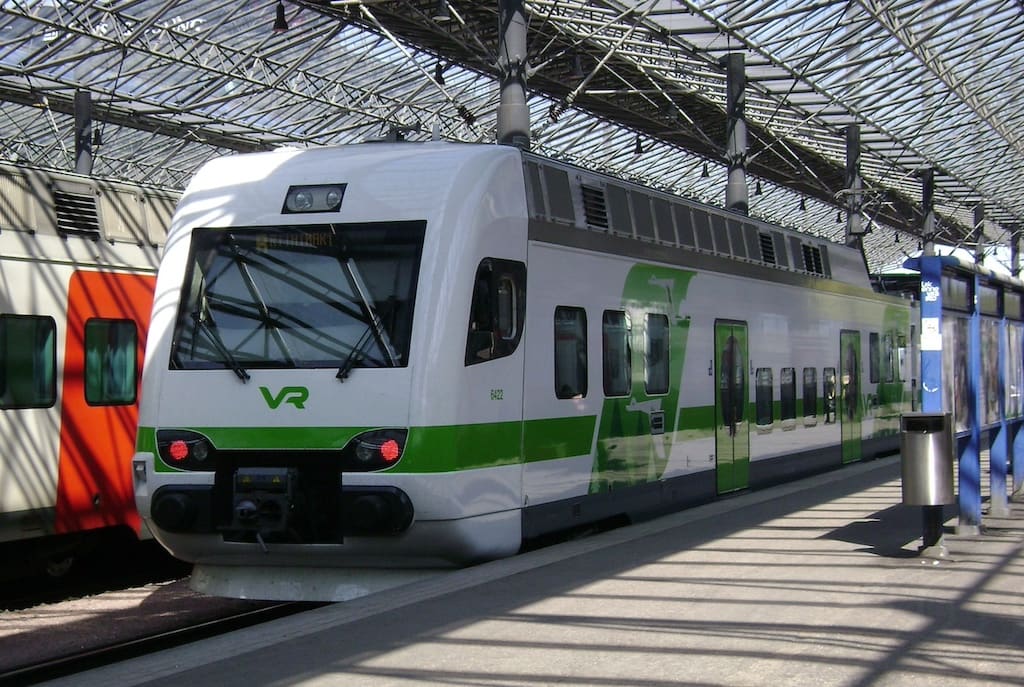
VR, Finland's state railway, operates the line with double-decker trains running twice daily in each direction. Journey time is one hour and forty minutes, and fares start at €5.40, though prices shift with demand and season. Onboard, passengers find second- and first-class seating, a bistro, and a playroom for children.
Why the Gap
Finland stopped running trains into foreign territory in 2022, when services to St Petersburg ended after Russia's invasion of Ukraine. But the gap with Sweden stretches back further. According to Juho Hannukainen, VR's director for new traffic, the last Finnish train over the border ran in 1988; the last Swedish service ended in 1992. The reasons were economic and political rather than technical, as cross-border demand dwindled and both countries turned their infrastructure priorities inward.
Now, with Nordic security cooperation deepening and European rail investment rising, the case for reconnecting the two countries has strengthened. Lulu Ranne, Finland's transport minister, travelled on the inaugural service and framed the link in strategic terms, saying transport connections also serve as security policy. She pointed to the way reliable travel infrastructure between neighbours builds resilience.
What It Opens Up
The new service does not extend beyond Haparanda. Rail gauges differ between the two countries, so passengers heading farther into Sweden must transfer to southbound trains at the border station. Even so, the connection unlocks itineraries that were difficult or impossible before.
Travellers can now complete a Helsinki-Stockholm journey entirely by rail in roughly 24 hours, looping around the top of the Gulf of Bothnia instead of taking a ferry across the Baltic. The route also forms the northern anchor of what some are calling Europe's longest continuous train journey: a 5,000-kilometre trek from Portugal's Algarve coast to Kolari, Finland's northernmost station.
Not everyone is convinced the routing is ideal. Mark Smith, who writes as The Man in Seat 61 and is widely followed for his rail expertise, called the Helsinki-Stockholm connection workable but noted a 17-minute transfer window at Tornio that he considers too tight. He suggested walking or taking a taxi between Haparanda and Tornio Itaïnen to catch a later sleeper train south. Still, he acknowledged that VR treats the connection as official and issues through tickets.
A Broader Shift
Elisa Markula, VR's chief executive, described the launch as part of a European rail renaissance, pointing to rising passenger numbers across the continent. The trend reflects a mix of factors: climate awareness, high fuel costs, improved rolling stock, and a generational shift in how people think about distance travel.
For Oulu and Haparanda, the service brings practical benefits. Oulu, sometimes called the capital of northern Finland, gains a direct link to Sweden's rail network. Haparanda, population under 10,000, becomes a cross-border hub again after decades as a quiet endpoint. Local officials hope the trains will spur tourism and business travel, particularly as travellers look for alternatives to flying short regional hops.
The route also tests whether appetite exists for slow, scenic travel in a region better known for long winters and sparse population. If ridership holds, it may encourage other dormant cross-border routes to reopen, stitching together parts of Europe that drifted apart in the late twentieth century.
What Comes Next
For now, VR is focused on proving the service can sustain itself. Twice-daily frequency leaves room to add departures if demand warrants, and the operator has not ruled out seasonal adjustments. The real measure will be whether passengers use the trains not just for novelty trips but as a regular alternative to driving or flying.
The return of cross-border rail between Finland and Sweden is a small reversal of a decades-long trend. It shows that infrastructure decisions made in the past are not permanent, and that changing political and environmental priorities can bring old routes back to life. Whether this one thrives will depend on how many people find value in a slow curve around the top of the Baltic, trading speed for simplicity and a view of the coast.