The Other Greece
Greece keeps pulling millions of visitors each summer, but most of them end up funneling through the same handful of islands. Santorini's caldera gets photographed a few million more times, Mykonos beach clubs stay packed until dawn, and the rest of the archipelago - over 200 inhabited islands - gets a fraction of the attention.
That imbalance is starting to shift. Travelers looking for the same cobalt water and long lunches, minus the crowds, are discovering islands that have stayed deliberately low-key or simply off the main ferry routes. Some are a short hop from Athens. Others require a connecting flight or a slower boat. What they share is a pace that feels less packaged, more lived-in.
Ikaria: The Island That Forgets to Age
Ikaria earned its reputation as one of the world's Blue Zones, places where people routinely live past 100. The reasons aren't mysterious: a diet heavy on vegetables, olive oil, and herbal tea; strong social ties; and terrain that keeps you moving whether you want to or not.
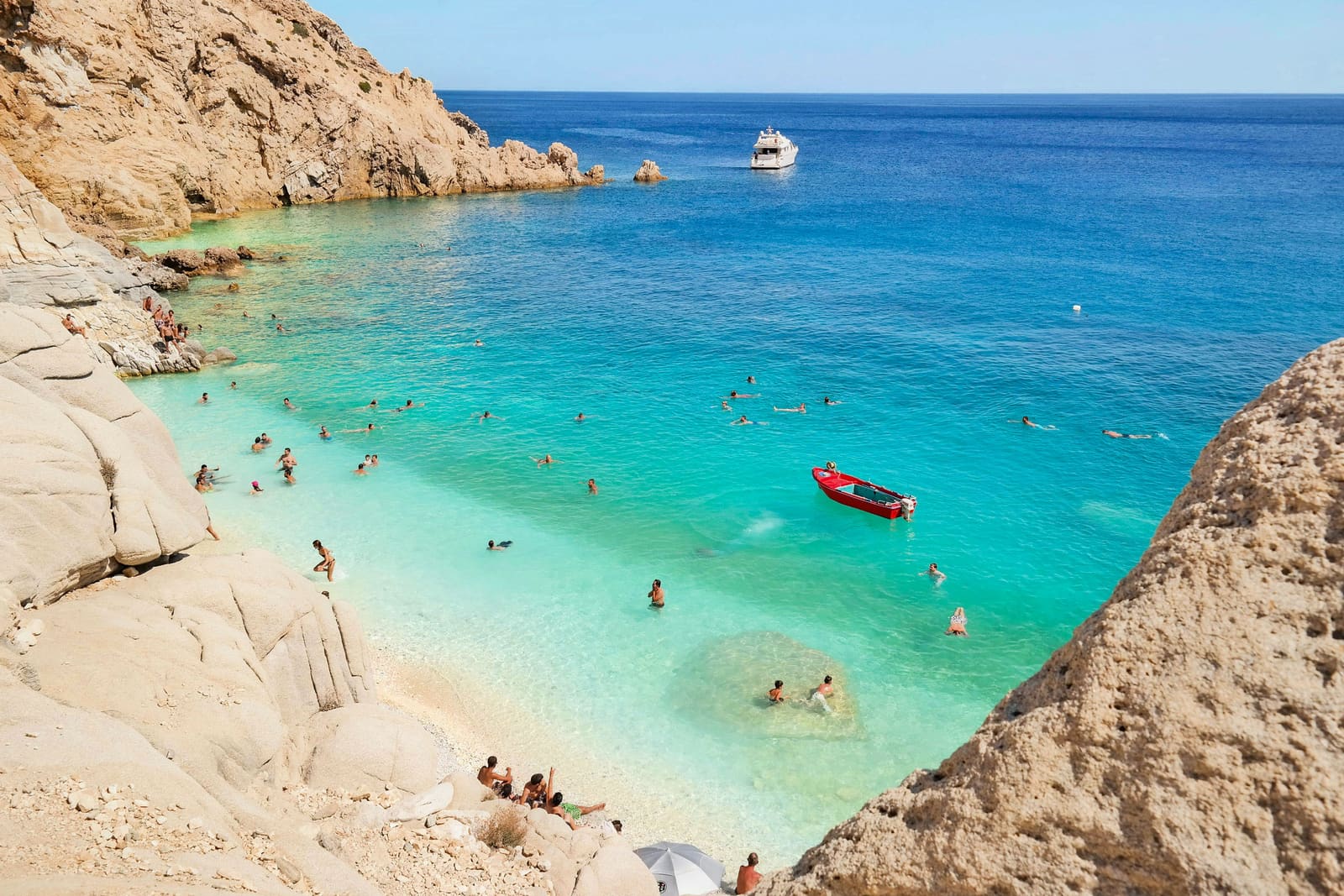
The island is wing-shaped and mountainous, with rocky slopes the color of dry butter. Trails cut through gorges, past waterfalls and ancient forests. Messakti beach draws surfers, and the island runs a surf school for beginners. But the real draw might be the panegyria, traditional feast days that stretch from dusk until sunrise, with dancing, wine, and no fixed schedule.
Kea: The Athenian Weekend
An hour by ferry from Lavrio, Kea - also called Tzia - is where Athenians go when they want the Cyclades without the commitment. The island is close enough for a long weekend, far enough to feel like an escape.
Hillsides roll down to beaches with deep, teal water. The ancient city-state of Karthea, founded in the seventh century BCE, sits in ruins along the coast, its temples partially restored and its submerged port accessible to snorkelers. In the capital, Ioulida, narrow lanes wind past the stone Lion of Kea, a mysterious carving that dates back as far as the ninth century BCE.
The island's ceramic tradition continues at Argilos Keas, where a fourth-generation family shapes pottery with marine motifs. For dinner, the seaside village of Vourkari offers tavernas like Ennea Kores, where sunset timing matters.
Lesvos: Ouzo, Sardines, and Fossils
Lesvos sprawls across the Northeast Aegean, large enough to support a thriving food culture that Greek gastronomes have quietly celebrated for years. The Gulf of Kalloni is famous for sardines, and villages around the coast are lined with family-run fish tavernas and meze spots. Grigoris, Giotes, and Mimis are local favorites.
The island also harbors a petrified forest, part of a UNESCO Global Geopark. Fossilized sequoia trees stand in place, and the Natural History Museum displays plant and animal fossils from millions of years ago. In the town of Plomari, Ouzo Varvayanni has been distilling the anise spirit since 1860 and offers tastings.
Karpathos: Where Tradition Holds On
Karpathos sits in the Dodecanese, an 80-minute flight from Athens, and it has held onto customs that other islands let slip. In the mountain village of Menetes, stone mansions display neoclassical architecture. In Olymbos, perched on a steep slope, some women still wear traditional dress daily. Brides from the village marry in richly embroidered sakofoustano, adorned with gold coins.
Beyond the cultural layer, Karpathos suits active travelers. Ecotourism Karpathos organizes hikes paired with wild herb-gathering, bird-watching excursions, and cooking classes focused on recipes like makarounes, a local fresh pasta. The beach at Kyria Panagia, named for the red-domed church on the rockface above it, delivers the postcard moment if you need one.
Kythnos: The Hidden One
The name Kythnos may derive from an ancient Greek word meaning "to hide," and the island has done a decent job of it. Low-key and easy to drive, it offers the Cycladic formula without the fuss: sun-baked mountains, sheltered bays with blue-green water, tamarisk shade.
Beaches like Antonides and Apokrousi stay quiet. Martinakia and Episkopi have beach bars if you want loungers and cocktails. The Monastery of Panagia Kanala, one of the Cyclades' major pilgrimage sites, sits in peaceful isolation. In the capital, Hora, whitewashed houses line cobblestone streets, their doorways painted in bright colors.
Serifos: Italians Know Something
A two-hour fast ferry from Piraeus, Serifos has no airport and a growing contingency of Italian fans, some of whom have built homes here. The island's small port shelters sailors when the meltemi winds blow in summer.
Beaches are sandy and unpretentious. At Agios Sostis, a trail climbs from the shore to a whitewashed church on a rocky headland. Psili Ammos has shallow, turquoise water and a no-frills fish taverna called Manolis. The bay at Megalo Livadi still shows traces of the island's mining past. After dark, the hilltop capital Hora comes alive with slim alleyways, dinner at Marathoriza, and drinks at Vatrachos.
Limnos: Space to Breathe
Limnos sits in the heart of the Aegean, a 60-minute flight from Athens. The capital, Myrina, has a medieval castle on a hill, offering views over the old harbor and the Romeikos Gialos promenade. Fallow deer and wild goats graze the hillsides in the morning and evening, wandering freely around the castle grounds.
The island's beaches are golden sand. Plati and Keros offer windsurfing and kitesurfing. Riha Nera has shallow seas and dramatic rock formations. Megalo Fanaraki works for beach volleyball and gives kids room to run.
On the northern side, sand dunes stretch across the landscape, a relic from three million years ago when the area was coastal. The dunes now shelter rare birds and reptiles among wild pear trees and oleander.
Lefkada: Drive-On Access
Lefkada connects to the mainland by causeway, making it one of two Greek islands you can drive to. But the more relaxed approach is the 70-minute ferry from Fiskardo in Kefalonia to Vassiliki, a windsurfing hub.
The west coast holds the best beaches: milky turquoise water, extra-fine pebbles that don't cling. Porto Katsiki, Egremni (down a long stairway), and Kathisma line the shore. Inland, the village of Egklouvi is known for high-quality lentils and has a shady square where Lithanofli serves meals. The coastal village of Agios Nikitas offers an easygoing base, especially for families.
Leros: Art Deco in the Aegean
Leros has a Greek identity with an Italian accent, thanks to the occupation between the world wars. In the southern town of Lakki, eucalyptus-lined squares hold churches, clock towers, theaters, and schools built in art deco, Bauhaus, and Renaissance styles - a blend labeled Italian rationalism.
The Italian army transformed the town, then called Portolago, into a military base, and the architecture remains. Preservation efforts are underway, and the buildings occasionally host contemporary art exhibitions. The island is also bike-friendly, with guided cycling tours and well-marked routes.
Spetses: Car-Free and History-Rich
A high-speed ferry from Piraeus reaches car-free Spetses in under two hours. The Saronic island, scented with pine, is popular with Athenians and has a storied past tied to Greece's independence movement in the 1820s.
Horse-drawn carriages, bicycles, and scooters handle transport. The island's maritime history is preserved in museums and old mansions. The pace is unhurried, the water clean, and the evenings long.
Choosing Your Island
These islands don't compete with Santorini's drama or Mykonos' energy. They offer something quieter: beaches where you can hear the water, tavernas where the menu is whatever came in that morning, and villages that haven't been reshaped for tourism.
Ferry schedules matter. Some islands connect easily to Athens or each other; others require planning. Flight availability varies by season. But the effort pays off in space, in time that moves differently, and in a version of Greece that feels less performed.