A City of Two Timelines
Hue sits roughly midway between Hanoi and Ho Chi Minh City, often bypassed by travelers moving between Vietnam's two largest urban centers. Yet this former seat of the Nguyen Dynasty holds a peculiar position in the country's cultural landscape: it's a place where preservation is both meticulous and selective.
The city served as Vietnam's imperial capital from 1802 until 1945, when the last emperor abdicated and Hanoi reclaimed the title. French colonial administrators controlled the region from the 1880s onward, keeping emperors on the throne as symbolic figures while wielding actual power. That dual legacy, imperial Vietnamese and colonial French, has left the city with layers of architecture that officials now decide which to protect and which to let fade.
Walk through Hue today and you'll encounter two parallel realities. Pagodas, tombs, and palace complexes receive careful maintenance and steady visitor traffic. A short distance away, an abandoned cement factory stands skeletal against the sky, visible from the road but fenced off. A former water park, closed since 2006, has been reclaimed by vines and graffiti. French colonial villas in the surrounding countryside lose their roofs to time and weather.
The contrast raises a question that extends beyond Hue: when a place inherits more history than it can afford to maintain, who decides what gets remembered?
The Water Park That Became a Film Set
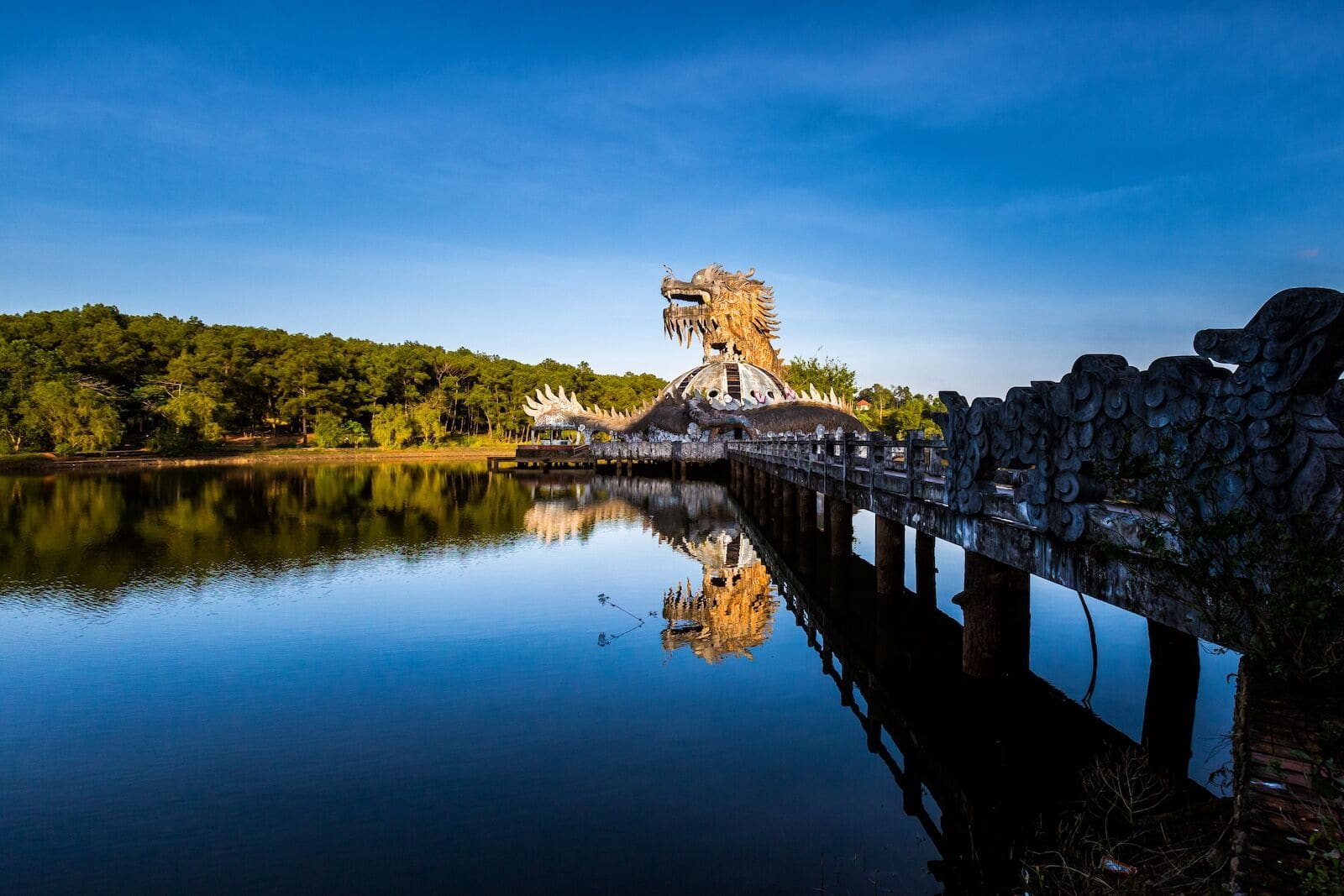
Ho Thuy Tien water park opened in 2004 and shut down within two years, reportedly never fully completed. For nearly two decades it sat empty, its dragon-shaped aquarium and concrete slides slowly overtaken by jungle growth. The site became an unofficial destination for urban explorers and photographers drawn to its post-apocalyptic aesthetic.
In 2025, the city formalized what had been happening informally: it reopened the site as a community park. Visitors now pay a small entrance fee, around 40 cents in US dollars, and city workers maintain the grounds. Bicycles are available for rent. The structures remain as they were, abandoned but structurally sound.
Peter Pham, who runs Hue Private Excursions, notes that foreign visitors are drawn to the contrast between nature and decay. The site has appeared in music videos by international artists, lending it a viral appeal that likely outweighs the cost of demolition.
For years, a rumor circulated that crocodiles once housed in the aquarium had escaped into the surrounding lake, fed by locals and backpackers while authorities debated their fate. The story spread through travel forums and online publications. The crocodiles did remain on-site after the park closed, but were eventually relocated to secure facilities. Still, the legend persists, adding to the site's mystique.
The park's transformation from abandoned ruin to managed attraction reflects a pragmatic approach: if people are coming anyway, formalize it and collect revenue. But it also suggests that tourism appeal can grant a kind of informal protection, even to sites with no historical pedigree.
Colonial Architecture on the Margins
French colonial buildings present a more contentious preservation challenge. Roughly 240 such structures stood in Hue as of 2000, according to a peer-reviewed study published in Sustainability. By the time the analysis was completed, only about 77 remained, casualties of urban expansion.
In 2018, city officials released a list of 27 colonial buildings designated for formal protection. Critics argued the list was also a tacit approval to demolish the rest. The decision sparked debate among residents who view the buildings as important cultural landmarks, even if they represent a painful chapter.
An Dinh Palace offers a case study in selective restoration. Built around 1900 and significantly remodeled in 1917 by Emperor Khai Dinh, the palace blends Vietnamese and European design elements. After the royal family abandoned it in the 1940s, the building deteriorated for decades. A German conservation team restored it in 2002, and today it functions as a visitor site managed by the Hue Monuments Conservation Centre. Many rooms are furnished as they would have been, though signs of earlier neglect remain visible on exterior walls.
About an hour south of the city, Bach Ma National Park contains roughly 100 French colonial villas in various stages of decay. Unlike the cement factory in town, these ruins are open to visitors. An Nguyen of Connect Travel, which organizes tours throughout Vietnam, says the villas are popular with photographers, especially when heavy mist drifts through empty window frames and roofless interiors.
Pham argues that protecting colonial structures, however uncomfortable their origins, creates educational opportunities and boosts tourism. The buildings are part of Vietnam's history, he says, whether the country likes it or not.
What Gets the Official Treatment
The Hue Monuments Conservation Centre manages around 40 formally protected sites, including temples, pagodas, and the tombs of Nguyen emperors. The Imperial City, a palace complex that served as the seat of power from 1802 to 1945, is the crown jewel of these efforts. The tombs of emperors Minh Mang, Tu Duc, and Khai Dinh draw steady crowds. One persistent rumor holds that Khai Dinh, fearing grave robbers, orchestrated a secret burial elsewhere, leaving his elaborate tomb as a decoy.
Thien Mu Pagoda, founded in 1601, sits on the grounds of an active monastery. Visitors stroll past monks tending gardens and performing daily maintenance. The pagoda has been continuously occupied by Buddhist monks for more than four centuries, a rare example of living preservation.
Ho Quyen arena, a more obscure site under the conservation centre's purview, once hosted brutal spectacles in which elephants, representing the Nguyen monarchy, fought tigers symbolizing enemies and rebels. Tigers were reportedly declawed and defanged to ensure the elephants won, a staged triumph of imperial power over dissent.
The conservation centre states that its goal is to preserve sites in a way that provides cultural and economic value to surrounding communities, not just to safeguard them for future generations. Officials emphasize that conservation and development are parallel processes, with preservation serving as the foundation for sustainable growth.
Tourism as a Preservation Tool
Vietnam welcomed more than 21 million visitors in 2025, a record high. Hue saw nearly 2 million visitors in the first three months of 2026 alone, a 30 percent increase over the same period the previous year. The influx brings both opportunity and pressure.
Pham views mass tourism as a net positive for preservation, arguing that increased visitor numbers generate tax revenue and funding for site management. The challenge lies in scaling infrastructure and conservation efforts to match the pace of growth.
The city's approach suggests a pragmatic hierarchy: imperial and religious sites receive formal protection and maintenance, while industrial ruins and colonial buildings exist in a gray zone. Some, like the water park, gain informal protection through visitor appeal. Others, like the cement factory, remain off-limits but visible, their futures uncertain.
What happens to the structures that didn't make the protected list will shape Hue's landscape in the coming decades. The city's decisions, whether driven by cultural priority, economic calculation, or tourism demand, will determine which chapters of its layered history remain legible and which fade into the jungle.