A Building That Belongs to the Sea
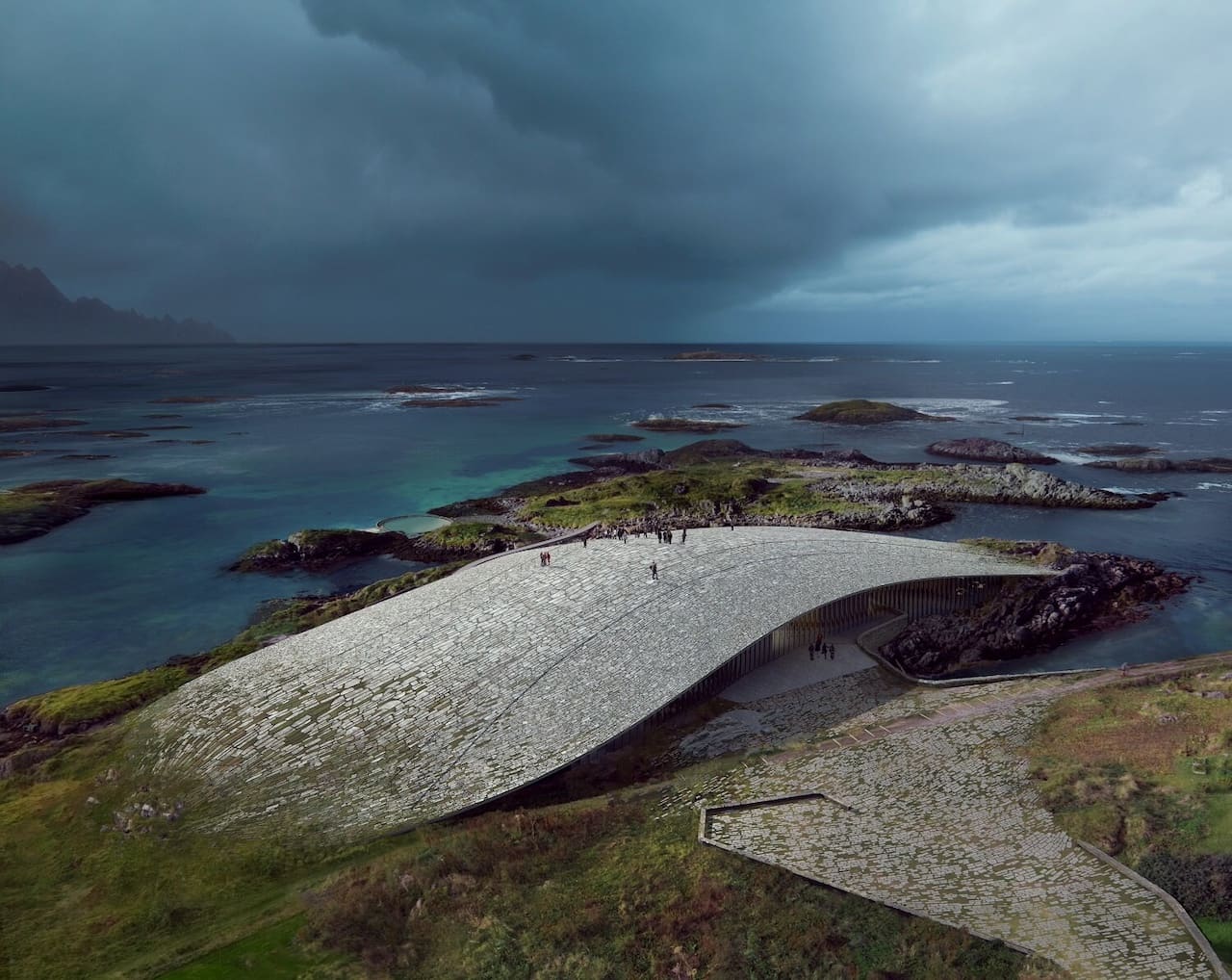
Andenes sits 300 kilometers north of the Arctic Circle, where the continental shelf drops away and whales pass close to shore in every season. Come June 2027, the town will unveil a museum designed to mirror that proximity. Danish architect Dorte Mandrup has shaped a structure that appears to emerge from the rocky coastline, its form echoing a whale breaking the surface.
The building's silhouette is deliberate. A sweeping concrete roof, clad in local stone, curves upward and extends toward the water. At ground level, a curved glass wall reflects the sea so precisely that the boundary between structure and environment softens. From certain angles, the museum seems to vanish into its surroundings, its materials and lines repeating the textures of rock, water, and sky.
The roof is open to visitors, offering a walking path across its surface. From there, the view takes in the ocean, the surrounding mountains, and the Andenes lighthouse. Mandrup has described the design as though a giant had lifted the Earth's crust and carved out a space beneath, revealing another layer of the world.
Inside the Hollow
That carved-out space holds the museum's core exhibits. Life-size wooden sculptures of killer whales appear to breach the surface within the interior. A Species Gallery catalogs all 90 modern whale species and traces their evolutionary arc across 50 million years.
One room dissects whale anatomy in detail, bone by bone, including the less familiar internal structures. Another, called the Horizon Room, reorients the globe to show the world's oceans as a single, connected body of water rather than separate seas divided by land.
At the center, a full-scale whale sculpture anchors the Library of Relations, an exhibit exploring the long entanglement between humans and whales. The focus is on parallels in communication, social cooperation, and caregiving behaviors that both species share.
Sound as a Gateway
The Soundscape is a dimly lit chamber designed to recreate the sensory experience of being underwater. Whale song plays at frequencies that fill the space, and the exhibit is built around the idea that these sounds do more than inform or entertain.
Research from the University of the Sunshine Coast has found that listening to whale vocalizations can trigger feelings of awe and a stronger sense of connection to the natural world. That emotional response, in turn, correlates with increased willingness to adopt environmentally conscious behaviors. The museum is betting that immersion in whale song will shift how visitors think about their relationship to marine life.
Why Andenes
The location is not arbitrary. Andenes sits at the edge of the continental shelf, where deep water lies close to shore. That geography makes it one of the few places on Earth where whales can be observed throughout the year, not just during migration windows.
Whale-watching excursions from Andenes typically last three to four hours and cost around 155 euros. Sperm whales are common in summer months, while humpbacks arrive in winter. Dolphins also frequent the area. The museum plans to offer packages that bundle admission with hotel stays and whale-watching trips; those packages are expected to go on sale this autumn.
A Building That Moves While Standing Still
What makes the architecture compelling is its refusal to dominate. Despite its scale, the museum reads as part of the landscape rather than an imposition on it. The materials are local, the color palette muted, the form fluid rather than rigid. It is monumental without being declarative.
Mandrup's design achieves something rare: a building that commands attention while appearing to recede. It is chameleon-like, shifting with the light and weather, never static. That quality mirrors the subject it celebrates. Whales are creatures of motion, visible only in glimpses, always moving between depths and surface. The museum captures that rhythm in concrete and glass.
For Andenes, the arrival of the museum represents a new kind of draw. The town has long been a departure point for whale-watching, but the building itself may become a destination. Early images suggest it will be worth the journey north, even for those who never board a boat.