A Different Kind of Greek Island Stay
Crete's western coast has long drawn travelers seeking pink-sand beaches and turquoise coves, but the accommodation choices have traditionally leaned toward sprawling resorts or simple guesthouses. The Revery, which opened this August near Chania, pitches itself somewhere in between: small enough to feel intimate, designed to blend into the landscape, and built around the idea that doing less to the land can mean more for the guest.
The property sits on a hillside above the Mediterranean, close to Elafonissi Beach and a two-hour drive from Chania International Airport. Its 24 rooms split into two formats. Lower down, tucked into coastal scrub, are the Revery Wild units: Greece's first safari-inspired tented pavilions, each at least 40 square meters, with private decks and hydrotherapy pools. Higher up, the Revery Suites stretch to 53 square meters, each with a heated infinity pool and views that run uninterrupted to the horizon. A standalone villa, sleeping up to six, offers 285 square meters across two floors and its own pool.
The hotel welcomes guests aged 12 and older, a policy that underscores its pitch as a place for quiet. The name itself, borrowed from the French rêverie, suggests daydream, and much of the design seems calibrated to encourage just that: sitting still, looking out, letting the hours blur.
Built Into the Hillside
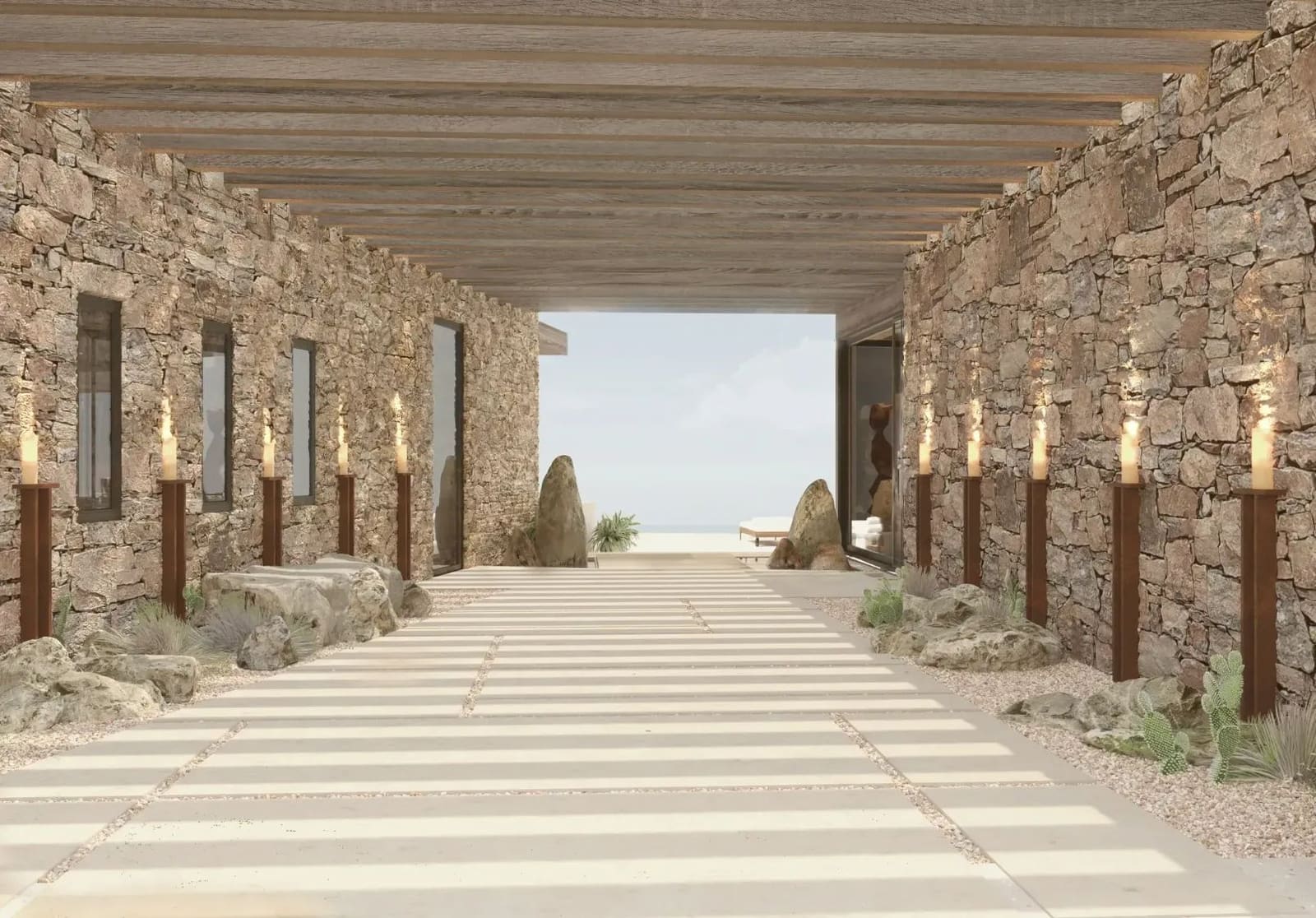
Local architect Eirini Apostolaki of Archtify led the project, with interiors by Sophia Vantaraki of ThingK, an Athens-based studio. The palette stays neutral: wood, stone, raw plaster. The aim, according to the design team, was to create spaces that feel restful without tipping into minimalism so spare it becomes cold. Every surface and sightline appears considered, but the effect is meant to be unobtrusive, as if the rooms grew out of the hillside rather than being imposed on it.
Sustainability shaped the construction from the start. The buildings rely on natural ventilation and solar power. Water-saving systems run throughout, and wastewater gets treated biologically on-site. Lighting was chosen to minimize pollution. Stone excavated during building was reused in walls and pathways, and any native plants displaced were replanted before work began. Paths follow the land's natural contours rather than cutting straight lines.
An 80-year-old chapel dedicated to St. Anthony, already standing on the property, was preserved and integrated into the grounds. It's a small detail, but one that signals the project's broader intention: to fit into what was already there rather than erase it.
Wellness Without the Hype
The ROEÉ Spa, named for the Greek word for flow, occupies its own corner of the property. It includes four treatment rooms and a thermal area with sauna, steam room, and alternating hot and cold baths. A gym faces the sea, and an outdoor yoga deck catches the morning light. The offerings are standard for a boutique property of this scale, but the setting does some of the work: treatments that might feel routine elsewhere gain something when the backdrop is olive groves and open water.
Fílema, the on-site restaurant, takes its name from a Greek term tied to hospitality and shared meals. The kitchen works with seasonal produce from local farms and follows traditional family recipes, a approach that's become common in smaller Greek hotels trying to root themselves in place. The menu shifts with what's available, and the dining room opens to the outdoors, so most meals come with a view.
Who It's For
The Revery positions itself for couples, solo travelers, and small groups of friends, particularly those who'd rather spend time on a terrace than touring archaeological sites. The age restriction and the emphasis on privacy make it less suited to families with young children, though the villa option does accommodate multi-generational groups willing to meet the 12-and-over threshold.
That said, the surrounding area offers plenty for guests inclined to move. Elafonissi, Kedrodasos, Falasarna, and Balos beaches are all within reach. The hotel can arrange guided canyon hikes, 4x4 safaris, windsurfing and kitesurfing lessons, private boat trips, and fishing excursions. Local artisans also lead craft workshops on-site, though details on frequency and cost remain unclear.
Chania International Airport connects to Brussels, London, Berlin, Vienna, and Milan with direct flights, among other European cities. That accessibility, paired with the relative seclusion of the western coast, gives the property a practical advantage: easy to reach, harder to stumble upon.
The Cost and the Trade-Offs
The Revery operates seasonally, from March through November. Rates start at 600 euros per night, positioning it firmly in the boutique luxury bracket. That price buys privacy, low-density design, and a commitment to environmental mitigation, but it also means the property will remain out of reach for many travelers, even those who might value its approach.
The seasonal schedule also raises questions about year-round employment for local staff and the broader economic impact on the surrounding area. Boutique properties often tout their connections to local suppliers and artisans, but when they close for four months, those relationships become more transactional than sustained.
Still, within the narrow category of small, design-focused hotels on Greek islands, The Revery makes a case for itself. It avoids the over-the-top luxury language that saturates so much of the sector, and its environmental measures go further than token gestures. Whether that's enough to justify the rate, or to stand out in an increasingly crowded field, will depend on what travelers prioritize: the experience itself, or the story they can tell about it.
For now, the property offers a version of Crete that feels both intentional and unhurried, a place where the architecture steps back and lets the landscape do the talking. That restraint, more than any single amenity, might be its strongest appeal.