A Celestial Event Meets a Tinder-Dry Landscape
Wednesday's total solar eclipse will sweep across northern Spain from the Atlantic coast to the Balearics, and the country is bracing for what may become one of the most complicated mass gatherings in recent memory. Up to six million people are forecast to position themselves along the path where the moon's shadow will pass, with roughly 460,000 arriving from abroad. It is mainland Spain's first total eclipse in over a century, a rare astronomical alignment that has filled hotels for months and sent camper-van bookings soaring.
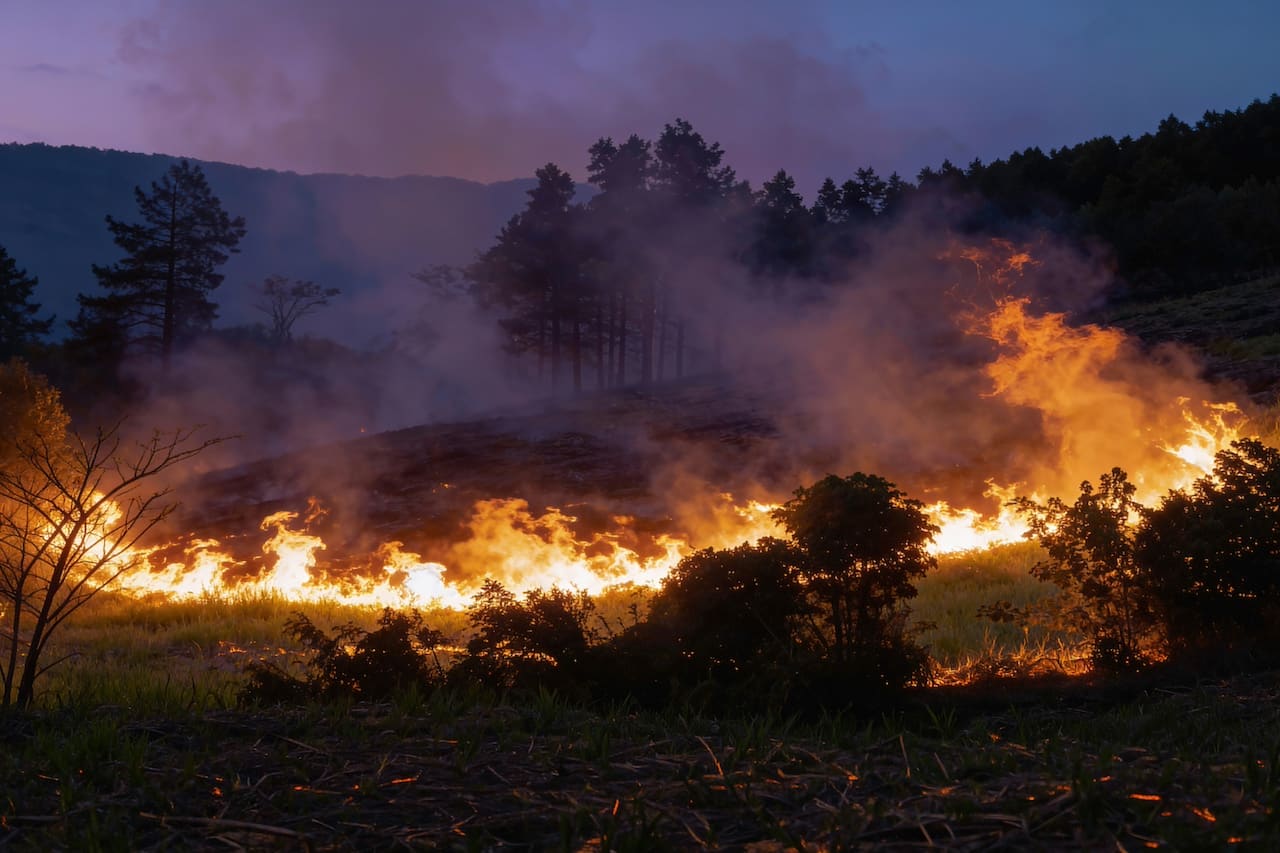
But the timing could hardly be worse. Spain has already lost around 200,000 hectares to fire this year, roughly six times what had burned by the same date in 2025. July delivered the least rain on record for the month since measurements began in 1961, with just 4.3 millimetres falling across the mainland, about a quarter of the usual amount. The same month tied as the hottest July ever recorded. Fires have flared in Huelva, Segovia, and Huesca in recent weeks, and much of the country remains under high or extreme fire-danger warnings as temperatures climb toward 40°C in some areas.
Spanish authorities have designated the eclipse a nationwide security matter, mobilising around 35,000 officers and establishing more than 660 official viewing zones. A control centre in Madrid will coordinate real-time surveillance and dispatch emergency teams. The Interior Ministry's Secretary-General for Civil Protection and Emergencies, Virginia Barcones, told reporters that Spain has endured an exceptionally difficult summer and that any activity capable of producing a spark must be curtailed.
The Fire Calculus
Environment Minister Sara Aagesen visited Niebla, a town recently scarred by flames, to underscore the danger. She described vegetation across the country as extraordinarily dry and warned that even the smallest oversight could ignite a destructive blaze. Officials are especially concerned about cigarette butts, portable barbecues, fireworks, and vehicles left idling on dry grass. The underside of a car, hot from driving, can touch off a fire if parked over brittle vegetation.
Regional governments have moved beyond warnings. Valencia has shut its natural parks and restricted access to rural footpaths for the day. Camping, open fires, barbecues, and pyrotechnics are banned in high-risk zones. Some planned eclipse gatherings elsewhere in the country have been cancelled outright because organisers could not guarantee safe conditions.
The influx is also expected to add roughly 1.5 million car journeys to Spain's road network. Authorities have asked travellers to avoid non-essential trips and to resist the temptation to pull over on highways or hard shoulders to watch the eclipse, particularly where stopped vehicles might block lanes needed by fire crews or ambulances. In rural areas, traffic jams could delay emergency responders trying to reach an ignition point before it spreads.
Accommodation Booked Out for Months
Despite the hazards, demand has been relentless. Small towns and villages along the eclipse corridor sold out their lodging months ago. Around 70 percent of Spain's caravan fleet has already been reserved, according to industry estimates. Hotel rates have climbed sharply in key viewing cities. A Coruña, which sits near the start of the path, has seen particularly strong interest, while Mallorca, Santiago de Compostela, and Bilbao have also recorded significant upticks as visitors compete for rooms within the narrow band of totality.
The phenomenon will be visible from a swath running from Galicia in the northwest to the Mediterranean, passing over cities including Bilbao and Zaragoza. NASA has chosen the village of Villalibado, population in the hundreds, as one of its observation posts, installing four high-powered telescopes beside the local Romanesque church to stream the event live to a global audience.
Eye Safety and Other Hazards
Wildfire is not the only concern occupying officials. Hospitals across the country are preparing for a possible wave of eye injuries among spectators who look directly at the sun without proper protection. Spain's consumer watchdog, FACUA, has withdrawn six brands of eclipse glasses after determining they do not meet safety standards. Authorities are urging anyone planning to watch the eclipse to use certified solar viewers and to avoid pointing smartphones or cameras at the sun without appropriate filters, which can damage both eyes and equipment.
The eclipse is expected to be the most significant in Europe for decades, drawing travellers not only to Spain but also to Iceland, another prime viewing location. Across the continent, millions more will see a partial eclipse. For Spain, the convergence of astronomical rarity and tourism demand has created an event unlike any other, but one shadowed by the reality of a landscape pushed to its environmental limits.
Managing the Convergence
Spain's approach reflects the scale of the challenge. More than 660 official sites have been designated, each selected for safety and accessibility, with the aim of concentrating crowds in places where they can be monitored and where fire risk can be managed. The national coordination centre will track conditions in real time, ready to respond if something goes wrong.
The eclipse will last only a few minutes in any given location, but the logistics extend across days. Travellers have been arriving throughout the week, filling campgrounds and parking areas. Some have driven across borders; others have flown into regional airports that rarely see such volumes. The economic boost is undeniable, but so is the operational burden.
For a country still recovering from one of its most severe fire seasons, the question is whether the infrastructure and the landscape can handle the surge. Officials are hopeful that the combination of public warnings, enforcement, and careful planning will prevent disaster. But with so many people fanning out into areas that are already vulnerable, the margin for error is narrow.
Spain's last total solar eclipse over the mainland occurred more than a century ago. The next one will not return for decades. Wednesday's event is a once-in-a-lifetime experience for most who will witness it. The challenge now is ensuring that the memory is not marred by tragedy.