A Rare Celestial Event Returns
Mainland Spain hasn't witnessed a total solar eclipse since two days before the Titanic sank. That changes this August 12, when the moon will block out the sun completely for the first time in more than a century, plunging parts of the Iberian Peninsula into daytime darkness.
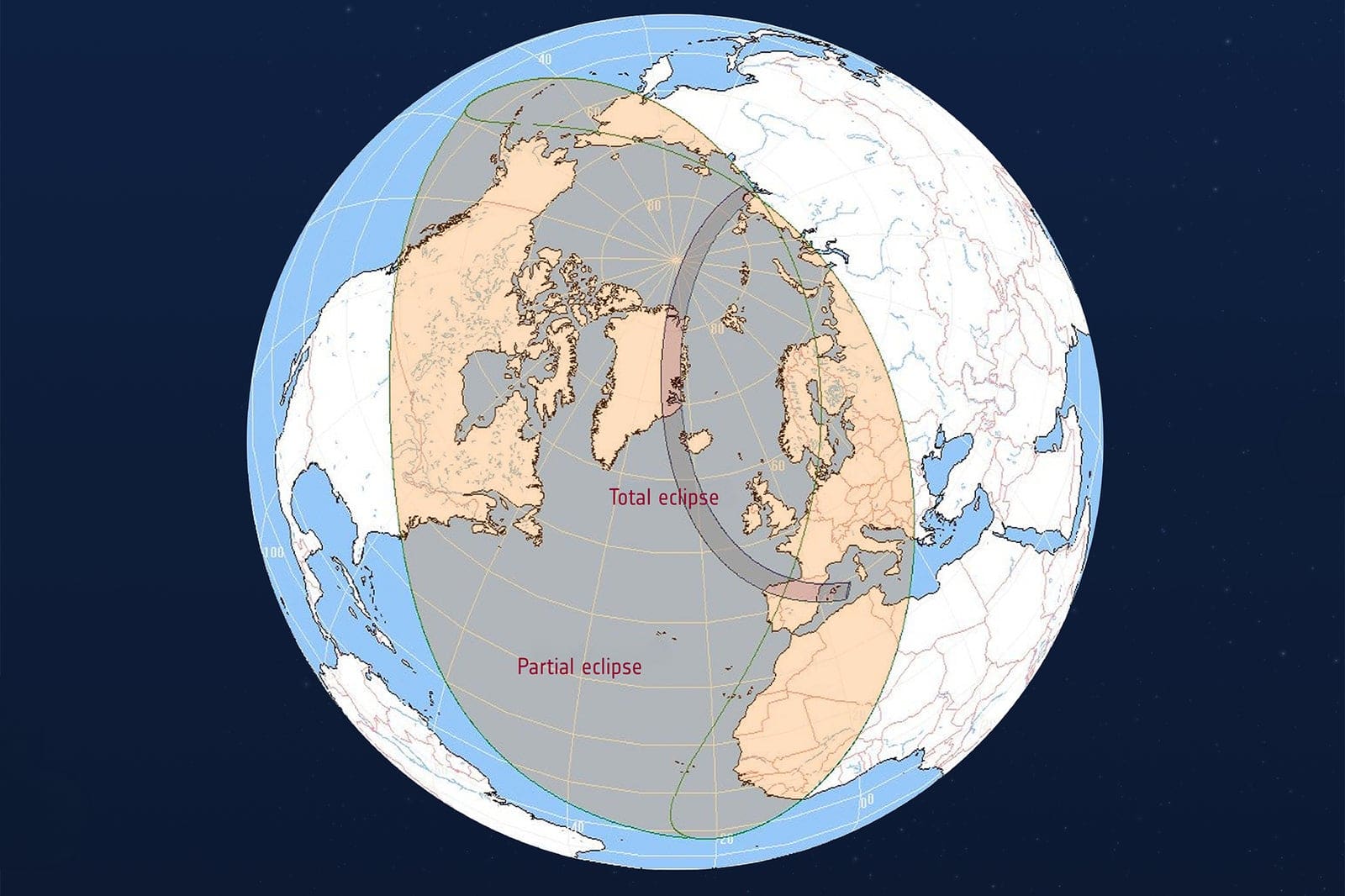
The eclipse will begin near the North Pole before tracking south, carving a narrow path that includes slivers of Greenland and Iceland before reaching Portugal and Spain close to sunset. At its longest, totality will last two minutes and 18 seconds, though by the time the moon's shadow reaches the Spanish mainland, that window will shrink to about a minute.
The European Space Agency will host a live broadcast from the Astrophysical Observatory of Javalambre and organize public events in Leon. NASA and other organizations will provide their own coverage as hundreds of millions of people position themselves along the path or settle for partial views from farther afield.
Who Gets to See What
The moon's shadow will race along a 5,130-mile course over about 90 minutes, much of it across the empty Atlantic. Maximum totality will occur off Iceland's west coast, where the alignment will be most precise.
Beyond the narrow band of totality, a much larger swath of the planet will see a partial eclipse. Dublin will experience 94% coverage, Oslo 83%. Montreal will see an 18% bite out of the sun, dropping to 9% in New York and just 2% in Norfolk, Virginia. The partial eclipse will be visible as far away as Alaska, Siberia, much of Europe, and parts of West Africa.
Anyone watching needs proper eclipse glasses. Even a sliver of visible sun can cause eye damage, and standard sunglasses won't cut it.
More Than Just the Eclipse
August 12 will pack multiple celestial events into a single day. Before dawn, six planets will form an arc across the sky. After nightfall, the Perseid meteor shower will peak under a new moon, offering ideal viewing conditions. Some of the brighter meteors might even streak through the darkened sky during totality, with planets and stars emerging in the background as the sun disappears.
Eclipse mapmaker Michael Zeiler, who will be chasing his 13th total solar eclipse from a cruise ship in a Greenland fjord, plans to point a video camera north during totality in hopes of catching the northern lights. A solar outburst at the right moment could trigger auroras visible against the darkened sky.
Research teams from U.S. universities will launch more than 60 high-altitude balloons from Spain and Iceland to study atmospheric changes during the eclipse. Temperature drops momentarily when the sun vanishes, and scientists want to measure how quickly that happens and what it does to air currents and other conditions.
A NASA high-altitude plane will chase the eclipse at 460 mph, extending totality to nearly three minutes in the air. Four cameras aboard the jet will capture thousands of images of the sun's outer atmosphere in nine different wavelengths during those 180 seconds.
Why Spain Matters Now
Spain's last full solar eclipse, not counting the Canary Islands, happened in 1912. Some eclipse historians argue it was actually 1905, since the 1912 event toggled between a ring-of-fire eclipse and just a few seconds of totality depending on location.
Either way, it's been a long wait. And this won't be Spain's only moment in the celestial spotlight. On August 2, 2027, an even longer total solar eclipse will sweep across the southern tip of Spain and continue into Morocco, Algeria, Libya, Egypt, Saudi Arabia, Yemen, and Somalia. Totality will last up to six minutes and 23 seconds, nearly three times longer than this year's event.
Then, on January 26, 2028, a ring-of-fire eclipse will complete Spain's three-part eclipse series. Carole Mundell, the European Space Agency's director of science, calls it a lucky coincidence. For a country that went more than a century between total eclipses, three major events in less than two years is remarkable.
The Science of Chasing Shadows
Two of ESA's space telescopes will observe the eclipsed sun and its corona from orbit. Proba-3, a pair of satellites designed to create artificial eclipses by flying in precise formation, will be in the wrong part of its orbit during the August 12 event but will attempt to capture images before and after.
Proba-3 has already created more than 60 simulated total solar eclipses over the past two years, with the longest lasting five hours and 38 minutes. According to Andrei Zhukov, a scientist with the Royal Observatory of Belgium working on the mission, artificial eclipses offer extended observation windows that natural eclipses can't match.
But there's something about the real thing. The temperature drop, the eerie quality of the light, the way animals react, the shared experience of watching the sky go dark in the middle of the day. Mundell describes it as more than a scientific moment. It's a human connection between people standing on Earth and the cosmos moving overhead.
For eclipse chasers like Zeiler, the appeal is straightforward. Rare phenomena are worth traveling for, whether that means a cruise ship in a Greenland fjord or a crowded hillside in Spain. And with another, even longer eclipse coming to the same region next year, this August is just the beginning.