A Rare Astronomical Convergence
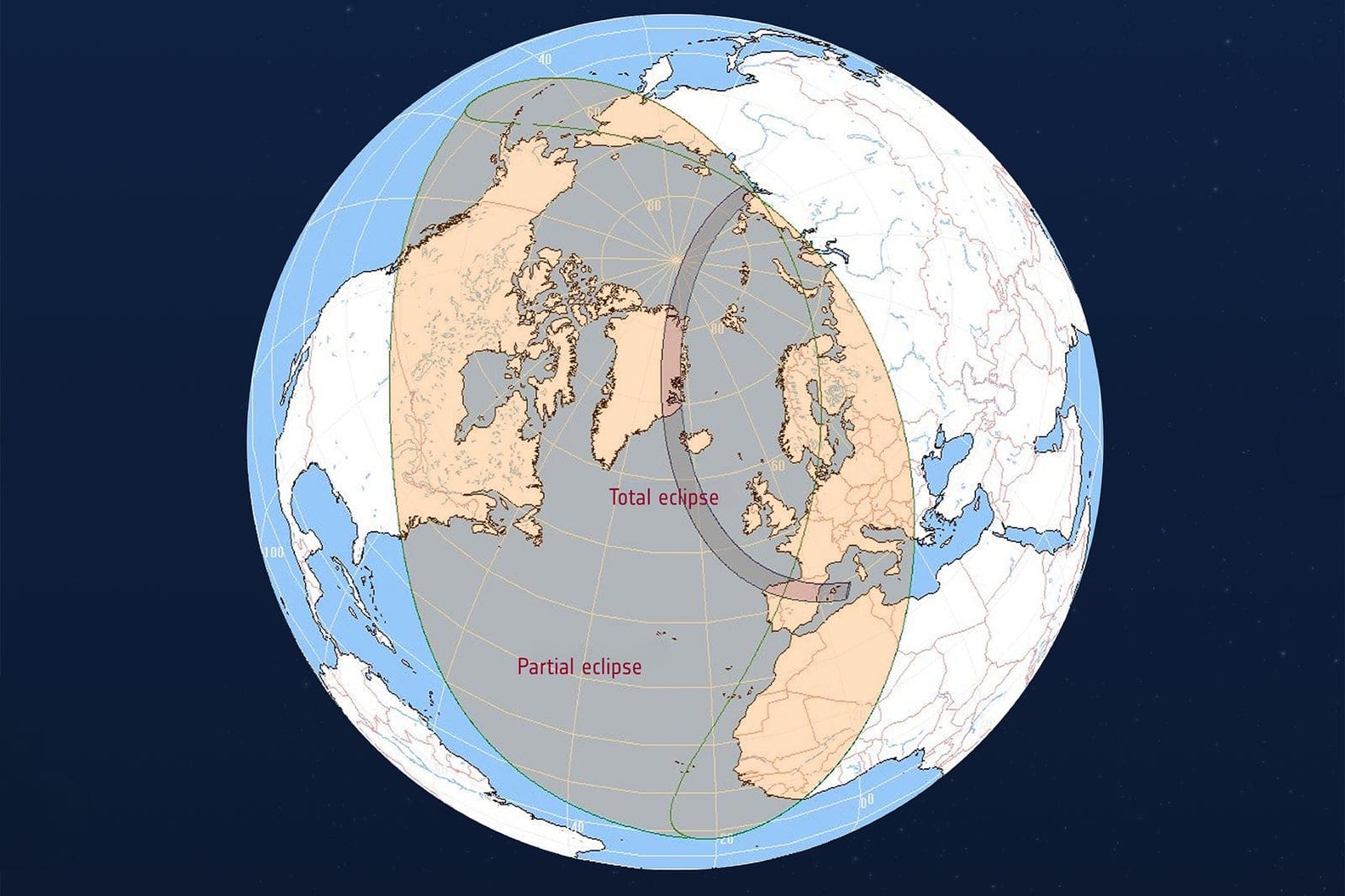
Mainland Spain hasn't seen a total solar eclipse in more than 100 years. That changes on August 12, when the moon's shadow will sweep across the Iberian Peninsula near sunset, bringing up to two minutes and 18 seconds of daytime darkness. The path will also clip parts of Greenland and Iceland before ending in the Mediterranean.
The timing adds another layer to the spectacle. The same day begins with six planets forming an arc in the pre-dawn sky and ends with the Perseid meteor shower peaking after dark under a new moon. Bright meteors could appear during totality itself, alongside visible planets and stars against the darkened sky.
According to the European Space Agency, the moon's shadow will travel 5,130 miles over the course of an hour and a half, most of it across the open Atlantic. Maximum totality will occur off Iceland's west coast. By the time the shadow reaches Portugal and Spain, where crowds are expected to gather in large numbers, totality will last closer to one minute.
Who Gets to See What
The total eclipse will be visible only along a narrow corridor, but hundreds of millions of people across a much wider area will experience a partial eclipse. Coverage drops off with distance from the path of totality: Dublin will see 94% of the sun blocked, Oslo 83%, Montreal 18%, New York 9%, and Norfolk, Virginia, just 2%.
Anyone watching, even in partial zones, will need eclipse glasses. No amount of dimming makes it safe to look directly at the sun without proper protection.
The eclipse begins near the North Pole before tracking south. Alaska, Siberia, Canada, the northern United States, and much of Europe and West Africa will all fall within the partial viewing zone.
Research Teams Mobilize
More than 60 high-altitude balloons will launch from Spain and Iceland as part of a NASA-funded atmospheric study. According to Montana State University's Angela Des Jardins, who leads the project, the brief drop in temperature and light during totality is enough to produce measurable changes in Earth's atmosphere.
A NASA research jet will chase the eclipse at 460 mph, extending totality to nearly three minutes in the air. Southwest Research Institute's Amir Caspi expects thousands of images from four onboard cameras recording the sun's corona in nine wavelengths during those 180 seconds.
The European Space Agency will provide live coverage from Spain's Astrophysical Observatory of Javalambre and host a public event in Leon. Two of ESA's space telescopes will observe the eclipsed sun and its outer atmosphere. NASA and the Virtual Telescope Project in Italy will offer their own streams.
Eclipse cartographer Michael Zeiler will be on a cruise ship in a Greenland fjord for his 13th total solar eclipse. He plans to point a camera north during totality, hoping to capture the northern lights if solar activity cooperates.
What Makes This One Special
Spain's last mainland total solar eclipse happened two days before the Titanic sank in 1912, and even that one toggled between a ring-of-fire and just a few seconds of totality. Some historians point to 1905 as the last full event. The Canary Islands saw totality more recently, but the mainland has waited more than a century.
This eclipse is a warm-up for an even longer event next year. On August 2, 2027, the southern tip of Spain will experience up to six minutes and 23 seconds of totality, with the path continuing into Morocco, Algeria, Libya, Egypt, Saudi Arabia, Yemen, and Somalia. That's nearly three times the observation window of this year's event.
Then, on January 26, 2028, a ring-of-fire eclipse will complete Spain's celestial trifecta within three years.
Carole Mundell, ESA's director of science, calls it a rare human connection between Earth and the cosmos. The alignment is exact, the timing compressed, and the opportunity fleeting. For researchers, it's a chance to gather data that only exists during totality. For everyone else, it's a reminder that the sky still holds surprises.
Andrei Zhukov, whose Proba-3 satellite mission has created more than 60 artificial eclipses over two years, is equally enthusiastic about natural ones. The longest simulated eclipse lasted five hours and 38 minutes, but nothing replaces the real thing.