A Window That Opens and Closes
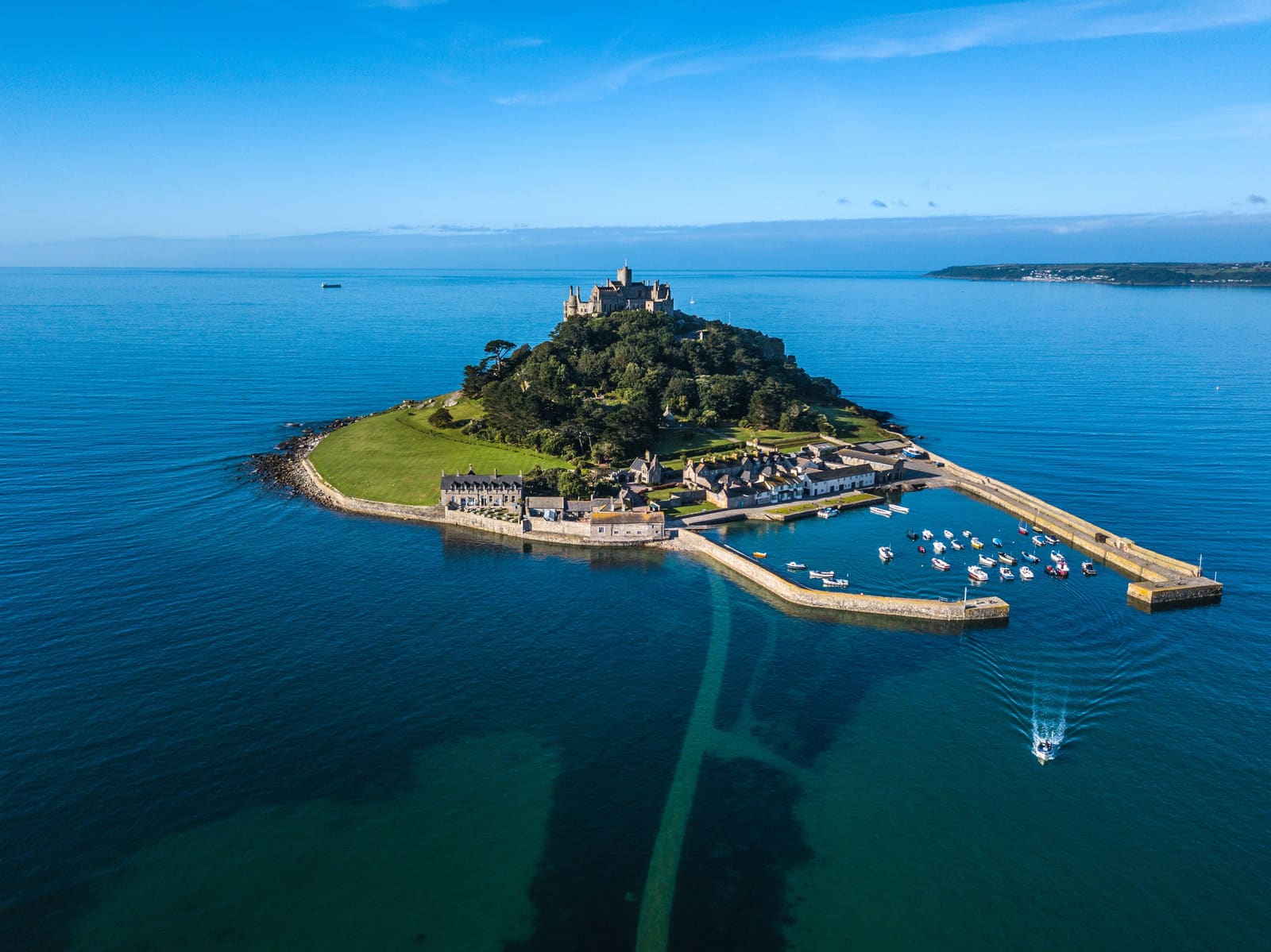
About 500 meters off the Cornish coast, a small island appears and vanishes from reach twice a day. St Michael's Mount sits in Mount's Bay, connected to the mainland town of Marazion by a causeway that emerges only at low tide. The window lasts a few hours, then the sea swallows the path again.
The timing makes every crossing deliberate. You watch the tide charts, plan your visit, and walk across cobblestones laid centuries ago. Miss the window and you're either stranded or taking the boat back.
The island spans 57 acres and rises to a medieval castle perched on granite rock. The National Trust manages the property alongside the St Aubyn family, who have lived here since the 1650s. Around 30 people still call the island home, most of them clustered in a small harbourside village that once served as a busy port.
The English Twin of Mont-Saint-Michel
St Michael's Mount shares more than a passing resemblance to its French counterpart, Mont-Saint-Michel, which sits off the coast of Normandy. Both are tidal islands crowned by religious structures, both bear the name of the archangel Michael, and both have served as pilgrimage sites for centuries.
The Cornish version dates to the 12th century, though legend places a monastery here even earlier. Over the years, the island has been a Benedictine priory, a fortress during the Wars of the Roses, and eventually a family home. The castle's interior holds medieval stonework, historic rooms, and a collection of portraits and artifacts accumulated over generations, including works depicting Sir John St Aubyn.
Gardens Clinging to Cliff Faces
Surrounding the castle, terraced gardens cascade down the slopes in a way that feels both improbable and deliberate. These were designed in 1878 for the St Aubyn family, taking advantage of Cornwall's mild maritime climate to grow subtropical plants that would struggle elsewhere in Britain.
Succulents, palms, and Mediterranean species nestle into crevices and stone walls, thriving in the salt air and sheltered microclimates. The effect is a botanical collision, plants from warmer latitudes growing against a backdrop of English granite and Atlantic waves.
The gardens are not vast, but they are layered. Paths wind through terraces, each level offering a different angle on the bay below. The planting feels informal, almost wild in places, as if the island itself decided what could take root.
Views Across Mount's Bay
From the castle's upper levels, the view opens across Mount's Bay to the Lizard Peninsula and the town of Penzance. On clear days, the panorama stretches wide, taking in the curve of the coastline and the patchwork of fields beyond. It is one of Cornwall's most photographed vantage points, and for good reason.
The castle itself is modest in scale compared to some English fortresses, but its position amplifies its presence. Perched on rock, surrounded by water, it commands attention without needing to dominate.
Inside, the rooms are furnished with a mix of periods, reflecting the castle's evolution from monastery to military stronghold to private residence. The sense of history is tangible, but not overwhelming. You can walk through and imagine the layers of lives lived here without needing a doctorate in medieval history.
Boats When the Causeway Disappears
When the tide is high, a boat service runs between the island and the mainland from April through October. Three landing points serve passengers depending on conditions: Chapel Rock, Gwelva, and Top Tieb. The boats are small, the ride short, and the experience less dramatic than walking the causeway but more reliable if you're not a slave to tide tables.
The boat option also means you can visit St Michael's Mount at any time of day, not just during the narrow low-tide windows. For visitors on tight schedules or those who prefer not to rush, it is a practical alternative.
Still, there is something about walking across that appeals. The causeway is not just a path; it is a threshold. You step off the beach and onto stones that have been crossed by pilgrims, soldiers, and smugglers. The island feels earned when you arrive on foot.
Marazion, the Town on the Other Side
Back on the mainland, Marazion is one of Cornwall's oldest chartered towns, with a history that stretches back to medieval markets and coastal trade. Today, it is quieter, a place of sandy beaches, art galleries, and small shops selling local crafts and produce.
The town's main draw is its proximity to St Michael's Mount, but it holds its own charm. The beach offers safe swimming and views of the island, particularly striking at sunset when the castle silhouette darkens against the sky. Cafes and pubs line the waterfront, many with outdoor seating that takes advantage of the view.
Marazion is not trying to be a destination in itself, and that restraint works in its favor. It is a pleasant place to spend an afternoon before or after visiting the island, without the pressure of packed itineraries or must-see lists.
The Rhythm of the Tides
St Michael's Mount operates on a rhythm dictated by the sea. The island does not bend to visitor convenience; visitors bend to the tide. That constraint shapes the experience, adding an element of patience and timing that many tourist sites have engineered out of existence.
The result is a place that feels less managed, more contingent. You cannot visit on a whim. You have to check the schedule, wait for the right moment, and commit to the crossing. That small barrier filters out some of the casual traffic and rewards those who plan ahead.
For travelers looking for something beyond the standard coastal castle, St Michael's Mount offers a mix of history, horticulture, and tidal drama that is hard to replicate elsewhere in Britain. It is not hidden, but it is not always accessible either, and that makes all the difference.