A Sharp Reversal
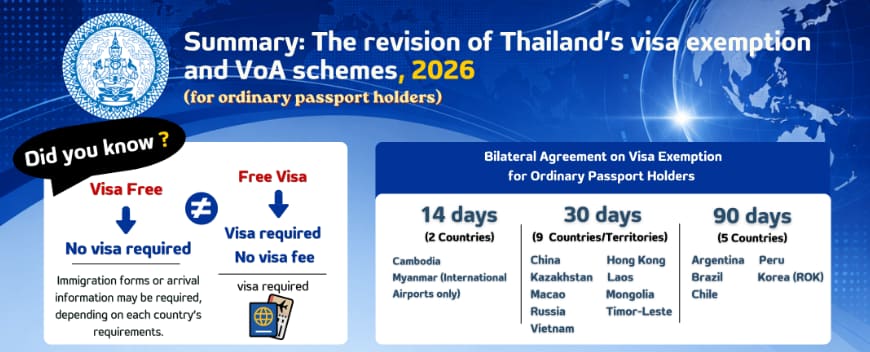
Thailand will cut visa-free stays from 60 days to 30 for passport holders from 59 countries, effective September 15. The change reverses a policy put in place just over two years ago, when the government extended exemptions to attract more visitors. The new regulation, published in The Royal Gazette on August 31 and signed by Prime Minister Anutin Charnvirakul, affects a long list that includes the United States, United Kingdom, Australia, Canada, Germany, France, Japan, and most of the European Union.
Visitors arriving by land will be limited to two visa-free entries per year. The government says the cap is designed to stop visa runs, the practice of leaving and re-entering the country repeatedly to extend a stay. Malaysia, Brunei, Indonesia, and Singapore are exempt from the land-entry limit.
Why the Tightening
The Thai government frames the shift as part of a broader effort to prevent misuse of visa privileges and align entry policy with the principle of "one country, one entitlement." According to the official announcement, the revisions weigh economic and security considerations, international relations, and reciprocity. Bangkok has said it hopes the recalibration will support negotiations for Schengen visa exemptions for Thai citizens and smooth the path for bilateral economic agreements.
The timing follows the introduction of new deportation regulations on August 28, which give authorities wider discretion to remove foreign nationals deemed a threat to public order or found violating local laws. Together, the two measures suggest a government trying to manage the social and administrative pressure that comes with high tourist numbers.
The Numbers Behind the Move
Tourism accounts for 13 percent of Thailand's GDP and 12 percent of its jobs, generating 1.54 trillion baht in 2025. The country welcomed 32.97 million international visitors last year, according to official figures, and expects around 33.5 million in 2026. As arrivals climb, so do complaints about overcrowding, environmental strain, and behavior that clashes with local norms.
The 60-day visa exemption was introduced in July 2024 for 93 countries, part of a post-pandemic push to rebuild visitor numbers quickly. The policy worked: arrivals surged. But the scale of the influx appears to have prompted a reassessment. By shortening the exemption window and capping land entries, the government is signaling a preference for shorter, higher-turnover visits over long-term stays that blur the line between tourism and informal residency.
Who Is Affected
The 30-day exemption now applies to a diverse group: wealthy Gulf states like Qatar, Saudi Arabia, and the United Arab Emirates; most of Europe; major Asia-Pacific markets including Australia, New Zealand, Japan, and South Korea; and North American travelers from the United States and Canada. India, which previously had visa-on-arrival, loses that option to eliminate what the government calls overlapping privileges.
A handful of countries retain longer access. Passport holders from Mauritius and the Seychelles get 15-day exemptions. Azerbaijan, Belarus, and Serbia can still obtain visas on arrival at designated checkpoints. The announcement does not explain why certain countries were carved out.
Travelers who entered Thailand before September 15 can stay for the full period allowed under the old rules. But anyone arriving after that date falls under the new framework.
The Long-Stay Alternative
For those who want more time, the Destination Thailand Visa remains an option. Launched as a digital-nomad and remote-work visa, the five-year, multiple-entry permit allows stays of up to 180 days per entry, extendable once for another 180 days. Applicants must show proof of at least 500,000 baht in a bank account and, if working remotely, evidence of employment outside Thailand. The visa costs 10,000 baht.
The DTV was designed to attract long-term visitors with stable income who spend money without competing for local jobs. By narrowing the visa-free window and steering longer stays toward a paid, vetted pathway, the government is effectively sorting travelers by intent and financial capacity.
Reciprocity as Leverage
The reciprocity language in the official statement is worth noting. Thailand has long complained that its citizens face onerous visa requirements when traveling to Europe, particularly the Schengen zone. By adjusting its own exemption policies, Bangkok may be trying to create bargaining chips in those negotiations. If European countries want their nationals to enjoy easy access to Thailand, the logic goes, they should extend the same courtesy to Thai travelers.
Whether that strategy will work is unclear. Visa policy is shaped by more than goodwill; it reflects assessments of overstay risk, illegal employment, and asylum claims. Thailand's leverage is real but limited. Tourism matters to its economy, but it also needs the visitors.
What This Signals
The policy shift reflects a tension that many popular destinations are grappling with: how to balance the economic benefits of tourism with the social costs. Thailand has spent years marketing itself as welcoming and easy to visit. The 60-day exemption was a logical extension of that brand. But as arrivals approached pre-pandemic peaks and then exceeded them, the downsides became harder to ignore.
Shortening the exemption is a modest correction, not a radical departure. Thirty days is still generous by global standards. But the change, combined with the new deportation rules and the emphasis on reciprocity, suggests a government that is less willing to absorb the costs of open access without question. The era of frictionless entry may be winding down, replaced by a more calibrated approach that asks visitors to move through quickly or commit to a formal, paid arrangement.
For travelers, the message is clear: plan shorter trips, or be prepared to apply for a visa.